
Understanding the Ontology of AI, Machine Learning, and Deep Learning

Understanding the Ontology of AI, ML, and DL: A Hierarchy for Telecommunications and Technology Professionals
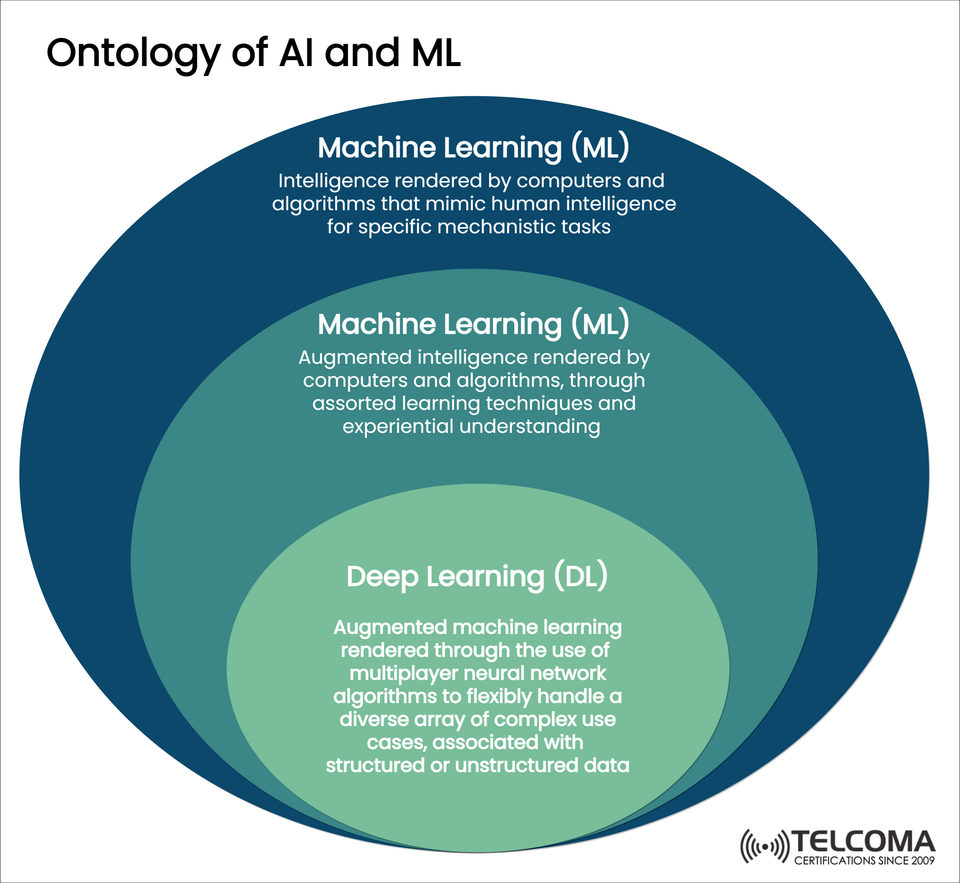
As we enter the age of digital transformation, intelligent networks, and the sports of AI, ML, and DL, it is important to understand how AI, ML, and DL fit in relation to one another and their respective hierarchies. The image above gives a brief ontology of how these technologies are structured in terms of how they relate to one another.
This blog will look at the definitions, relationships and applications of AI, ML, and DL with a focus on technology enthusiasts and telecommunications professionals who desire to leverage automation, analytics, and cognitive technologies.
What is Ontology in AI and ML?
Meaning a hierarchy that organizes and classes what is important within a field. In this case AI will show how it relates to other major concepts such as Machine Learning, which relates to even more specific subfields, such as Deep Learning.
Visual breakdown: The Three Layers of Intelligence
- Machine Learning (ML) - Outer Layer
Definition:
Intelligence from Computers using algorithms to simulate human intelligence for mechanistic tasks.
Function:
Automates repetitive operation or uses human logic to automate identification through pattern recognition, recommendation and classification. - Machine Learning (ML) - Augmented Intelligence
Definition:
Learning with the use of assorted algorithms and experiential understanding
Use Cases:
Adaptive network traffic management, predicting churn in telecommunications, predictive maintenance. - Deep Learning (DL) - Inner Core
Definition:
An advanced branch of ML that employs multi-layer neural networks to assess very complicated data formats.
Capabilities:
Handles unstructured data (such as video, audio, and social media)
Enables natural language processing (NLP), image recognition, and real-time analytics
Telecom use case examples:
Customer emotion analysis from voice calls
Automatic, real-time detection of anomalies in network activity
Fraud detection in billing systems
Comparison Table: ML vs DL
Feature Machine Learning (ML) Deep Learning (DL)
Data Requirement Moderate Large-scale datasets in vast quantities required
Complexity Basic to intermediate algorithm Highly complex multi-layered models
Fit for use case Structured data, logic tasks Unstructured data, perceptual tasks
Execution time Faster training Requires swathes of raw computational costs
Examples Spam filters, churn prediction Vive voice recognition, NLP/image analysis
Why This Ontology Is Important For Telecom Professionals
As telecom networks transition towards intelligent architecture that can be self-optimizing (5G and beyond, 6G architectures), it is critical to appreciate the layers of AI. Here is an example of its importance:
Operational Insights
Deep learning could relate the quality of a call and recommend to a customer the rerouting of their call and/or data and at what quality levels.
Predict субscriber churn based on ML models and recommend actions they could take to retain their customers.
Network Automation
AI enabled orchestration can modify its own methods and processes to change in the load of the network.
DL-based models power more autonomous Network healing and self-optimizing solutions.
Improved Customer Experience
Deep learning chatbots and virtual assistants increase the efficiency of the service.
Machine learning predictions can personalize offers and content based on user behavior.
Conclusion: Making Smarter Systems with a Layered AI Ontology
Using an ontology of AI, ML, and DL can help demystify the increasingly complex nature of artificial intelligence. By understanding how they all relate to each other in layers, our ICT professionals and technology developers can better match appropriate layered technology to the problem.
Integrating an AI Ontology into Telecommunications Infrastructure
Telecommunication networks are all operating systems today, more than they are collection of hardware and signals -- telecommunications networks are intelligent ecosystems. To realize this potential, telecommunication operators are layering AI (ML and DL) into all phases of network planning, building, monitoring, and optimizing.
AI in Network Lifecycle
Stage Machine Learning Task Deep Learning Task
Planning Forecasting demand, predicting load zones source geolocation data in spatial patterns
Deployment Automate the configuration of equipment analyze real time video feed during site validation
Monitoring event classification, KPI analysis detect any small anomalies from streaming telemetry
Real-Time Examples of ML and DL in Telecoms
Here are real-world examples of applications that capture the influence of AI ontology in today's telecom practice:
- Predictive Maintenance ML role: Observes log files and anticipates hardware failure based on historical performance data. DL role: Utilizes sensor fusion algorithms to identify strange noises or temperature spikes from sensors.
- Network Anomaly Detection ML role: Looks for and raises flags on known anomalies using agreed-upon thresholds. DL role: Discovers unknown threats or zero-day anomalies through unsupervised learning.
- Customer Sentiment Analysis ML role: Surveys and feedback forms. DL role: Uses models of NLP to decode tone and intent from voice calls and text messages.
Aligning AI Ontology with 5G and beyond
The arrival of 5G, and then 6G, means networks must become:
Autonomous (self-diagnosing and self-healing),
Predictive (understanding demand and addressing issues before they arise),
Contextual (who the user is, where they are, how they are using the service).
This is why adding the hierarchical factors of ML and DL is so important to networks. ML provides a structured logic to handle rules, while DL is the means of cognition. The goal is to create:
- Self-optimizing networks (SON)
- Intent-based orchestration
- AI-native 6G infrastructure
Key Takeaways
Machine Learning (ML) encompasses all forms of data-driven intelligence.
Deep learning (DL) feeds the cognition in autonomous behavior.
Conclusion:
How to Build an AI-Ready Telecom Enterprise
Recognizing the ontology of AI, ML, and DL is more than an academic exercise — it is a strategic serviceable insight. With the pressures of telecom companies to lower OPEX, deliver low-latency services and manage billions of connected devices, the layered intelligence model is represented by an intelligent library of sources to enable scalable automation.
Looking to the Future:
AI-enabled network digital twins for network simulation
Federated learning for privacy-preserving telecom AI
Real-time DL analytics at the network edge
Interoperability of AI ontology and Open RAN and private 5G