
Understanding the OpenAirInterface 5G Radio Access Network (RAN) Project: NSA and SA Architecture Explained

The shift from 4G LTE to 5G has changed the game for wireless communication, bringing in speeds, capacity, and flexibility we’ve never seen before. Leading this change is the OpenAirInterface (OAI) 5G Radio Access Network (RAN) Project, which is an open-source initiative that lets researchers, developers, and network operators build, test, and roll out 5G systems with actual, software-defined networking components.
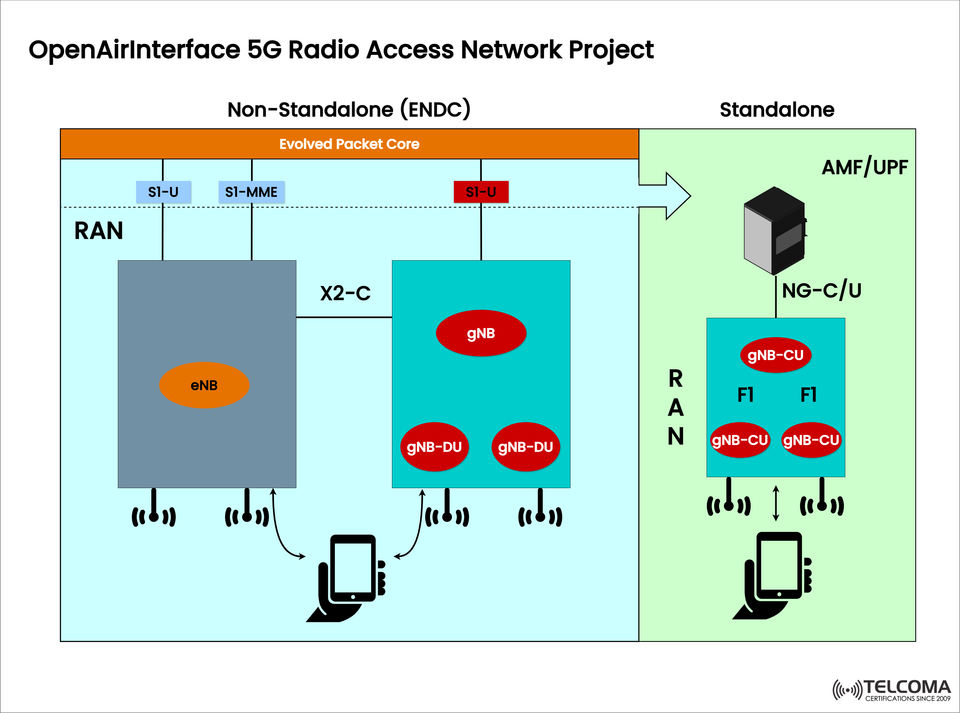
The image uploaded gives a good look at both Non-Standalone (NSA) and Standalone (SA) setups within the OAI 5G RAN project. It shows the main network components like eNB, gNB, gNB-DU, gNB-CU, and how they connect to the Evolved Packet Core (EPC) and the 5G Core (5GC).
In this article, we’ll break down these components, explain the differences between NSA and SA modes, and how OpenAirInterface helps drive innovation in 5G RAN development.
What is OpenAirInterface (OAI)?
OpenAirInterface (OAI) is an open-source software platform that allows the implementation and testing of both 4G and 5G systems. It offers a complete stack, covering everything from the radio access network (RAN) to the core network, giving researchers and telecom experts the chance to experiment with real-world 5G setups.
Some key points about OAI include:
It implements 3GPP-compliant 4G LTE and 5G NR protocols.
It supports both NSA and SA architectures for 5G.
It can integrate with commercial hardware and software-defined radios (SDRs).
It’s being used in academic research, testbeds, and pre-commercial deployments.
Understanding the 5G RAN Structure
The Radio Access Network (RAN) connects user devices, like smartphones and IoT sensors, to the mobile core network. In the 5G world, RAN can be set up in a distributed or centralized way, based on what’s needed.
The main parts of a 5G RAN include:
gNB (Next-Generation Node B): This is the 5G base station that manages radio communications with user devices (UE).
gNB-DU (Distributed Unit): Takes care of real-time Layer 1 and Layer 2 tasks like scheduling and beamforming.
gNB-CU (Centralized Unit): Handles non-real-time control functions, like mobility management and data routing.
Interfaces (F1, NG, X2): They define how different network components talk to each other.
Non-Standalone (NSA) Architecture — ENDC Mode
The left part of the diagram shows the Non-Standalone (NSA) or Evolved-Universal Terrestrial Radio Access Network Dual Connectivity (ENDC) mode.
In this arrangement, 5G runs alongside 4G LTE, using the Evolved Packet Core (EPC) to manage control signaling, while 5G NR adds extra capacity for user data.
Key Components:
eNB (Evolved Node B): This is the LTE base station, acting as the main node for control communication.
gNB (Next-Gen Node B): The 5G base station that acts as a secondary node for additional data throughput.
S1-U, S1-MME: These interfaces link LTE base stations to the EPC (for user and control planes respectively).
X2-C: This interface coordinates signaling between eNB and gNB.
How It Works:
The UE (User Equipment) connects to the eNB for control signaling.
The eNB talks to the gNB via the X2-C interface to set up dual connectivity.
The Evolved Packet Core (EPC) manages data from both LTE and 5G NR through the S1 interfaces.
Benefits of NSA Mode:
Quick launch of 5G using existing LTE infrastructure.
Reduced deployment costs with faster entry into the market.
High data rates supported through dual connectivity.
Limitations:
It relies on the LTE control plane, limiting some advanced 5G features like ultra-low latency.
It complicates coordination between 4G and 5G cell systems.
Standalone (SA) Architecture
The right section of the image shows the Standalone (SA) 5G architecture. Here, 5G operates on its own, with its own 5G Core (5GC) and RAN components.
Key Components:
gNB-CU (Centralized Unit): This captures non-real-time control and user-plane functions, like session management and routing.
gNB-DU (Distributed Unit): It manages real-time Layer 1 and Layer 2 operations.
AMF/UPF (Access and User Plane Functions): These core network entities take care of authentication, session management, and routing user data.
NG-C/U: Interfaces that connect the gNB to the 5G Core for control (C) and user (U) planes.
F1 Interface: Links gNB-DU and gNB-CU, allowing for flexible RAN deployments.
How It Works:
The UE connects directly to the 5G RAN (gNB).
The gNB communicates with the 5G Core (5GC) using NG-C/U interfaces.
The AMF manages authentication and mobility, while the UPF deals with routing user data traffic.
Benefits of SA Mode:
Fully leverages 5G capabilities like network slicing, ultra-low latency, and massive IoT connectivity.
Simplified architecture without relying on LTE.
Supports versatile cloud-native deployments and edge computing.
Limitations:
Higher deployment costs because of the need for a new 5G Core.
Requires upgraded infrastructure and device compatibility.
NSA vs SA: A Comparative Overview
Feature Non-Standalone (NSA) Standalone (SA)
Core Network Uses 4G EPC Uses 5G Core (5GC)
Control Plane Anchored on LTE Anchored on 5G NR
Deployment Speed Faster (uses LTE infra) Slower (needs new infra)
Latency Moderate Ultra-low
Network Slicing Not supported Fully supported
Best For Early 5G rollouts Full-scale 5G deployments
OpenAirInterface and the 5G Research Ecosystem
The OAI 5G RAN Project plays a key role in pushing forward 5G research and innovation. It enables:
End-to-end 5G testing: With OAI, researchers can simulate full network stacks, from RAN to core.
Interoperability studies: They can work on integrating with commercial EPC and 5GC platforms.
Performance evaluation: Real-time testing of RAN components on SDR hardware is possible.
Cloud-native evolution: Supports containerized and virtualized RAN architectures.
OAI’s open-source nature encourages collaboration between academia, industry, and standardization bodies, speeding up 5G adoption around the globe.
The Role of Interfaces: S1, X2, NG, and F1
The image highlights several important interfaces in 5G architecture:
S1 (S1-U, S1-MME): Connects LTE eNB to EPC for user and control planes.
X2-C: Enables coordination between LTE and 5G base stations.
NG-C/U: Provides signaling and data paths between the 5G gNB and 5G Core.
F1: Splits RAN functionality between centralized and distributed units, helping with scalability and virtualization.
These interfaces make sure there’s seamless connectivity and handover between 4G and 5G systems.
Benefits of OpenAirInterface in 5G Development
Open Innovation: The freely accessible source code promotes collaboration worldwide.
Rapid Prototyping: It allows for quick setups to test new features and use cases.
Flexible Deployment: It’s compatible with cloud environments, virtual machines, and SDRs.
Educational Resource: A great tool for telecom students and professionals to get hands-on experience with 5G architecture.
Interoperability: Works with both LTE and 5G standards, making it perfect for mixed research environments.
Future Directions
As 5G pushes toward 6G and AI-native networks, OAI will keep ev olving its features to include:
Open RAN (O-RAN) compliance for disaggregated architectures.
Integration with AI-driven RIC (RAN Intelligent Controllers).
Support for millimeter-wave and massive MIMO technologies.
Edge computing and cloud-native orchestration.
OpenAirInterface’s flexibility positions it as a key player in the future of open, intelligent, and software-driven mobile networks.
Conclusion
The OpenAirInterface 5G Radio Access Network Project helps bridge the gap between theory and real-world application by providing a robust, open-source platform for creating both NSA and SA 5G systems.
With its adaptable architecture, clear interfaces, and community-driven development, OAI empowers telecom engineers, researchers, and developers to innovate, test, and effectively roll out next-generation 5G solutions.
As 5G continues to advance, OpenAirInterface remains a cornerstone for open innovation and collaboration—leading the telecom industry toward smarter, more connected, and efficient wireless networks.