
Understanding the Short Preamble Packet Type: Structure, Timing, and Function in Modern Wireless Systems

Understanding the Short Preamble Packet Type in Wireless Communication Systems
In high-efficiency wireless systems, the design of the preamble is super important for ensuring quick synchronization, estimating channels, and decoding data reliably. Among various packet structures, the Short Preamble Packet Type has become a compact and optimized choice, especially suited for low-latency and high-throughput situations.
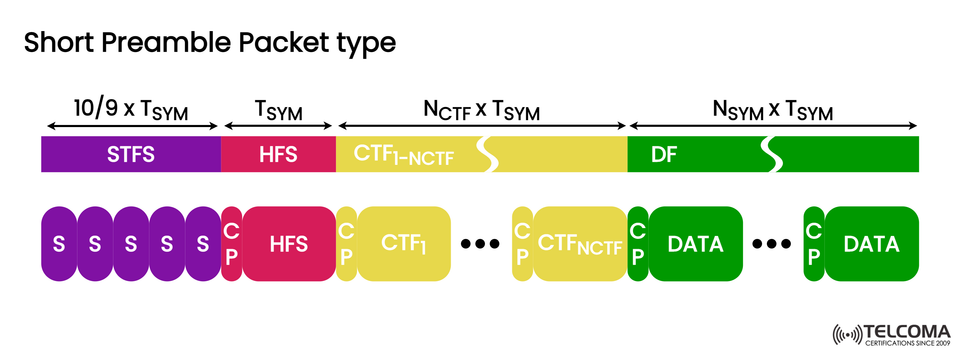
The image above does a great job of showing the structure of the Short Preamble Packet Type, highlighting how different parts—STFS, HFS, CTF, and DF—come together over time. This design cuts down on transmission overhead and facilitates fast link setups, making it particularly relevant for systems like IEEE 802.11ax (Wi-Fi 6), 802.11ay, and 5G NR (New Radio).
Let’s dive into the packet fields, explore their timing relations, and look at the technical purpose behind each segment.
Overview of the Short Preamble Packet Type
A preamble is the first part of a transmitted packet that helps the receiver get in sync and prepare for data decoding. The Short Preamble Packet Type aims to keep the preamble duration short while still covering all necessary functions like synchronization, channel estimation, and frame detection.
Field-by-Field Technical Breakdown
3.1 STFS (Short Training Field Sequence)
Color: Purple
Purpose: Provides rough time and frequency synchronization, AGC training, and packet detection.
Duration: 10/9 × Tₛᵧₘ
The STFS is the receiver’s first interaction with the incoming signal. It consists of repeated short OFDM symbols that allow the receiver to:
Identify the start of a frame
Automatically adjust RF gain
Estimate the coarse carrier frequency offset (CFO)
This helps the receiver align its local oscillator for accurate demodulation of the following fields.
3.2 HFS (Header Field Sequence)
Color: Red
Purpose: Encodes essential packet metadata and refines synchronization.
Duration: 1 × Tₛᵧₘ
After the initial alignment from STFS, the HFS sharpens timing accuracy and supplies crucial control information such as:
Packet length
Modulation and coding scheme (MCS)
Number of spatial streams or antennas
So, the HFS serves as a bridge between preamble acquisition and channel training.
3.3 CTF (Channel Training Field)
Color: Yellow
Purpose: Used for channel estimation and calibration, aiding equalization in the receiver.
Duration: NCTF × Tₛᵧₘ
Each CTF sequence sends known reference symbols, enabling the receiver to estimate the channel impulse response (CIR) and apply correction filters for fading, multipath, or Doppler effects. Multiple CTF blocks (CTF₁ to CTFₙ) can be transmitted to improve accuracy.
In advanced MIMO systems, CTF sequences are vital for spatial channel estimation across multiple antennas.
3.4 DF (Data Field)
Color: Green
Purpose: Contains the actual user data payload.
Duration: NSYM × Tₛᵧₘ
Here’s where the main information—like IP packets, voice, or video data—gets sent. Before the data field, a Cyclic Prefix (CP) is added to reduce intersymbol interference (ISI) and maintain OFDM orthogonality.
The Role of Cyclic Prefix (CP) Segments
The Cyclic Prefix (CP), shown as small vertical segments labeled “C” in the diagram, is crucial for maintaining signal integrity. It acts as a guard interval between OFDM symbols to prevent overlap and interference from multipath reflections.
Each transition between fields—CTF₁, CTFₙ, and DATA—includes a CP to preserve time-domain stability and ensure reliable demodulation at the receiver.
How the Short Preamble Improves Efficiency
The Short Preamble Packet Type is designed for efficiency and low latency, with a few standout advantages:
Advantages:
Reduced overhead: A shorter preamble means less time spent on non-data transmission.
Faster synchronization: Great for time-sensitive or burst-mode systems.
Lower power consumption: Shorter transmissions save energy in IoT and mobile devices.
High throughput: Allows for better effective data rates, especially in crowded areas.
Use Cases:
Wi-Fi 6/6E/7 (IEEE 802.11ax/ay)
5G NR uplink transmissions
IoT networks and low-latency links
Private 5G or unlicensed spectrum deployments
In these scenarios, the short preamble helps devices quickly establish communication, especially in multi-user or beamformed contexts.
Comparison: Short Preamble vs. Long Preamble
Parameter Short Preamble Long Preamble Preamble Duration Shorter Longer Overhead Lower Higher Synchronization Speed Fast Moderate Channel Estimation Accuracy Moderate High Energy Efficiency High Lower Use Case Low-latency, high-density environments Long-range, high-mobility environments
The Short Preamble Packet Type makes some sacrifices in channel estimation precision for quicker setups and higher throughput— which is a fair trade-off for short-range or controlled environments.
Mathematical Relationship of Timing Parameters
Let’s lay out the total packet duration (T_total) mathematically:
T_{total} = (10/9 × T_{SYM}) + T_{SYM} + (N_{CTF} × T_{SYM}) + (N_{SYM} × T_{SYM})
Where:
T_{SYM} = OFDM symbol duration
N_{CTF} = Number of CTF repetitions
N_{SYM} = Number of data symbols
This formula helps system designers gauge throughput, timing, and spectral efficiency.
Design Relevance in Next-Generation Networks
The idea of short preamble packets fits well with current trends in 5G NR, Wi-Fi 7, and even 6G research, where:
Dynamic preamble lengths allow for adaptive control based on channel conditions.
Beamforming benefits from fast channel sounding made possible by compact preambles.
Ultra-reliable low-latency communication (URLLC) needs minimal setup delays.
Basically, the short preamble structure promotes the balance of speed and reliability that new networks are aiming for.
Practical Implementation Insights
Telecom pros working on PHY-layer designs should keep in mind:
Adaptive preamble configurations for different link scenarios.
Hardware synchronization tolerance and CFO correction capabilities.
CTF duration calibration for varying SNR and multipath conditions.
Efficient CP management to lower latency and overhead.
Getting these optimizations right is key in small-cell 5G systems, Wi-Fi chipsets, and IoT radio modules.
Conclusion
The Short Preamble Packet Type is a fundamental element of modern wireless design—facilitating faster synchronization, cutting down on overhead, and boosting spectral efficiency.
As detailed in the diagram, its streamlined structure—comprising STFS, HFS, CTF, and DF fields—strikes a balance between accuracy and efficiency, making it perfect for next-gen wireless systems like 5G NR, Wi-Fi 6/7, and industrial IoT.
For telecom experts, getting a handle on this preamble structure is crucial for optimizing link setup times, enhancing data throughput, and building networks that are ready for the future.