
Understanding the Three-Tier CBRS Architecture: Spectrum Sharing in the 3.5 GHz Band

Understanding the Three-Tier CBRS Architecture: Spectrum Sharing in the 3.5 GHz Band
The Citizens Broadband Radio Service (CBRS) is shaking up how spectrum is accessed and managed in the U.S. It operates within the 3550–3700 MHz frequency range, often called the 3.5 GHz band. CBRS introduces a dynamic spectrum sharing model that aims to balance the requirements of federal users, licensed commercial entities, and the general public.
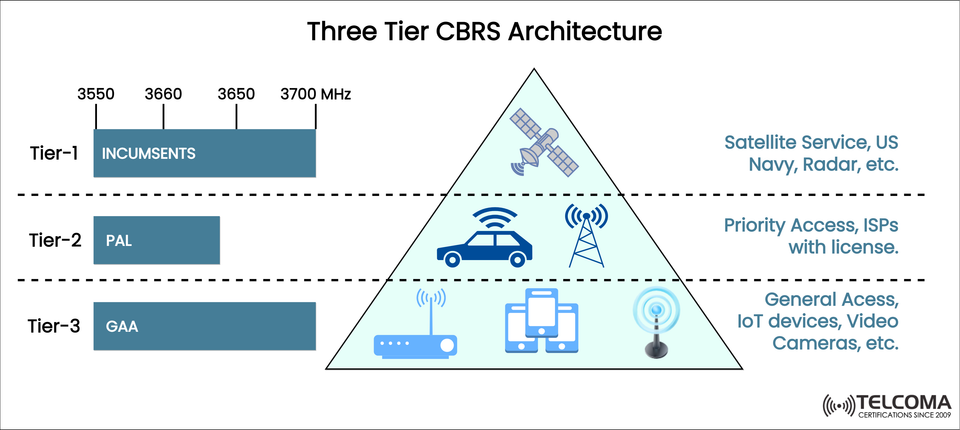
The diagram above illustrates the Three-Tier CBRS Architecture, designed to enhance spectrum efficiency while minimizing interference among different users.
What is CBRS?
CBRS (Citizens Broadband Radio Service) functions as a shared spectrum framework overseen by the Federal Communications Commission (FCC). It lets a variety of users share the same frequency band under regulated conditions, which leads to:
Improved spectrum utilization
Fewer barriers for wireless innovation
The rollout of private LTE and 5G networks
Previously, the 3.5 GHz CBRS band was solely used by federal agencies, like the U.S. Navy and certain radar systems. Now, with better management and coordination, it’s open to new commercial players and businesses, making it key for shared spectrum innovation.
Frequency Range: The 3550–3700 MHz Band
The CBRS band spans 150 MHz from 3550 MHz to 3700 MHz and is split into 10 MHz channels. This range is great for mid-band 5G, providing:
Good coverage (better than mmWave)
High capacity for data throughput
Effective indoor and outdoor penetration
The FCC’s innovative approach aims to maximize usage without hindering current operations.
The Three-Tier Spectrum Access Framework
CBRS uses a three-tiered system for spectrum access, ensuring fair use while preventing interference. As shown in the diagram, the tiers include:
Tier Name | User Type | Priority
Tier 1 | Incumbents | Federal and protected users (like the U.S. Navy, radar, satellite) | Highest
Tier 2 | Priority Access License (PAL) | Licensed commercial users (e.g., ISPs, enterprises) | Medium
Tier 3 | General Authorized Access (GAA) | Unlicensed users and the general public | Lowest
Tier 1: Incumbent Access (Protected Users)
Overview
Tier-1 consists of incumbent users, the original holders of the 3.5 GHz band. This includes:
U.S. Navy radar systems
Satellite ground stations
Fixed satellite services (FSS)
Defense and weather radar operations
Key Characteristics
Full protection: Tier-1 users have the highest priority and are shielded from any interference.
Dynamic detection: When an incumbent is active in an area, lower-tier users (Tier-2 and Tier-3) must vacate or lower their power to protect operations.
Automatic coordination: This is managed through the Spectrum Access System (SAS), which ensures compliance in real-time.
Use Case Example
For instance, if a Navy ship is using radar near the shore, nearby CBRS commercial systems will automatically change their frequencies or power levels to avoid any interference.
Tier 2: Priority Access License (PAL)
Overview
Tier-2 users possess Priority Access Licenses (PALs) that are allocated through FCC auctions. These licenses cover specific areas (like counties) for a period of 10 years, ensuring guaranteed access to part of the spectrum.
Who Uses PAL?
Internet Service Providers (ISPs)
Mobile Network Operators (MNOs)
Businesses deploying private LTE or 5G networks
Smart city infrastructure providers
Characteristics
Protected Access: Tier-2 users have priority over Tier-3 (GAA) users but must yield to Tier-1 incumbents.
Controlled License Area: Each PAL license covers 10 MHz channels per county.
Dynamic Assignment: The SAS dynamically assigns frequencies to minimize interference among licensees.
Benefits for Operators
More cost-effective than traditional spectrum auctions.
Supports private cellular deployments in factories, campuses, and hospitals.
Encourages new entrants into the wireless market (e.g., utilities, logistics, manufacturing).
Tier 3: General Authorized Access (GAA)
Overview
Tier-3 users can access CBRS without needing a license, similar to how Wi-Fi works. This is known as General Authorized Access (GAA) and opens up spectrum access for small businesses, communities, and individuals.
Who Uses GAA?
Businesses and schools deploying private LTE/5G networks.
IoT devices and sensors.
Video surveillance systems and industrial automation.
Fixed Wireless Access (FWA) for broadband delivery.
Key Features
No license fees: GAA users operate freely as long as they steer clear of interfering with higher tiers.
Dynamic coordination: The SAS dynamically assigns available frequencies to avoid conflicts.
High flexibility: Perfect for innovation, testing, and private 5G deployments.
Example
A university could set up a private LTE network using CBRS GAA spectrum, ensuring reliable wireless coverage for IoT-enabled classrooms.
Spectrum Access System (SAS): The Brain of CBRS
The Spectrum Access System (SAS) is the control center of the CBRS ecosystem. It manages and coordinates spectrum access across the three tiers.
Functions of SAS:
Spotting active incumbents and protecting them from interference.
Dynamically assigning channels to PAL and GAA users.
Making sure all operations comply with FCC regulations.
Enabling real-time frequency reallocation when incumbents are active.
SAS Administrators
A number of certified companies oversee SAS platforms, including:
Federated Wireless
CommScope
Sony
Amdocs
This dynamic management makes CBRS one of the most intelligent and adaptable spectrum systems globally.
CBRS in Action: Real-World Applications
CBRS’s flexibility opens the door to various deployments across different sectors:
Enterprise Connectivity
Private LTE/5G networks in sectors like manufacturing, education, healthcare, and logistics.
Enhanced data privacy and control over networks compared to Wi-Fi.
Wireless Internet Service Providers (WISPs)
Affordable broadband access for rural areas and underserved communities.
Increased capacity using mid-band spectrum.
Smart Cities
Connected infrastructure, video surveillance, and IoT applications.
Industrial IoT
Real-time automation, predictive maintenance, and robotics in Industry 4.0 settings.
CBRS vs. Traditional Licensed Spectrum
Aspect | CBRS Model | Traditional Model
Spectrum Ownership | Shared (three tiers) | Exclusive licenses
Cost | Lower entry cost | Expensive auctions
Flexibility | Dynamic and adaptive | Fixed and rigid
Innovation Speed | High | Moderate
Use Cases | Private networks, IoT, enterprises | National mobile carriers
CBRS’s shared model lowers barriers to entry and encourages new business models for both telecom operators and enterprises.
Future Outlook: CBRS and 5G Expansion
As 5G deployments ramp up, CBRS is crucial for enabling localized private 5G networks and neutral-host architectures.
With Open RAN and edge computing integration, CBRS can:
Support smart factories and logistics hubs.
Facilitate autonomous vehicles and drones.
Back smart campus and healthcare ecosystems.
The CBRS framework is also becoming a global reference model for shared spectrum initiatives in other countries and inspiring similar efforts in Europe and Asia.
Conclusion
The Three-Tier CBRS Architecture signifies a groundbreaking transformation in spectrum management. By integrating federal protection, licensed priority, and open access, CBRS fosters a balanced environment for innovation.
From the U.S. Navy to IoT startups, everyone can now share the same 3.5 GHz band—efficiently and intelligently—thanks to the Spectrum Access System (SAS).