
Understanding the Voice Call Handover Process from 5G to 4G in Mobile Networks
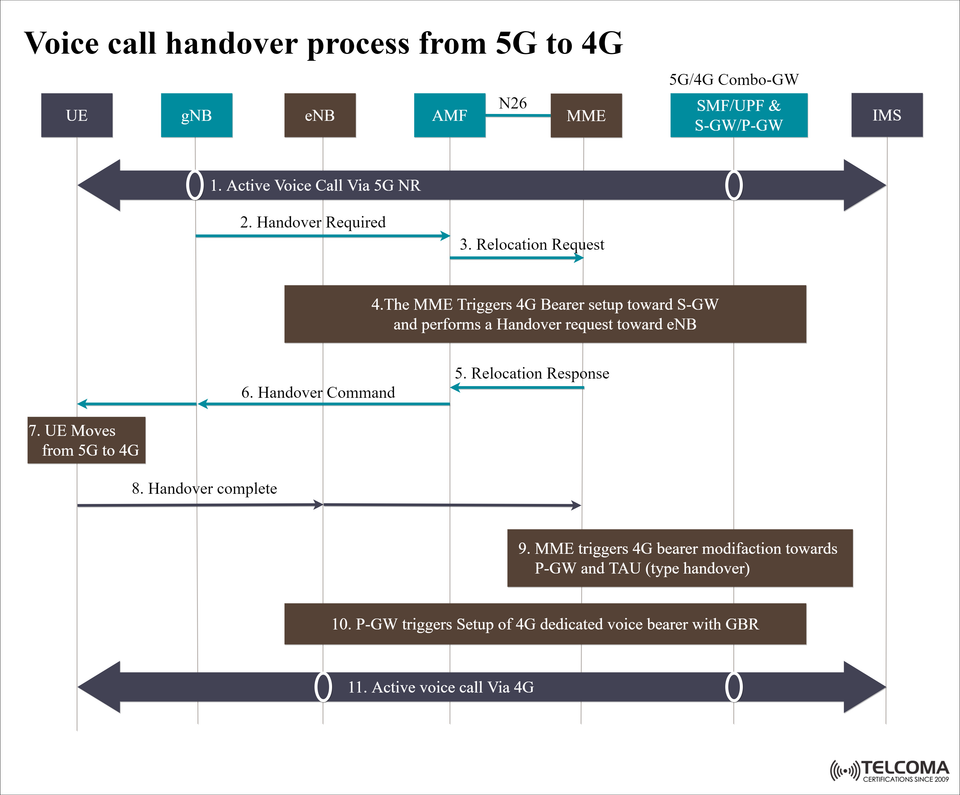

Voice Call Handover from 5G to 4G: A Technical Walkthrough
With 5G being introduced around the world, the ability to maintain voice continuity during access technology changes has become a key requirement. One of the most significant cases in point is the handover of active voice calls from 5G NR to 4G LTE in Non-Standalone (NSA) and Inter-RAT situations.
The diagram that I have uploaded above outlines the signalling flow and the steps involved, and most importantly, how the various network functions such as gNB, eNB, AMF, MME and IMS interact as the active voice session is passed from 5G to LTE.
This blog will further elaborate on how the process operates in a simple but concrete manner for telecommunications professionals and network engineers.
What is voice handover from 5G to 4G?
Voice handover from 5G to 4G is the handover of an active voice call from a 5G New Radio (NR) connection to a 4G LTE connection. This is essential in the following cases:
When the 5G signal is weak (e.g. user moved indoors or moved to rural areas).
The voice service (VoNR) is not available or hasn't been deployed.
When the call was started over IMS and requires a fallback feature to LTE VoLTE.
In Sequence: 5G to 4G Voice Handover Process
Here’s the handover scenario detailed in the image:
Step Description
1️⃣ Voice Call active via 5G NR - The user equipment (UE) is actively in a voice call utilizing the 5G New Radio.
2️⃣ Handover needed - With the UE moving (or regardless) the kNB requests a handover.
3️⃣ Relocation request - AMF sends a relocation request to MME via the N26 interface.
4️⃣ Bearers setup and handover request - MME triggers bearer setup through the Serving Gateway (S-GW) on the 4G and sends a handover request to the 4G eNB.
5️⃣ Relocation response - eNB responds that it is ready for the UE.
6️⃣ Handover command - AMF sends a handover command to the UE.
7️⃣ UE moves to 4G - User equipment is now in the 4G radio space.
8️⃣ Handover successful - eNB notifies MME the UE has moved successfully.
9️⃣ Bearers Modification - MME triggers bearer changes to the new Packet Gateway (P-GW) and a tracking area update (TAU).
🔟 Dedicated voice bearer setup - P-GW setup a 4G Guaranteed Bit Rate (GBR) bearer, for the active voice call.
1️⃣1️⃣ Voice Call active via 4G - The voice call continues to reside in the 4G LTE network.
Key Network Elements Involved
UE (User Equipment): Mobile phone or device connected to service provider.
gNB (Next Generation Node B): A 5G radio access point.
eNB (Evolved Node B): A 4G LTE radio access point.
AMF (Access and Mobility Management Function): Responsible for registration and mobility in 5G.
MME (Mobility Management Entity): Typically responsible for mobility and session control in 4G.
SMF/UPF (Session and User Plane Functions): Components of the 5G core that perform the routing of traffic.
S-GW/P-GW (Serving and Packet Gateway): Packet core gateways in 4G.
IMS (IP Multimedia Subsystem): Manages SIP (Session Initiation Protocol) signaling for telephony and video services over an IP connection.
Why the N26 interface is Important
The N26 interface facilitates interworking between AMF (5G Core) and MME (4G Core). It governs handover processes ensuring session context is conserved during inter-RAT transitions. Without the N26 interface, fall back could require a service interruption or re-establishment.
Benefits of Seamless Handovers from 5G to 4G
✅ Zero Call Drop: Users experience accessible and uninterrupted voice communication.
✅ Mobility: Works across rural and urban geographies.
✅ Smooth 5G Migration: Allows carriers to take advantage of existing LTE infrastructure when rolling out 5G.
✅ Quality of Service (QoS) Maintenance: For calls, dedicated bearers reduce chances of drops (via GBR).
Challenges with Voice Handover
Important technical challenges for handover of voice calls involve:
Latency Sensitivity: Voice services are time sensitive and can be impacted by latency.
Conclusion
The transition of an active voice call from 5G to 4G despite its non-trivial nature is an important feature of 5G and any modern mobile network. By coordinating multiple control and user plane elements - AMF, MME, IMS, and gateways - the operator can support voice services across its deployments of all Radio Access Technologies.
As 5G deployment evolves, the aforementioned interworking mechanisms will continue to be critical in supporting the achievement of voice service ubiquity and maximal user experience.
Real-World Use Case: Urban Mobility with 5G Voice Handover
An example of this capability would be a user starting a VoNR (Voice over New Radio) call in a 5G covered urban area whilst commuting. As the user moves into a subway station, they lose 5G coverage, triggering the network to utilize a handover to the still present but slightly less robust 4G LTE coverage in the subway station. As a result of the signaling developed above, the user continues their call uninterrupted despite the changing underlying radio access and core network.
This seamless experience is enabled through:
Efficient signaling between the AMF and MME utilizing the N26 interface
Pre-defined handover policies in both the gNB and eNB
Fast bearer reconfiguration via P-GW and S-GW
Preservation of IMS session maintaining the SIP session state.
Industry Implications: Why Does This Matter Now
Mobile operators have now or are in the process of transitioning to full 5G deployments that also interwork with existing LTE infrastructure. More than just a nice-to-have natural, the handover process is a must. There are several reasons why this handover process is crucial for operators:
Avoid VoNR black holes: VoNR is not widely supported and there are still areas even in urban space that lack VoNR, at least LTE can provide coverage.
Phased network upgrades: as not all sites are 5G radio capable, LTE can operate as a buffer.
Regulatory reasons: monitoring active emergency services like e911 requires continuity of voice service regardless of RAT.
User expectations: users expect zero dropped calls, even during handovers.
Glossary of Terms
Term Definition
VoNR Voice over New Radio – Voice service provided over 5G NR utilizing IMS.
VoLTE Voice over LTE – Voice service provided over 4G utilizing IMS.
IMS IP Multimedia Subsystem – Framework for delivering voice/video using IP.
gNB 5G base station (NextGen Node B).
eNB 4G LTE base station (Evolved Node B).
AMF Access and Mobility Management Function – one of the functions that comprise the 5G core.
MME Mobility Management Entity – signalling and control node of the 4G core that manages context and connection states.
P-GW / S-GW Packet and Serving Gateways – they handle user plane traffic in the LTE cores.
GBR Bearer Guaranteed Bit Rate – dedicated resources that enable quality of service for real-time services such as voice.