
Understanding U-plane and C-plane MDT in 5G Networks
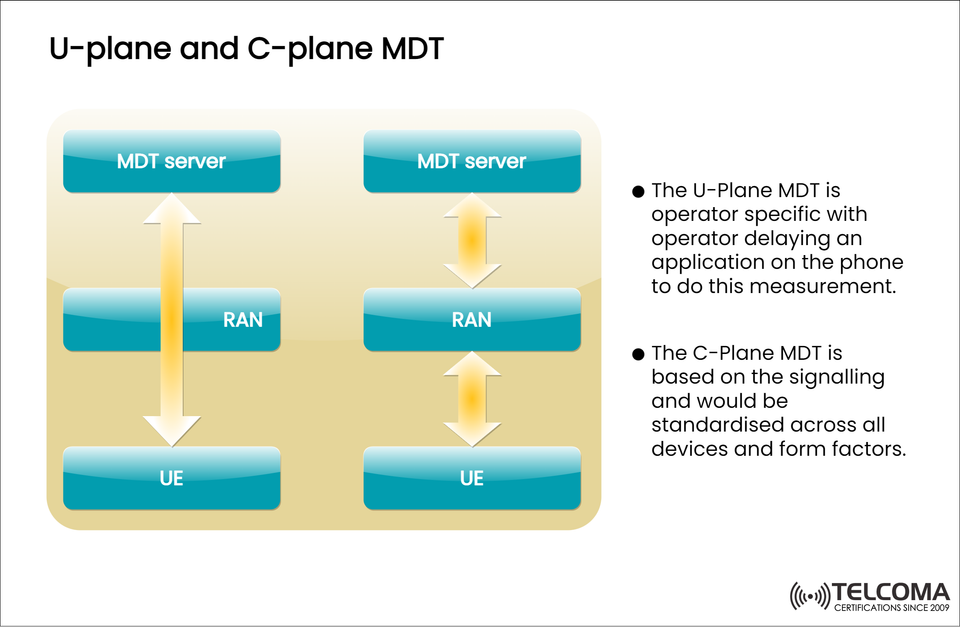

U-plane and C-plane MDT: Essential for 5G Network Performance
Today's telecom networks heavily depend on data insights to ensure smooth connectivity, enhance coverage, and improve user experiences. One key feature helping in this regard is Minimization of Drive Tests (MDT), which allows operators to gather real-world performance data straight from User Equipment (UE).
In the MDT framework, there are primarily two ways to collect measurements: U-plane MDT (User Plane MDT) and C-plane MDT (Control Plane MDT). Recognizing their differences is crucial for network engineers, planners, and anyone interested in telecom.
What’s MDT? (A Quick Overview)
Minimization of Drive Tests (MDT) was introduced by 3GPP to help operators cut down manual drive testing by leveraging data from actual user devices.
MDT can function in:
Immediate Mode: This gathers and reports measurements in real-time when the device is active.
Logged Mode: In this case, measurements are recorded while the device is in idle mode and sent later.
U-plane and C-plane MDT serve as two methods for transporting MDT data from UE to the network.
Breaking Down U-plane MDT
U-plane MDT operates through the user plane (the data layer), sending measurement reports from the UE to the MDT server.
Key Features of U-plane MDT:
Customized by Operators: Each operator can tailor U-plane MDT, depending on what their network needs and the vendor’s specifications.
Application-Level Control: Operators may deploy a specific application or service on the UE to gather and transmit measurements.
Possible Delayed Reporting: Utilizing the user plane allows operators some control over when to send data, helping to manage congestion.
Greater Flexibility: This approach is great for scenarios that require in-depth logging and advanced analytics.
Breaking Down C-plane MDT
C-plane MDT works through the control plane (the signaling layer) to carry measurements. This makes it a more uniform and vendor-agnostic method.
Key Features of C-plane MDT:
Standardized Signaling: C-plane MDT follows 3GPP standards, promoting compatibility across various devices and forms.
Direct RAN Integration: Measurements are packaged in signaling messages (RRC/NAS) and sent straight to the network.
Timely or Scheduled Reporting: Ideal for situations where quick measurements are needed for troubleshooting or optimization.
Less Tailored by Operators: This method promotes consistency across different networks, devices, and regions.
U-plane MDT vs C-plane MDT: A Close Look
Aspect U-plane MDT 📝C-plane MDT ⚡Transport Mechanism User plane (data path)Control plane (signaling path)Standardization Operator-specific, implementation may differ3GPP standardized Reporting Flexibility High – can delay or schedule reporting Lower – adheres to signaling events Device Impact May need a dedicated application Native support in UE Use Cases Advanced analytics, tailored KPIs Standardized coverage and quality monitoring Interoperability Limited across devices/networks High – compatible across vendors and devices
This table provides a handy reference for telecom pros to determine which MDT type suits their network optimization needs best.
How U-plane and C-plane MDT Work Together
In practice, operators frequently use both U-plane and C-plane MDT to get a comprehensive picture of network performance:
C-plane MDT gives foundational, standardized measurements across the network.
U-plane MDT adds value with richer, operator-specific data and custom KPIs.
This hybrid strategy helps operators:
Link network events with user experiences.
Optimize coverage and capacity more accurately.
Identify anomalies and troubleshoot issues faster.
Advantages of U-plane and C-plane MDT
For Network Operators:
Cost Savings: Cuts down on traditional drive testing efforts and costs.
Detailed Insights: Reveals information on cell-edge performance, coverage issues, and mobility problems.
Smarter Capacity Planning: Data-driven decisions for using spectrum and deploying cells.
For End Users:
Enhanced Quality of Experience (QoE): Fewer dropped calls, better throughput, and smoother transitions.
Quicker Problem Resolution: Operators can spot and fix issues before they impact a lot of users.
Challenges and Considerations
While U-plane and C-plane MDT are powerful tools, they do come with challenges:
Device Compatibility: Devices must support MDT features according to 3GPP guidelines.
Privacy Concerns: It’s important to anonymize measurements to protect users’ privacy.
Network Load: If not set up properly, C-plane MDT can increase signaling overhead.
Battery Drain: Frequent logging can lead to faster battery depletion in UE.
Applications of U-plane and C-plane MDT in 5G Networks
5G Coverage Check: Verifying that 5G NSA/SA cells provide uninterrupted coverage.
VoNR Optimization: Monitoring voice quality over NR using MDT reports.
Mobility Performance: Analyzing handovers and transitions from idle to connected.
QoE Assurance for URLLC: Confirming ultra-low latency applications meet their service-level agreements.
Actionable Insights for Telecom Professionals
Set Up the Best MDT Parameters:
Don't measure too often; it can create unnecessary signaling issues.
Use various logging intervals depending on whether you're in a city or out in the countryside.
Combine MDT Data with SON Platforms:
This can help automate things like optimizing coverage and spotting interference.
Leverage AI and machine learning to link MDT data with customer feedback.
Make Sure to Follow Privacy Regulations:
Always remove user identifiers before you store or analyze data.
Keep in mind GDPR, CCPA, and any local laws you need to adhere to.
Utilize MDT for 5G Deployments:
Confirm that 5G NSA/SA coverage is good to go before the commercial launch.
Use MDT for testing and fine-tuning VoNR.
Wrap-Up
U-plane and C-plane MDT form crucial elements of network data collection in 5G. While U-plane MDT allows for flexibility and operator-specific tweaks, C-plane MDT brings standardization and cross-device compatibility to the table.
Together, they provide a holistic view of network performance, enabling operators to deliver top-notch services, optimize coverage, and trim down operational costs.
As we move into an era of AI-driven network enhancements and self-organizing networks (SON), MDT data—both U-plane and C-plane—will continue to be vital in crafting smarter, more resilient, and user-focused networks.
Conclusion
As we move into a 5G-focused era, where the quality of networks and the user experience (QoE) are crucial for success, U-plane and C-plane MDT are must-have tools. By effectively managing both user and control plane data, operators can:
Gather precise network measurements from actual users
Automate troubleshooting and coverage planning
Improve voice and data quality across various devices
The true strength of MDT comes from merging U-plane and C-plane strategies with top-notch analytics, AI, and SON. This combination makes sure that networks are forward-thinking, self-optimizing, and prepared for future challenges like IoT, URLLC, and the evolution to 6G.