
Understanding UDM Subscriber Data Management in 5G Standalone Registration
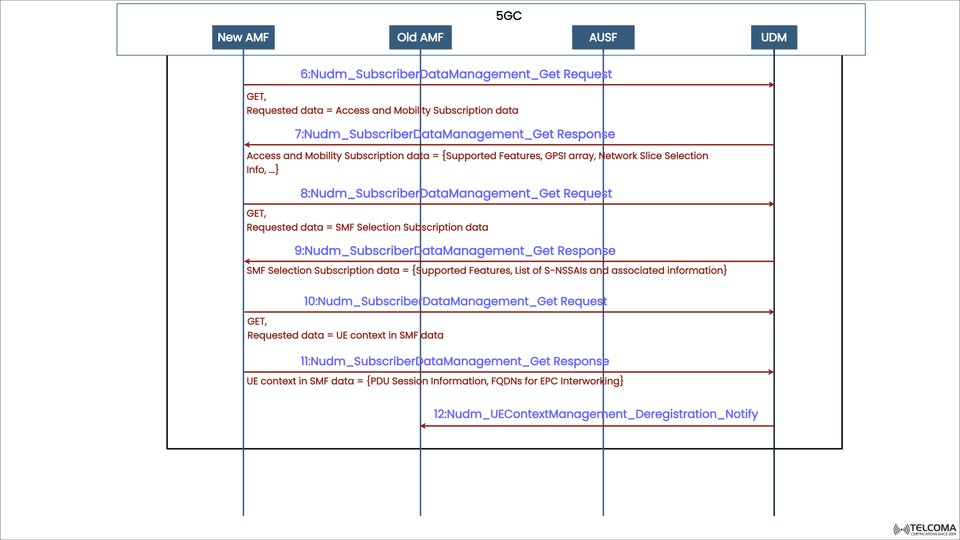

UDM Subscriber Data Management in 5G Standalone Registration
In the realm of 5G Standalone (SA) architecture, Unified Data Management (UDM) acts as the core for managing subscriber identity, authentication, and session context. After going through the authentication and registration processes, the Access and Mobility Management Function (AMF) pulls essential subscriber details from the UDM to finalize user registration and set up the session.
The attached image shows the second phase of UDM interactions during 5G standalone access registration. It focuses on how the AMF retrieves subscriber data, manages information for SMF selection, and deals with UE context deregistration.
Role of UDM in Subscriber Data Management
The UDM within the 5G Core is responsible for several crucial functions:
It acts as a centralized database for subscribers across all core network functions.
It provides mobility, session, and slice-specific data to both the AMF and SMF.
It enables service continuity by managing the UE context.
It supports deregistration notifications to ensure synchronized states among network functions.
Once a user is authenticated (as discussed in the earlier UDM interaction phase), the AMF requests various data sets from the UDM to move forward with session management and policy enforcement.
Message Flow Overview
The diagram illustrates the signaling procedures for Nudm Subscriber Data Management (SDM) and UE Context Management (UCM) among the New AMF, Old AMF, AUSF, and UDM. The main aim here is to retrieve a variety of subscription data and update the UE context in UDM, ensuring everything stays consistent across the network.
This flow consists of six primary messages, numbered 6 to 12, which cover:
Access and Mobility Subscription Data Retrieval
SMF Selection Subscription Data Retrieval
UE Context Data Retrieval
UE Deregistration Notification
Let’s break it down step by step.
Access and Mobility Subscription Data Retrieval
Step 6: Nudm_SubscriberDataManagement_Get Request
Interface: Nudm
Direction: New AMF → UDM
Purpose: To retrieve Access and Mobility Subscription Data
Details:
Request Type: GET
Requested Data: Access and Mobility Subscription information
Explanation:
When the New AMF takes over UE registration, it sends a Nudm_Subscriber Data Management_Get Request to the UDM to gather Access and Mobility (A&M) Subscription Data. This data encompasses details like the UE’s supported features, the allowed GPSI array, and information for network slice selection.
Step 7: Nudm_SubscriberDataManagement_Get Response
Interface: Nudm
Direction: UDM → New AMF
Response Data:
Supported Features
GPSI Array
Network Slice Selection Information
Explanation:
The UDM replies with comprehensive subscription information that aids the AMF in managing network slice selection and mobility registration. This information details:
Which network slices (S-NSSAIs) the UE can access
Preferred public identities for communication
Subscriber features like voice over NR and emergency services
SMF Selection Subscription Data Retrieval
Step 8: Nudm_SubscriberDataManagement_Get Request
Interface: Nudm
Direction: New AMF → UDM
Purpose: To retrieve SMF Selection Subscription Data
Request Type: GET
Explanation:
After gathering mobility-related data, the AMF goes on to request SMF Selection Subscription Data. This info is vital for determining which Session Management Function (SMF) will manage the UE’s data sessions.
Step 9: Nudm_SubscriberDataManagement_Get Response
Interface: Nudm
Direction: UDM → New AMF
Response Data:
Supported Features
List of S-NSSAIs and Associated Information
Explanation:
The UDM sends the SMF Selection Subscription Data back, which helps the AMF assign the appropriate SMF to each PDU session. This ensures that every data session connects to the right network slice (S-NSSAI) and that the chosen SMF has the necessary service capabilities.
UE Context in SMF Data Retrieval
Step 10: Nudm_SubscriberDataManagement_Get Request
Interface: Nudm
Direction: New AMF → UDM
Purpose: To retrieve UE context in SMF Data
Request Type: GET
Explanation:
Once the AMF has the mobility and session management data, it sends another GET request to collect UE context data stored in SMF. This ensures that all session-level information is available for continuity or for working with the Evolved Packet Core (EPC).
Step 11: Nudm_SubscriberDataManagement_Get Response
Interface: Nudm
Direction: UDM → New AMF
Response Data:
PDU Session Information
FQDNs for EPC Interworking
Explanation:
The UDM provides UE context data regarding existing PDU sessions, which includes:
PDU session identifiers
Session management information
Fully Qualified Domain Names (FQDNs) for EPC interworking
This info guarantees a smooth transition between different AMF or SMF instances and facilitates seamless mobility and handovers in multi-access 5G setups.
Deregistration Notification
Step 12: Nudm_UEContextManagement_Deregistration_Notify
Interface: Nudm
Direction: UDM → AMF
Purpose: To notify about the Deregistration of UE Context
Explanation:
When the UE deregisters—like when switching to idle mode or explicitly deregistering—the UDM sends a Deregistration Notification to the AMF. This keeps both entities in sync and prevents outdated session records.
Deregistration plays a key role in:
Releasing allocated resources
Clearing session details
Ensuring clean handovers and re-registrations
Interfaces and Network Functions Involved
Interface Between Function Nudm_SDMAMF ↔ UDM Used for retrieving subscription and session management data Nudm_UCMUDM ↔ AMF Used for managing UE context registration and deregistration NausfAUSF ↔ UDM Handles authentication and key management (from the earlier phase)
These service-based interfaces (SBI) leverage RESTful HTTP APIs and JSON encoding, making them flexible and scalable for the cloud-native 5G Core environments.
Technical Insights: Data Types Retrieved by AMF
Here are some key data types that AMF pulls from UDM during the standalone registration process:
Data Type Description
Access and Mobility Subscription Data Governs how UE accesses the network and moves between slices SMF Selection Subscription Data Guides SMF allocation for PDU sessions UE Context in SMF Data Contains session identifiers, PDU details, and interworking data Deregistration Notification Keeps UDM and AMF context synchronized during user detach or network change
Each of these data sets ensures accurate subscriber provisioning, session continuity, and efficient mobility management in the 5G standalone architecture.
Importance of UDM in Subscriber Lifecycle Management
The UDM isn’t just a database; it’s the intelligent hub for managing subscriber lifecycles in 5GC. Through the Nudm_SDM and Nudm_UCM interfaces, it makes sure that:
Subscriber data is always accurate and accessible to AMF, SMF, and PCF.
Network functions can dynamically access just the data they need.
Deregistration and re-registration events are synchronized seamlessly.
This significance of UDM is key for network slicing, policy enforcement, and providing a smooth user experience in 5G Standalone deployments.
Conclusion
The UDM Subscriber Data Management process is a cornerstone of the 5G Standalone architecture. Through efficient Nudm interactions, the UDM ensures that every registered UE has consistent, secure, and up-to-date subscription data throughout the 5G Core Network.
By managing access, mobility, and SMF selection details, and by coordinating deregistration events, the UDM enables operators to offer reliable connectivity, seamless handover processes, and optimized service delivery within a cloud-native, service-based 5G environment.