
Understanding UL Preemption in 5G NR Release 16: How URLLC and eMBB Coexist Efficiently

Understanding UL Preemption in 5G NR Release 16
As 5G New Radio (NR) develops, it’s essential for the technology to manage a variety of service types, each with its own performance needs. Release 16 steps up by introducing Uplink (UL) preemption, which allows URLLC (Ultra-Reliable Low Latency Communication) to work alongside eMBB (enhanced Mobile Broadband) traffic smoothly.
To put it simply, UL preemption makes sure that critical low-latency traffic—think industrial automation or remote surgery—can quickly grab uplink resources, even if those resources are already promised to less urgent broadband tasks.
Why Do We Need UL Preemption in 5G?
The goal of 5G networks is to support a wide range of applications, including:
eMBB: High-speed data for activities like streaming, gaming, and VR.
URLLC: Applications that are mission-critical and need super-low latency and high reliability.
mMTC: Support for massive IoT connections.
While eMBB usually relies on scheduled uplink resources, URLLC needs immediate chances to transmit. When URLLC packets come in unexpectedly, the system has to be able to make space for them without waiting for the next scheduling round.
That’s where uplink preemption comes into play.
What’s UL Preemption in 5G NR?
UL preemption allows the network (gNB) to interrupt ongoing uplink transmissions from eMBB devices to free up resources for URLLC users who need quick access.
Key Features:
Dynamic resource reallocation: The uplink resources assigned to eMBB can be partially or completely preempted.
Preemption Indication (PI): The eMBB device gets a signal letting it know that part of its scheduled resources will be taken away.
Smooth coexistence: This ensures URLLC meets its latency targets without fully disrupting eMBB performance.
Breaking Down the UL Preemption Workflow
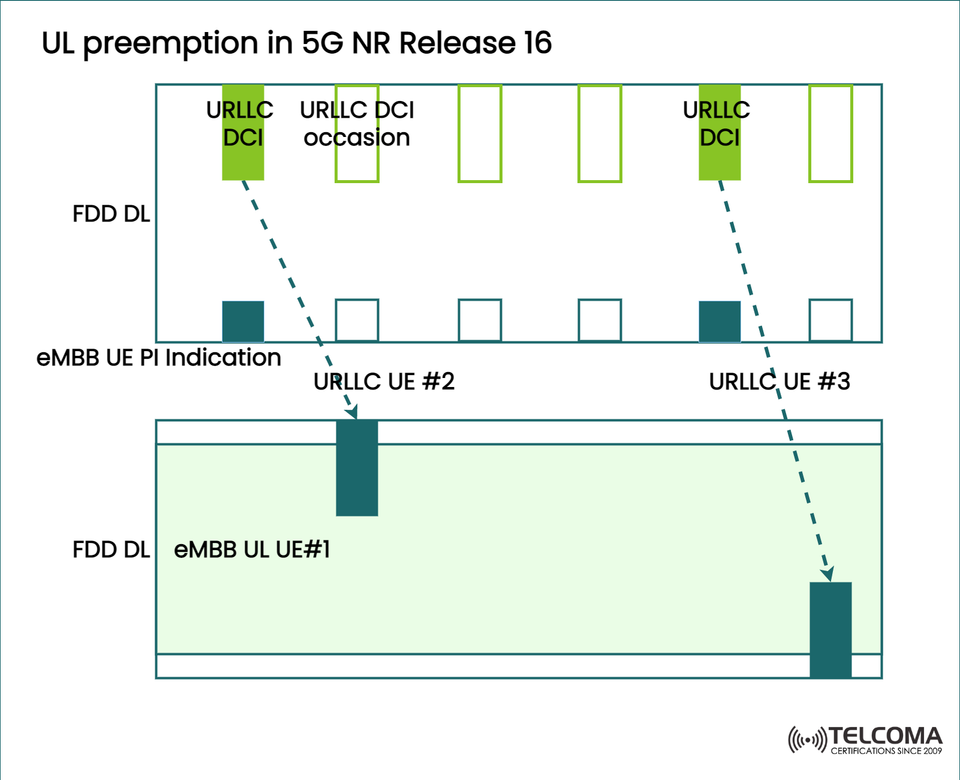
The image shared shows how the UL preemption mechanism works in a Frequency Division Duplex (FDD) setup. Here’s how it goes:
Step 1: Sending URLLC DCI
The gNB sends out URLLC DCI (Downlink Control Information) periodically.
These signals point out when there might be an opportunity for URLLC users to jump to the front for uplink resources.
Step 2: eMBB UE PI Notification
eMBB devices (like eMBB UE #1) get a Preemption Indication (PI).
This means that some resource blocks they were supposed to use for uplink are being shifted to URLLC devices.
Step 3: URLLC Transmission
URLLC devices (like UE #2 and UE #3) quickly send their essential uplink information using the now preempted resources.
The gNB makes sure that URLLC’s latency goals (usually under 1 ms) are met.
Step 4: eMBB Compensation
Later, the gNB might reschedule eMBB devices to make up for the lost resources, keeping the impact on throughput and user experience minimal.
- Digging Deeper into the UL Preemption Mechanism
Component Function
URLLC DCI Occasion: Scheduled times when URLLC control messages can be sent.
Preemption Indication (PI): A signal to tell eMBB devices that their uplink resources are being preempted.
eMBB UE: Continues to transmit but might temporarily lose some of their assigned resources.
URLLC UE: Gains immediate access to the uplink channel to meet its latency needs.
Example from the image:
The URLLC DCI prompts uplink transmissions for URLLC UE #2 and UE #3.
eMBB UE #1 gets a PI indicating that some of its resources have been reassigned.
This setup guarantees that URLLC gets instant access while ensuring overall system efficiency.
- Advantages of UL Preemption
Super-Low Latency Support: URLLC packets can go through right away, which is vital for time-sensitive tasks like:
Factory automation
Smart grid management
Remote healthcare
Better Resource Usage: Uplink resources are reassigned based on real-time needs.
Maintaining eMBB Service: Although eMBB transmissions may be interrupted, the use of preemption indications and rescheduling limits long-term throughput loss.
Network Efficiency: There’s no requirement for dedicated URLLC uplink slots, which optimizes spectral efficiency.
What’s New in 3GPP Release 16?
Release 16 built on the earlier 5G NR framework from Release 15, focusing on industrial-grade communication and extending reliability.
Key Enhancements for UL Preemption:
Dynamic UL Scheduling Improvements: More adaptable grants and quicker DCI signaling.
PUSCH Preemption Management: A method for eMBB devices to report preemption and request retransmissions.
PI Configuration Options: Adjustable PI details and latency limits.
Integration with QoS Framework: Works with 5QI (5G QoS Identifier) for prioritized processing.
Together, these changes make uplink preemption more predictable, measurable, and efficient.
How UL Preemption is Different from DL Preemption
Aspect DL Preemption UL Preemption Direction Downlink (from g NB to UE)Uplink (from UE to gNB) Trigger URLLC data in DLURLLC data in UL Resource Control g NB reallocates downlink resources g NB reallocates uplink resources Impact e MBB gets partial downlink data e MBB loses some uplink resources Notification Preemption Indication to UEPI sent before URLLC transmission
UL preemption is trickier since uplink transmissions are coming from UEs, requiring quick coordination to avoid data collision or packet loss.
Challenges of Implementing UL Preemption
Even with its perks, UL preemption comes with its own set of challenges:
Timing Synchronization: URLLC devices have to transmit right away, with barely any signaling delays.
Complex Scheduling Algorithms: The gNB has to decide quickly which eMBB transmissions to interrupt.
Interference Management: Preempted data must not interfere with ongoing eMBB traffic.
Error Recovery: eMBB devices need effective ways (like HARQ or retransmission) to recover any lost data.
5G vendors have to come up with sophisticated algorithms to manage these trade-offs, often using AI-based strategies for scheduling and network slicing.
Real-World Uses of UL Preemption
UL preemption makes possible mission-critical 5G applications such as:
Smart Manufacturing: Immediate machine control that needs latency under 1 ms.
Autonomous Vehicles: Quick communication from sensors to the cloud.
Healthcare IoT: Remote surgeries and patient monitoring that require ultra-reliable connections.
Public Safety Networks: Fast data transmission from first responders during emergencies.
These applications rely on the predictable latency enabled by UL preemption.
In Conclusion: The Future of Low-Latency 5G
UL preemption in 5G NR Release 16 is a key innovation that ensures URLLC and eMBB services can work together efficiently. By flexibly reallocating uplink resources, 5G networks are equipped to meet the stringent demands of low-latency communications without sacrificing overall throughput.
As we look ahead to Release 17 and beyond, further improvements in preemption control, AI-driven scheduling, and network slicing integration are on the horizon, making low-latency performance not just reliable but also scalable.
In short, UL preemption is a great example of how 5G NR balances conflicting demands to deliver both speed and reliability in the upcoming era of wireless communication.