
Understanding UNI and OTN Architecture: Control, Transport, and Management Planes Explained

Getting to Know UNI in Optical Transport Networks: A Closer Look at Control, Transport, and Management Planes
In today's telecom world, Optical Transport Networks (OTN) serve as the backbone for fast data transmission. They’re built to be scalable, reliable, and automated, enabling smooth management of optical signals in intricate multi-layer networks.
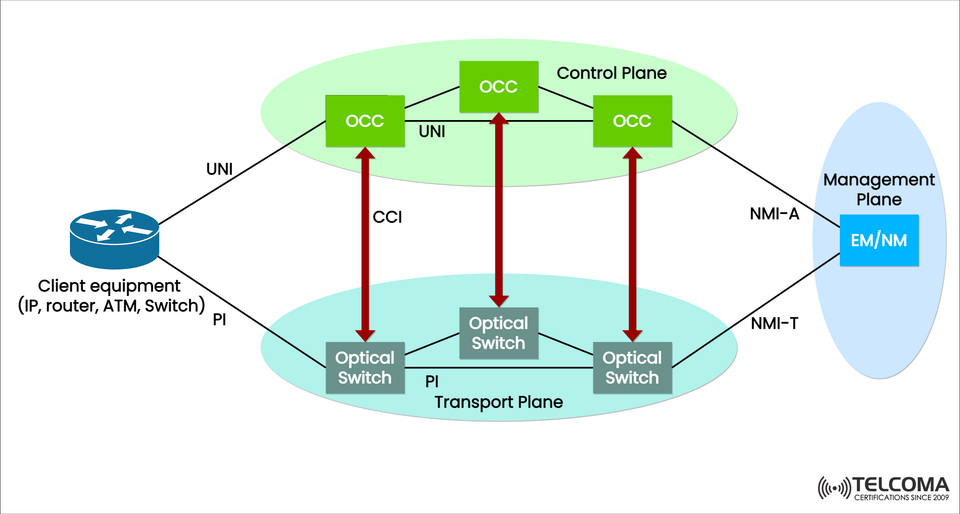
The image uploaded gives a clear visual of how the OTN framework ties together the Control, Transport, and Management Planes using key interfaces, especially the User-Network Interface (UNI) and Network-to-Network Interfaces (NNIs).
This post is designed to clarify the roles these planes play and highlight the importance of the UNI in creating a seamless optical networking experience.
Overview of Optical Transport Network (OTN) Architecture
An OTN sets the stage with a standardized structure (as outlined by ITU-T G.872 and G.709) for transporting, multiplexing, routing, and managing optical channels. It handles high-capacity optical data communication across carrier networks.
The architecture of OTN consists of three core planes:
Control Plane
Transport Plane
Management Plane
Each of these planes has its own unique role, but they all depend on each other to function properly. Let’s dive into what they do and how they connect through specific interfaces.
Control Plane: The Brain of the Network
The Control Plane acts as the “brain” behind the OTN. It's in charge of path computation, signaling, and managing resources.
In the image, you’ll see that this plane is represented by OCCs (Optical Connection Controllers), which interact through different interfaces, including:
UNI (User-Network Interface)
CCI (Control-Channel Interface)
What the Control Plane Does:
Automatically sets up and tears down optical connections
Manages routing, signaling, and wavelength allocation
Optimizes how resources are used and handles traffic
Detects faults and allows for automatic recovery
Key Interface – UNI:
The UNI (User Network Interface) connects client equipment like IP routers and switches to the OTN.
It lets clients request optical services dynamically without needing to set things up manually.
For instance, if a router wants to set up a lightpath, it uses the UNI to send that request, and the Control Plane takes care of everything else — from figuring out the best path to allocating resources and making the connection happen.
Other Control Plane Interfaces:
CCI (Control Channel Interface): Facilitates communication between OCCs to share signaling and routing information within the control area.
Internal UNI: Allows coordination of control signaling between OCC nodes.
Transport Plane: Where Data Flows
The Transport Plane is where the actual data transmission happens. It includes optical switches, DWDM links, and photonic elements that handle heavy data streams.
In the image, the Optical Switches are the heart of the Transport Plane, linked through:
PI (Physical Interface) connecting client equipment to optical switches
Internal PI linking various optical switches
What the Transport Plane Does:
Forwards optical signals through wavelength channels
Provides switching, multiplexing, and demultiplexing capabilities
Manages physical connections and lightpath setups
Ensures Quality of Service (QoS) through Optical Channel Data Unit (ODU) structures
PI Interface (Physical Interface):
Defines how client equipment connects to the optical network.
Supports various client types like IP routers, ATM switches, or Ethernet nodes.
Facilitates end-to-end optical path establishment via control signaling starting from the UNI.
So while the Control Plane figures out the routing and setup, the Transport Plane is responsible for transmitting the data using those optical paths.
Management Plane: The Backbone of Operations
The Management Plane ensures that the OTN runs smoothly and efficiently. It covers network supervision, performance tracking, fault identification, and configuration management.
In the image, the Management Plane is depicted by EM/NM (Element Manager/Network Manager), which communicates with both the Control and Transport Planes through:
NMI-A (Network Management Interface – Administrative)
NMI-T (Network Management Interface – Transport)
What the Management Plane Does:
Provisioning: Sets up resources for new services.
Fault Management: Identifies and isolates network issues.
Performance Monitoring: Keeps track of important metrics (like BER, latency, utilization).
Security and Access Control: Manages secure operations.
Coordination with Control Plane: Monitors and records automated provisioning actions.
Explaining the Interfaces:
NMI-T: Connects the Management Plane to the Transport Plane for monitoring faults and performance.
NMI-A: Links the Management Plane to the Control Plane for supervision, policy enforcement, and event logging.
These connections ensure end-to-end visibility and consistent operations across the OTN.
Inter-Plane Communication Interfaces
To grasp how the planes coordinate, here’s a summary of the key interfaces shown in the image:
Interface Full Form Connects Purpose
UNI User-Network Interface Client Equipment ↔ OCC Allows client-driven service requests and signaling
PI Physical Interface Client Equipment ↔ Optical Switch Physical data interface between client and OTN
CCI Control Channel Interface OCC ↔ OCC Exchange of control plane signaling and routing data
NMI-A Network Management Interface – Administrative EM/NM ↔ OCC Administrative control and coordination
NMI-T Network Management Interface – Transport EM/NM ↔ Optical Switch Transport network monitoring and management
This design with multiple interfaces allows the OTN to achieve autonomy, scalability, and effective management.
How the OTN Planes Work Together
Let’s go through a simple example to show how they interact:
A router (client equipment) makes a request for a new optical connection using the UNI interface.
The Control Plane’s OCC processes that request and figures out the best lightpath.
The OCC then signals the Optical Switches in the Transport Plane using the CCI to create the physical connection.
The Management Plane (EM/NM) keeps an eye on the whole process using NMI-A and NMI-T, updating the network status and logging any issues.
Once the connection is set up, data flows smoothly through the Transport Plane, and the Control Plane ensures everything stays controlled and can recover if needed.
This coordination leads to an intelligent, automated optical network that's capable of dynamic service provisioning and fault resilience.
Benefits of Having a Multi-Plane OTN Architecture
Separating the Control, Management, and Transport Planes offers several perks:
- Better Network Automation
Automation in the Control Plane through UNI lets for self-service provisioning.
Cuts down on manual setup and potential human mistakes.
- Improved Resource Utilization
Dynamic bandwidth allocation thanks to optical path computation.
Optimizes how wavelengths and fibers are used.
- Fault Tolerance and Resilience
Automatic rerouting if failures occur, providing quick restoration.
Ongoing monitoring via the Management Plane.
- Compatibility Across Vendors
Standardized interfaces (UNI, NMI, PI) guarantee compatibility among different equipment manufacturers.
- Scalability
Supports easy expansion with little reconfiguration needed.
Adapts well to multi-layer (IP over DWDM) and multi-domain networks.
Applications of UNI and OTN Architecture
Carrier-grade backbone networks
Data center interconnects (DCI)
Metro and long-haul optical networks
Cloud services and enterprise connectivity
SDN-controlled optical domains
This design is the foundation for smart, software-driven optical networking, essential for 5G backhaul, cloud computing, and IoT ecosystems.
Wrapping Up
The OTN framework shown here illustrates how the Control, Transport, and Management Planes work together, connected through standardized interfaces like UNI, CCI, and NMI.
The User Network Interface (UNI) is critical in linking client demands with network automation, while systems like EM/NM ensure ongoing monitoring and management.
Separating these functions not only boosts scalability and efficiency but also enables operators to provide on-demand optical services, aligning with the forward-thinking vision of autonomous and programmable networks.
Ultimately, grasping the UNI and OTN plane architecture is key for telecom professionals looking to master next-gen optical transport systems.