
Understanding UPF Interactions During 5G Standalone Access Registration
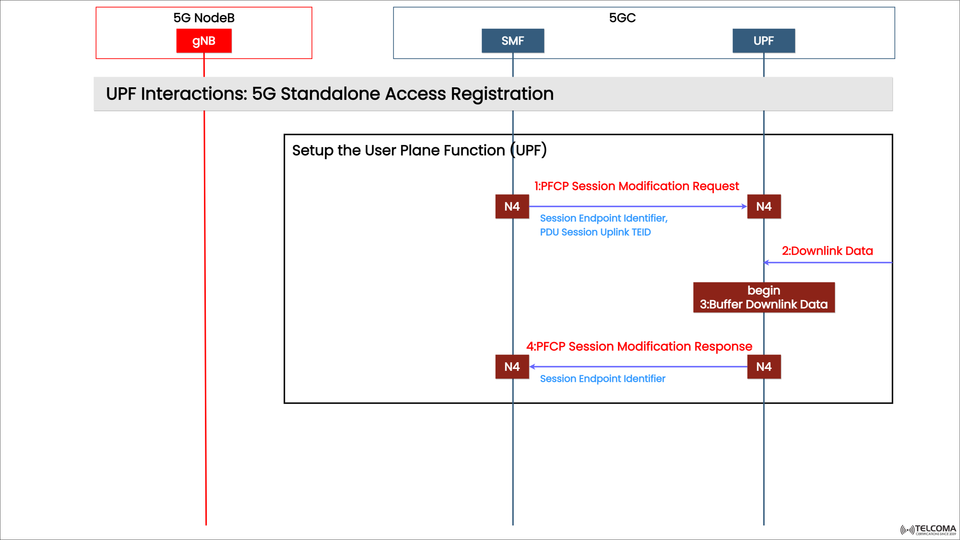

UPF Interactions in 5G Standalone Access Registration
In 5G Standalone (SA) networks, the User Plane Function (UPF) is essential for the data path. It takes care of packet forwarding, ensuring Quality of Service (QoS), buffering data, and interacting with outside data networks. While the Session Management Function (SMF) oversees control-plane signaling, the UPF is responsible for managing actual user-plane traffic.
The picture included highlights how the UPF is set up during the 5G access registration phase, focusing on the PFCP (Packet Forwarding Control Protocol) messages exchanged between SMF and UPF via the N4 interface.
This process makes sure that the PDU session (Protocol Data Unit session) is correctly configured to manage user data packets for both uplink and downlink flows.
The Role of UPF in the 5G Core (5GC)
The UPF (User Plane Function) serves as the bridge between the 5G Core and external data networks, such as the internet, IMS, or corporate networks. Its task is to manage user traffic in real time.
Key Responsibilities of UPF:
Packet Routing and Forwarding: Handles user data traffic between gNB and other networks.
QoS Enforcement: Implements Quality of Service policies from SMF and PCF.
Traffic Measurement: Gathers usage data for billing and analysis.
Policy Enforcement: Enforces rules for charging, lawful interception, and rate control.
Buffering and Data Handling: Temporarily stores data during UE transitions or handovers.
The UPF works under the direction of the SMF, which controls how user sessions are created, altered, and ended. They coordinate over the N4 interface, set by PFCP messages.
The N4 Interface and PFCP Protocol
The N4 interface connects the SMF (control plane) with the UPF (user plane), using the Packet Forwarding Control Protocol (PFCP) to set up and manage sessions and data flows.
PFCP Functions:
Sets up a user-plane session.
Changes forwarding rules when the user state alters.
Deletes or updates session contexts.
Sends acknowledgment responses for synchronization.
Each PFCP message exchange ensures the UPF operates according to SMF-defined rules, which is vital for stable and secure user connectivity.
Setup of the User Plane Function (UPF)
In the image, the setup process for the UPF during 5G Standalone Access Registration includes four main steps:
PFCP Session Modification Request
Downlink Data Reception
Buffering of Downlink Data
PFCP Session Modification Response
These steps take place after the control-plane registration and PDU session is set up, enabling data transfer to start between the UE and external networks.
Step-by-Step Message Flow Explanation
Step 1: PFCP Session Modification Request
Interface: N4
Direction: SMF → UPF
Purpose: Adjust or create the user-plane session
Parameters: * Session Endpoint Identifier * PDU Session Uplink TEID (Tunnel Endpoint Identifier)
Explanation:
When a UE successfully registers, the SMF sends a PFCP Session Modification Request to the UPF. This message includes identifiers like the PDU Session Uplink TEID, which uniquely identifies the uplink path between the gNB and UPF.
Through this request, SMF instructs UPF to:
Create or revise forwarding rules
Allocate TEIDs for data tunneling
Define QoS parameters and buffering behavior
The aim here is to make sure that user-plane forwarding paths are set up and properly configured before any data transmission begins.
Step 2: Downlink Data
Interface: N4
Direction: UPF → SMF
Purpose: Notify about incoming downlink data for a path that isn’t established yet
Explanation:
Following the PFCP session modification request, the UPF might get downlink data from the data network even if the user-plane setup isn’t complete.
Since the downlink path to the UE isn't set up yet, the UPF alerts the SMF that downlink data has come in. This triggers buffering to avoid data loss.
Step 3: Buffer Downlink Data
Interface: Internal UPF Process
Action: Start buffering incoming downlink data
Explanation:
When the UPF receives downlink data ahead of time, it begins buffering it temporarily until the session setup is finalized. This ensures data continuity and packet integrity, preventing the loss of early arriving packets.
Once the session modification response is confirmed, the buffered packets are then sent to the UE via the gNB.
Step 4: PFCP Session Modification Response
Interface: N4
Direction: UPF → SMF
Purpose: Confirm successful modification of the PFCP session
Parameters: * Session Endpoint Identifier
Explanation:
The UPF sends back a PFCP Session Modification Response to SMF, confirming that it has made all requested updates. This concludes the UPF setup process.
Following this exchange, the user-plane path between the UE (through the gNB) and the external data network becomes active, allowing data transfer to commence.
Importance of Buffering in UPF
Buffering is a crucial function in the UPF, especially during registration and mobility events.
Reasons Buffering is Needed:
Prevent Packet Loss: When UE switches states or sessions, buffering keeps the data until the user-plane is ready.
Ensure Session Continuity: Helps maintain uninterrupted data services even during network changes.
Support Low-Latency Applications: Buffered packets are sent immediately once the session is re-established.
If there weren’t any buffering, downlink packets arriving before UPF setup would just be dropped, leading to possible data loss and a poor user experience.
SMF–UPF Coordination During Registration
The SMF and UPF work in perfect sync over the N4 interface to ensure a smooth PDU session setup.
SMF takes care of control signaling — defining session rules, QoS, and routing.
UPF manages data handling — forwarding, buffering, and enforcing rules.
This division between control and user planes follows the Service-Based Architecture (SBA) of 5G Core, promoting scalability and efficiency.
Relation to Other 5G Core Functions
While UPF and SMF are key players in this flow, other 5G Core components support them:
AMF (Access and Mobility Function): Helps with UE registration and mobility management before the data plane setup.
PCF (Policy Control Function): Offers QoS and policy rules that SMF enforces via UPF.
UDM (Unified Data Management): Provides subscriber data that affects session creation and policy decisions.
Together, these elements form a cohesive framework for managing user sessions from registration to data transfer.
Real-World Use Case: First Packet Delay Optimization
In real-world 5G deployments, downlink buffering is crucial for reducing first packet delay.
For instance, when a user opens a streaming app right after registering, the UPF might get downlink packets from the content delivery network before the UE’s session is fully established. The UPF will buffer these packets and send them right after PFCP setup is acknowledged, which helps ensure a low-latency experience.
This capability is essential for ultra-reliable low-latency communications (URLLC) and enhanced mobile broadband (eMBB) services.
Conclusion
The UPF interactions during 5G Standalone access registration lay the groundwork for creating the user-plane path that enables real data transmission. By working with the SMF through PFCP messages over the N4 interface, the UPF guarantees efficient packet handling, reliable buffering, and smooth connectivity.
Basically, these interactions turn the control-plane decisions of SMF into actionable data-plane operations, helping 5G deliver super-fast, low-latency, and reliable connections for all users and devices.
Whether it’s for streaming, IoT, or critical communications, grasping this UPF setup process is vital to understanding how 5G brings the network of the future to life.