
Understanding User Equipment (UE) in LTE Networks: Architecture, Interfaces, and EPC Integration

Getting to Know User Equipment (UE) in LTE Networks: Architecture, Interfaces, and EPC Integration
The way we communicate has dramatically changed, especially with how we connect, work, and enjoy digital content. Central to this shift is the User Equipment (UE)—whether it’s your smartphone, tablet, or any IoT device—that serves as the link between the user and the mobile network.
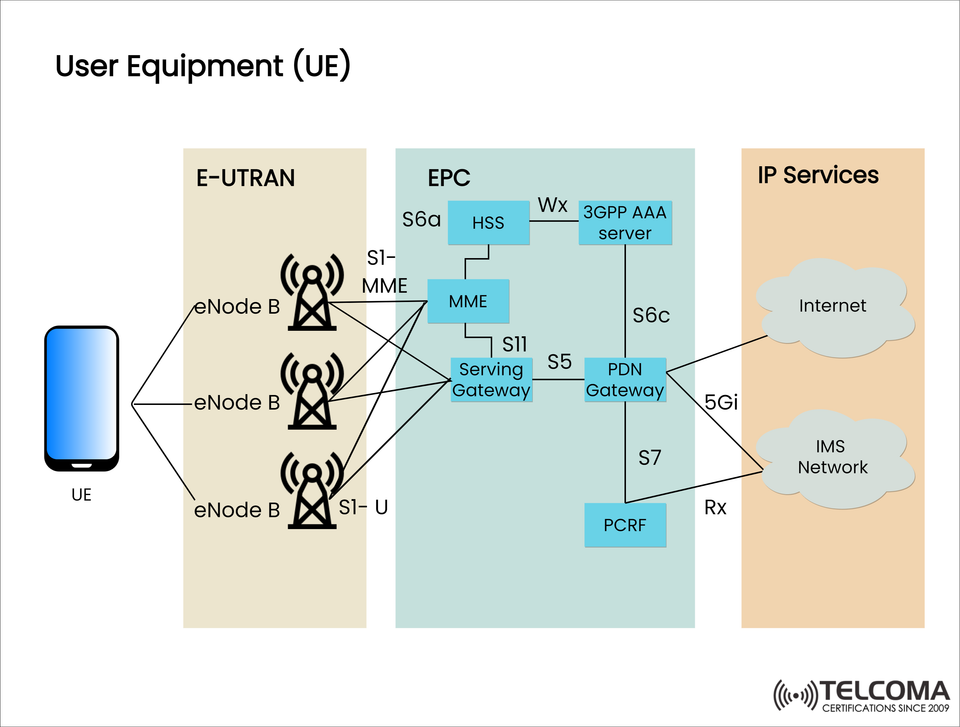
In LTE (Long Term Evolution) systems, the UE connects with various parts of the Evolved Packet Core (EPC) and Evolved UMTS Terrestrial Radio Access Network (E-UTRAN) to provide fast, dependable, and secure connections. The diagram above outlines how the UE interacts with the radio access network and EPC nodes, ultimately reaching external IP services like the Internet and IMS (IP Multimedia Subsystem).
This blog will walk you through the architecture, interfaces, and functions of UE in LTE networks, making it enjoyable to read for enthusiasts while being technically correct for telecom professionals.
What is User Equipment (UE)?
In the context of LTE, User Equipment (UE) describes the mobile device or terminal that connects users to the cellular network. Some examples include:
Smartphones
Tablets
IoT devices
Dongles or wireless modems
The UE isn’t just any device; it’s a key player in the network that manages things like authentication, mobility, session handling, and secure access to services.
The Role of UE in LTE Architecture
The UE acts as the entry point into the LTE system. It connects with the eNodeB (base station) through the air interface, creating a radio link. Once that’s in place, the data moves through the EPC towards various IP-based services.
Some key functions of UE include:
Establishing radio links with e Node B
Authenticating through the Home Subscriber Server (HSS)
Managing mobility during handovers
Requesting and maintaining bearer sessions for data transfer
Interfacing with external services like the Internet, IMS, and enterprise applications
E-UTRAN: The First Connection Point
The Evolved UMTS Terrestrial Radio Access Network (E-UTRAN) is made up of e Node Bs, which are the base stations. The UE connects to these stations via the air interface (U u interface).
S1-MME interface: Manages signaling between e Node B and the MME (Mobility Management Entity).
S1-U interface: Looks after user-plane data, moving actual IP packets towards the EPC.
The e Node B is in charge of important tasks such as:
Managing radio resources
Making handover decisions among neighboring cells
Balancing loads and scheduling
EPC: The Core of LTE
The Evolved Packet Core (EPC) serves as the foundation for data transport, mobility, and security. It includes several logical components that play critical roles:
MME (Mobility Management Entity) - Handles signaling between UE and EPC - Manages authentication with the HSS - Looks after mobility (handover, idle mode tracking)
Serving Gateway (SGW) - Acts as a local mobility anchor - Forwards user data packets between eNodeB and PGW - Connects with MME through the S11 interface
PDN Gateway (PGW or P-GW) - Gives UE access to external IP services (Internet, IMS, private networks) - Handles IP address allocation - Applies QoS and policy enforcement (in conjunction with PCRF)
HSS (Home Subscriber Server) - Central database for subscribers - Stores user profiles, authentication credentials, and subscription details - Communicates with MME through the S6a interface
PCRF (Policy and Charging Rules Function) - Sets rules for QoS and charging - Communicates with PGW via S7 interface - Interacts with IMS services through the Rx interface
3GPP AAA Server - Facilitates authentication, authorization, and accounting - Works with HSS and PGW
IP Services: Connecting to Internet and IMS
The main aim of LTE is to deliver IP-based services. The PGW acts as a bridge between the EPC and external networks:
Internet: Offers access to browsing, streaming, cloud services, and apps.
IMS Network: Supports VoLTE (Voice over LTE), video calling, messaging, and advanced multimedia services.
The connection here is through:
5Gi: Linking PGW to IP services (Internet, IMS).
Breaking Down LTE Interfaces
For those in the LTE field, grasping interfaces is essential. The diagram illustrates various standardized reference points:
Interface Connects Function U u UE ↔ e Node B Air interface for radio communicationS1-MMEeNodeB ↔ MME Control plane signalingS1-UeNodeB ↔ SGW User-plane data transportS11MME ↔ SGW Session managementS5SGW ↔ PGW User-plane and control signalingS6aMME ↔ HSS Authentication, subscriber dataS7PGW ↔ PCRF Policy and charging controlS6cPGW ↔ AAA Server Authorization and authentication Rx PCRF ↔ IMS Policy exchange for multimedia5GiPGW ↔ IP Services Connection to Internet/IMS
Data Flow from UE to the Internet: A Step-by-Step Look
UE connects with e Node B using the U u interface.
e Node B communicates with MME for signaling (authentication, bearer setup).
MME checks with HSS to verify user identity and subscription.
MME sets up a bearer through the Serving Gateway (SGW).
SGW sends data onto the PDN Gateway (PGW).
PGW allocates an IP address to UE and connects to Internet or IMS.
PCRF enforces policies for QoS and billing.
This whole process ensures that the user’s device enjoys a seamless, high-speed IP connection.
Why Understanding UE Architecture Matters
For telecom professionals, getting the hang of UE interactions is crucial for:
Network optimization: To guarantee smooth handovers and minimal latency.
Security: To safeguard user data through authentication and encryption.
Quality of Service (QoS): To ensure performance for VoLTE, streaming, and gaming.
Scalability: To accommodate billions of IoT devices in 4G/5G networks.
Final Thoughts
The User Equipment (UE) isn’t just a smartphone—it’s the main way users connect with the LTE network. Through a sophisticated mesh of interfaces, the UE links up with e Node Bs, EPC components (MME, SGW, PGW, HSS, PCRF, AAA server), and external IP services like the Internet and IMS.
For telecom pros, mastering these interactions is essential for designing, improving, and maintaining LTE networks. And for enthusiasts, it shows just how sophisticated a “simple” mobile connection can be.
As we head towards 5G and beyond, understanding the basics of UE in LTE stays at the heart of mobile communication knowledge.