
Understanding V2X Communication Architecture: Automotive DFM, Message Dispatcher, and Road Traffic Authority

Grasping V2X Communication Architecture: Automotive DFM, Message Dispatcher, and Road Traffic Authority
V2X communication, or Vehicle-to-Everything, is fundamental to the upcoming wave of smart transportation systems. It allows vehicles, road users, and infrastructure to share real-time info, making mobility safer, smarter, and more efficient.
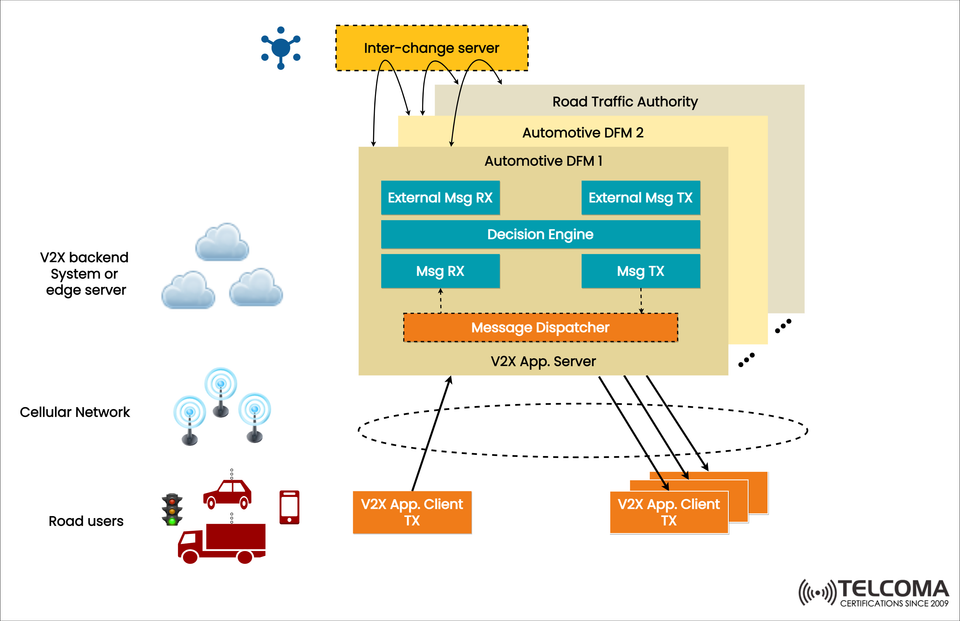
The diagram provided breaks down the end-to-end architecture of V2X communication, showcasing how road traffic authorities, automotive decision-making modules (DFMs), V2X application servers, and client transmitters work together to form a unified ecosystem.
In this piece, I’ll elaborate on each part of the architecture, clarify its function, and illustrate how the whole system boosts road safety and traffic oversight.
What’s V2X Communication?
V2X (Vehicle-to-Everything) is a communication framework that enables cars to link with:
V2V (Vehicle-to-Vehicle): Cars sharing live data on speed, location, and direction to prevent crashes.
V2I (Vehicle-to-Infrastructure): Communication with roadside infrastructure like traffic lights, toll booths, and traffic management systems.
V2P (Vehicle-to-Pedestrian): Notifications for pedestrians and those at risk on the road.
V2N (Vehicle-to-Network): Connectivity with backend servers and the cloud for data processing and updates.
This setup relies on cellular networks (C-V2X) or dedicated short-range communication (DSRC) for sending and receiving messages.
Key Components of the V2X Architecture
The diagram lays out the layered structure of V2X communication, involving road traffic authorities, automotive systems, servers, and clients.
- Road Traffic Authority
The road traffic authority forms the regulatory and control layer of the system. It ensures that communications between vehicles and infrastructure meet safety, legal, and operational requirements.
Gathers and tracks traffic data
Sends out alerts, like road closures or accidents
Connects with interchange servers for cross-regional data sharing
- Automotive DFMs (Decision Function Modules)
The Automotive DFM 1 and DFM 2 serve as the decision-making modules within the V2X framework.
Automotive DFM 1 is the main decision engine responsible for processing both internal and external messages.
External Msg RX/TX: Manages communication with external entities like other vehicles or roadside units.
Msg RX/TX: Oversees internal interactions within the automotive system.
Decision Engine: Analyzes the data and decides on necessary actions (like sending an alert, initiating braking support, or passing along data).
Automotive DFM 2 provides redundancy and assures consistent decision-making across various automotive layers.
- Message Dispatcher
The Message Dispatcher links the decision engine to the V2X Application Server.
Directs data packets to the appropriate V2X client applications
Guarantees reliability and low latency for crucial safety messages
Supports different message formats for compatibility among vehicles and infrastructure
- V2X Application Server
This server functions as the central processing unit for V2X communication.
Processes and interprets incoming messages from vehicles and infrastructure
Manages V2X applications (safety, navigation, infotainment)
Connects with backend or edge servers for high-performance data analysis
- V2X App Client TX (Transmitters)
These client transmitters are found in vehicles and roadside infrastructure.
Broadcast data like speed, braking status, and traffic light changes
Ensure real-time transmission of safety-critical messages
Numerous transmitters might be set up for scalability and redundancy
- Inter-change Server
This server manages cross-border or cross-region communication, ensuring that data flows smoothly between various traffic management systems.
Supporting Layers in V2X Communication
Beyond the main components, the architecture depends on various supporting systems:
Cellular Network: Acts as the connectivity backbone for C-V2X. Low latency and high reliability are essential for safety-critical scenarios.
V2X Backend System or Edge Server: Handles heavy computation, processes large data streams, and uses AI/ML for predictive analytics.
Road Users: Comprises vehicles, pedestrians, and smart devices, all of which share data with the system.
How Does It Work? A Step-by-Step Guide
Road users (cars, trucks, pedestrians with smartphones) generate data.
This data is sent through the cellular network to the V2X application server.
The Message Dispatcher organizes and forwards data to the Decision Engine within Automotive DFM.
The Decision Engine evaluates the data, makes safety or operational decisions, and routes responses through Msg TX or External Msg TX.
The Road Traffic Authority gathers insights, updates policies, and spreads alerts if needed.
Inter-change servers facilitate data sharing across different regions or systems.
Advantages of the Architecture
This layered setup offers several benefits:
Safety: Gives early warnings regarding collisions, traffic jams, or road dangers.
Efficiency: Optimizes traffic flow through connected signals and route management.
Scalability: The modular design allows for easy integration of new applications.
Low Latency: Real-time message delivery ensures that safety-critical communication is prompt.
Interoperability: Standardized message handling enables seamless communication among various manufacturers and road systems.
DFM vs Traditional Vehicle Systems: A Comparison
Feature Traditional Vehicle Systems Automotive DFM in V2XCommunicationIsolated, vehicle-only Connected to vehicles, infrastructure, and network Decision - Making Local, limited Distributed and network-assisted Safety Features Reactive (e.g., airbags)Proactive (collision avoidance, alerts)Updates Manual, infrequent Real-time via network/cloud Scalability Limited High, supports multiple apps and transmitters
Deployment Challenges
Even with its potential, the V2X architecture grapples with certain challenges:
Network Reliability: Cellular connectivity needs to ensure ultra-low latency.
Security: Safeguarding messages from spoofing or tampering is crucial.
Interoperability: Effective coordination between various automakers, infrastructure providers, and authorities is essential.
Cost: Implementing on a large scale requires considerable investment in roadside units, servers, and software.
In Conclusion
The V2X communication architecture depicted in the diagram embodies the future of connected and autonomous mobility. By integrating Automotive DFMs, message dispatchers, interchange servers, and road traffic authority systems, vehicles can interact with everything around them—improving safety, cutting down on congestion, and paving the way for smart cities.
For telecom experts and automotive engineers, grasping this architecture is vital to developing scalable, secure, and efficient V2X systems. As we move forward with 5G and edge computing, V2X is set to become the backbone of autonomous driving and intelligent transportation ecosystems.