
Understanding Wi-Fi Channel Availability in 2.4 GHz, 5 GHz, and 6 GHz Bands

📡 Wi-Fi Channel Availability Between 2.4 GHz, 5 GHz, and 6 GHz
As Wi-Fi technology continues to develop, understanding the channel availability across frequency bands is critical for telecommunications engineers, network designers, and Wi-Fi strategists. The release of the 6 GHz band (Wi-Fi 6E and Wi-Fi 7) alters the landscape of wireless communication, providing increased channel availability with minimal interference.
Here, we define the channel availability in each band and how you may leverage this in your networks' design, performance, and future growth.
📊 Channel Availability Comparison: An Overview
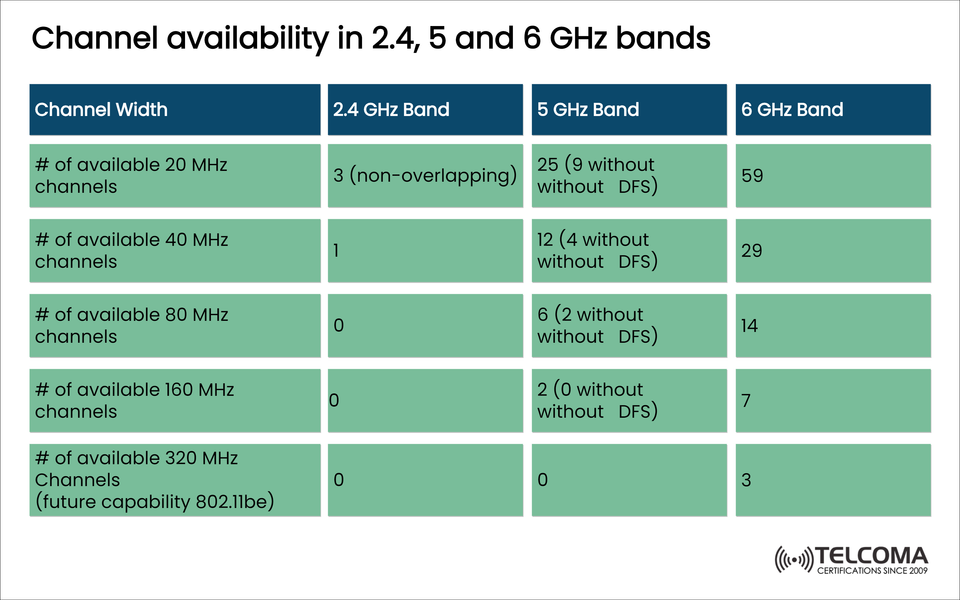
In this summary table, you'll find available channels by band and width, keeping in mind DFS (Dynamic Frequency Selection) limitations:
Channel Width 2.4 GHz Band 5 GHz Band 6 GHz Band
20 MHz Channels 3 (non-overlapping) 25 (9 without DFS) 59
40 MHz Channels 1 12 (4 without DFS) 29
80 MHz Channels 0 6 (2 without DFS) 14
160 MHz Channels 0 2 (0 without DFS) 7
320 MHz Channels (802.11be) 0 0 3
📶 2.4 GHz Band: Limited but Legacy-Friendly
The 2.4 GHz band is sluggishly the oldest and most congested Wi-Fi spectrum. While it has distance for range, it is limited to channel count, while it is designed to be high interference; hence it is less effective for a modern, time-critical application.
General Characteristics:
• Only 3 non-overlapping 20 MHz channels (1, 6, 11)
• One usable 40 MHz channel
• High interference from Bluetooth, microwaves, and other IoT devices
• No support for 80 MHz, 160 MHz or 320 MHz
📡 5 GHz Band Frequencies: Balance of Performance and Availability
The 5 GHz band frequencies have an industry balance of capacity and coverage. Moderate channel width and lesser interference provide for enterprise and densest residential best practice deployments.
Key Attributes:
Up to 25 channels - 20 MHz; 9 channels that are interference-free (non-DFS)
DFS channels may be subjected to temporary signal interference (with radar, or other signals) - especially if near airports or
weather stations
Up to 12 channels - 40 MHz; 6 channels - 80 MHz; and 2 channels - 160 MHz
Cautions:
DFS may cause temporary disconnect, or reallocation
Only 2 channels available for direct use of 160 MHz; limiting for high-throughput applications
Use case:
Best fit for Office Networks, Campus Deployments, and General Purpose Wi-Fi High-Speed Applications.
🚀 6 GHz Band Frequencies: The Next Generation of Wireless Speed
The 6 GHz band frequencies, introduced to the realm of Wi-Fi with Wi-Fi 6E (and it would be used to its full extent in Wi-Fi 7) allows for contiguous spectrum of massive availability.
This allows low latency, bandwidth-hungry applications a future proof option.
Key Attributes:
59 clean 20 MHz channels, no legacy interference
Up to 29 channels - 40 MHz; 14 channels - 80 MHz; and 7 channels - 160 MHz
3 channels - 320 MHz (to come with 802.11be / Wi-Fi 7)
DFS not required (in most regulatory domains)
Ease of use:
Excellent for VR/AR, 8K video streaming, remote surgery - ultra-low latency use cases
This cleaner spectrum means lower latency and less congestion
Multi-gigabyte wireless access is possible.
🧠 Intelligence for Network Architects
Understanding DFS
Access points are required to detect radar activity on DFS channels and to change channels if interference is detected.
Always prefer Non-DFS Channels in mission-critical environments because they guarantee uptime.
Channel Bonding
Bigger channels mean bigger throughput (80, 160, 320 MHz); but need clean and contiguous spectrum.
Use wider channels in less interference-prone 6 GHz areas.
🔍 Summary: Strategic Deployment Intelligence
Metric 2.4 GHz 5 GHz 6 GHz
Max Channel Width 40 MHz 160 MHz 320 MHz (future)
Interference Level High Moderate (DFS) Low
Device Compatibility High (legacy) Medium Low (new devices)
Throughput Potential Low Medium-High Very High
DFS Regulatory Limitations Nothing Present Minimal
✅ Conclusion: Choose Your Spectrum Wisely
You need to know how many channels you have at various widths and in each frequency band to design the ideal network. The 6 GHz band has the best future potential, while the 5 GHz band still has reliable functionality. The 2.4 GHz band still has its place, especially with lower data devices like IoT.
🔧 Practical Takeaways:
Use 6 GHz for next-gen performance (Wi-Fi 6E/7)
Use 5 GHz conservatively, for legacy, and in stable environments.
Use 2.4 GHz only, for IoT and legacy clients.
If interruption-free performance is critical, don't use a DFS channel.
🔄 Looking Forward: Preparing for Wi-Fi 7 and Beyond
As demand for ultra-high-speed wireless hops and connectivity grows, particularly with the advancement of Wi-Fi 7 (IEEE 802.11be), finding spectrum availability becomes increasingly important. The many additional channels available in the 6 GHz band can support 320 MHz each, giving users access to multi-gigabit speeds and ultra-low latency, both of which will be requisite for:
Augmented & Virtual Reality (AR/VR)
Cloud gaming and 8K video streaming
Real-time industrial automation
Next-generation remote work and online learning environments
🌐 Preparing for the Future
If you are developing infrastructure for future-proof networks:
Start upgrading educational institutions to support tri-band access points (2.4, 5, and 6 GHz)
Make the cleanest spectrum available in which to operate by exploiting 6 GHz channels first
Test with Wi-Fi 7 client devices
Keep track of the resulting DFS impacts in 5 GHz bands with network monitoring tools
🧰 Bonus: Tools and Resources for Wi-Fi Planning
In case you need to use tools to make it easier to deploy wireless:
Tool/Resource Purpose
Wi-Fi Analyzer Apps View the channels you are using in real time and interference
Heat Mapping Tools Show the strength of the signal for each band across physical spaces
✅ Final Thoughts
The move to 6 GHz and wider channels is more than a simply a technical update, it's a strategic enabler for high-density, high-performance wireless networks. Knowing how each band performs, the number of channels available, and the trade-offs makes it possible for you to:
Maximize performance
Minimize interference
Future-proof your network .
Wireless engineer, IT manager, hobbyist or enthusiast, as long as you are aware of these fundamentals, they will ensure you are designing with the constraints of today and the capabilities of tomorrow in mind.