
Unlicensed Spectrum for V2X Sidelink Positioning: Enhancing 5G Automotive Communication

Unlicensed Spectrum for V2X Sidelink Positioning in 5G
The rise of 5G V2X (Vehicle-to-Everything) communication has really changed the game for connected-car technology. Now, vehicles can chat with each other as well as infrastructure. To get precise positioning and super reliable communication, 5G brings in sidelink communication, which creates a direct connection between cars, roadside units, and other network entities.
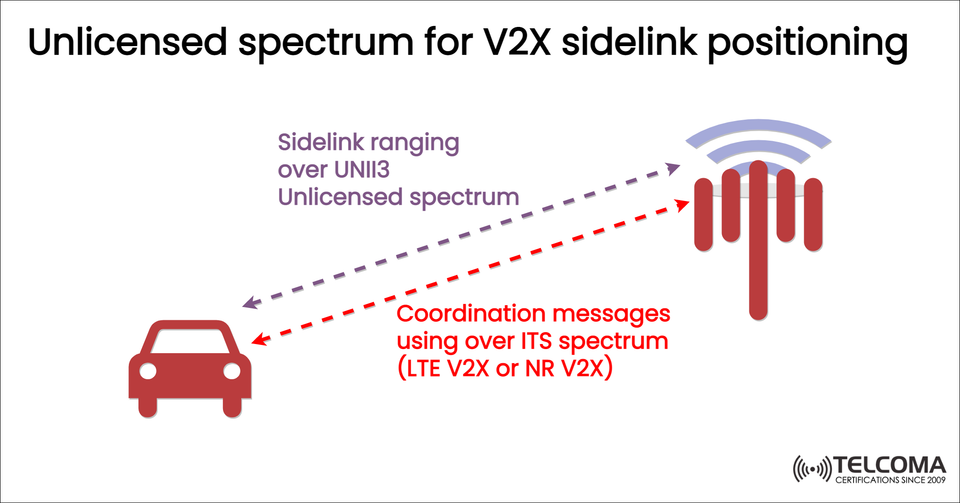
The image above shows how unlicensed spectrum can be used to boost V2X sidelink positioning, highlighting two key communication paths:
Sidelink ranging over the UNII-3 unlicensed spectrum,
Coordination messages sent over ITS-licensed spectrum using LTE V2X or NR V2X technologies.
Using this mixed approach enhances accuracy, resilience, and spectrum efficiency in vehicular networks while lessening the reliance on licensed spectrum.
Understanding V2X and Sidelink Communication
What is V2X?
V2X (Vehicle-to-Everything) is a crucial part of smart transportation, connecting vehicles to:
V2V (Vehicle-to-Vehicle): Direct communication between vehicles to avoid accidents.
V2I (Vehicle-to-Infrastructure): Interactions with roadside units, traffic signals, or toll systems.
V2P (Vehicle-to-Pedestrian): Warnings for pedestrians and cyclists.
V2N (Vehicle-to-Network): Cloud-based data and traffic management.
The Role of Sidelink (PC5 Interface)
The sidelink interface allows devices, including vehicles, to communicate directly, skipping the base station. In V2X, sidelink is utilized for:
Quick message exchanges,
Accurate positioning and ranging,
High reliability when out of coverage.
5G NR V2X (3GPP Release 16 and 17) boosts sidelink capabilities, making it suitable for autonomous driving, sensor sharing, and advanced positioning.
Licensed vs. Unlicensed Spectrum in V2X
Historically, V2X communication has relied on licensed ITS spectrum, typically around 5.9 GHz, for essential safety messages. But with the surge of connected vehicles and smart mobility solutions, we’ve hit a spectrum shortage.
To tackle this issue, 5G leverages unlicensed spectrum—specifically, the UNII-3 band (5.725–5.850 GHz)—to take care of certain functions like ranging and positioning while keeping coordination over licensed bands.
Spectrum Type Typical Frequency Use Case Ownership Example Licensed ITS Spectrum~5.9 GHz Safety-critical messages Dedicated LTE V2X / NR V2XUnlicensed UNII-3 Band5.725–5.850 GHz Sidelink ranging / positioning Shared Wi-Fi, NR-U, 5G sidelink
This dual-spectrum approach gives us the best of both worlds—keeping reliability with licensed bands while taking advantage of unlicensed channels for scalable, cost-effective operations.
How V2X Sidelink Positioning Works
In 5G V2X systems, sidelink positioning enables vehicles to figure out their relative positions through ranging signals exchanged directly between UEs (vehicles or roadside units).
Process Overview
Coordination Phase (Licensed ITS Spectrum):
Vehicles share control or coordination messages over the ITS spectrum using LTE V2X or NR V2X.
This phase takes care of scheduling, synchronization, and channel allocation to minimize interference.
Ranging Phase (Unlicensed Spectrum):
After coordination is sorted out, cars use the UNII-3 unlicensed spectrum for sidelink ranging.
Time-of-Flight (ToF) or Round-Trip-Time (RTT) measurements help estimate distances.
These ranging exchanges occur directly between devices, ensuring low latency and easing the load on licensed spectrum.
Position Calculation:
The system calculates distances and triangulates the vehicle's position.
If multiple nodes are involved, the overall positioning accuracy gets a significant boost.
This separation of spectrum ensures everything runs smoothly without sacrificing performance for safety-critical messages.
Advantages of Using Unlicensed Spectrum for Sidelink Ranging
- Spectrum Efficiency
Shifting high-volume ranging signals to unlicensed bands allows the ITS-licensed spectrum to stay available for safety-critical communications like collision warnings or emergency braking alerts.
- Cost-Effectiveness
Tapping into unlicensed spectrum cuts down the reliance on licensed bandwidths, helping to lower operational costs, which is especially useful in busy urban settings.
- Enhanced Positioning Accuracy
The unlicensed UNII-3 bands offer plenty of bandwidth for high-precision time-based ranging, enabling centimeter-level accuracy that’s crucial for autonomous driving.
- Improved Scalability
Multiple vehicles can carry out parallel ranging operations without overloading the licensed channels, making it easier to scale in high-traffic situations.
- Resilience and Redundancy
If there’s interference or congestion on the ITS band, vehicles can still share positioning information via the unlicensed path, boosting the system's resilience.
Technical Parameters of V2X Sidelink Positioning
Parameter Description Frequency BandsUNII-3 (5.725–5.850 GHz) for ranging; ITS (5.9 GHz) for coordination Communication LinksPC5 (sidelink) interface Ranging Techniques ToF, RTT, and phase-based measurements Latency Requirement< 10 ms for V2V coordination Positioning Accuracy≤ 30 cm in dense urban scenarios Standard Reference3GPP Release 17 and 18 (5G V2X Enhancements)
LTE V2X vs. NR V2X: Complementary Technologies
Feature LTE V2XNR V2XStandard3GPP Rel-14 / 153GPP Rel-16 / 17 / 18Use Case Basic safety messaging Advanced autonomous driving Spectrum Use Licensed ITS bands Licensed + Unlicensed Positioning Support Limited Enhanced RTT & Angle-of-Arrival (AoA)Latency~20 ms< 10 ms (URLLC)Accuracy Meter-level Sub-meter / centimeter-level
NR V2X brings sidelink-based positioning with high-bandwidth ranging and cross-layer synchronization, laying the groundwork for future autonomous mobility systems.
Challenges and Considerations
Even with the benefits, using unlicensed spectrum for sidelink positioning does come with its challenges:
- Interference Management
Unlicensed bands get shared with Wi-Fi and other gadgets. We need effective listen-before-talk (LBT) methods and dynamic frequency selection (DFS) to manage interference.
- Regulatory Compliance
Different regions have various rules for using unlicensed spectrum. V2X setups must follow regional spectrum regulations (like the FCC or ETSI).
- Synchronization Accuracy
For precise ranging, tight time coordination among vehicles is a must. Advanced GNSS-aided synchronization or network-assisted timing can enhance results.
- Security and Privacy
Direct sidelink communication requires solid authentication and encryption to keep out spoofing or malicious meddling with positioning data.
- Coexistence with Other Technologies
It’s important to manage integration with Wi-Fi 6E and future 6 GHz unlicensed systems to make sure everything works well together without performance issues.
Future Outlook: 5G Advanced and 6G V2X
3GPP Release 18 and beyond are set to refine V2X sidelink capabilities:
5G Advanced will up the game with multi-band ranging, angle-based positioning, and hybrid sensor fusion.
AI-driven resource allocation will dynamically choose the best combo of licensed and unlicensed spectrum.
6G V2X is targeting centimeter-to-millimeter positioning accuracy, enabling cooperative perception and vehicle swarm intelligence.
Unlicensed spectrum will continue to be key for developing scalable, cost-effective, and energy-efficient vehicular communication systems.
Conclusion: Enabling Intelligent Mobility Through Spectrum Innovation
Using unlicensed spectrum for V2X sidelink positioning is a big step forward in 5G automotive communication. By marrying UNII-3 ranging with ITS-licensed coordination, vehicles can achieve precise, reliable, and efficient positioning—even in heavy traffic or tough environments.
This blended model:
Maximizes spectrum use
Boosts positioning accuracy
Cuts deployment costs
Enhances system resilience for autonomous driving
As we move from 5G to 6G, the combination of licensed and unlicensed spectrum will drive us into a new era of smart, connected, and self-aware transport systems—making our roads safer, smarter, and way more efficient.