
UPF Isolation in 5G: Coordinated Simulation of gNB and SMF over N3/N4 with LoadCore

Why UPF Testing Matters in 5G
The User Plane Function (UPF) is crucial for the 5G Core (5GC) user plane, acting as a bridge from access networks to external data networks. It ensures that user data travels smoothly from devices to apps. With various 5G use cases like eMBB (Enhanced Mobile Broadband) and URLLC (Ultra-Reliable Low-Latency Communication), the UPF faces the challenge of managing huge traffic loads, super low latency, and strict QoS requirements.
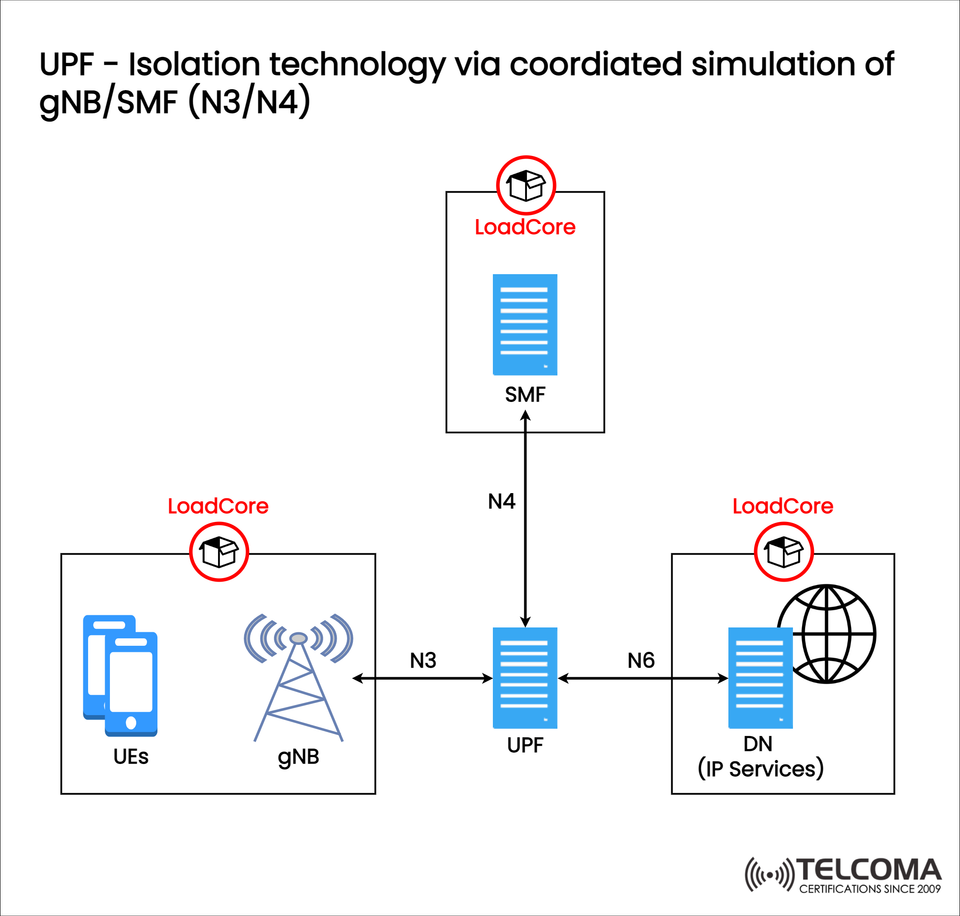
To ensure everything runs smoothly, UPF isolation testing is really important. The diagram we’ve uploaded shows how UPF can be tested through coordinated simulation of gNB and SMF across N3 and N4 interfaces, using LoadCore to mimic real-world conditions. This method validates the UPF independently, making sure it’s solid before full-scale rollout.
What is UPF Isolation in 5G?
UPF isolation is about testing the UPF in a controlled environment without depending on the complete 5G Core. Instead of linking up with live AMF, SMF, or gNBs, these components are simulated using tools like LoadCore.
The goals here are to:
Validate how well UPF can manage user plane data traffic.
Test for QoS enforcement and packet routing.
Measure performance in different load and mobility scenarios.
By isolating UPF, operators and vendors can spot performance issues early on.
Components in UPF Isolation Testing
a) User Equipment (UE) & gNodeB (gNB)
Generates user-plane traffic directed at the UPF.
Uses the N3 interface for data forwarding.
b) Session Management Function (SMF)
Handles session creation, changes, and terminations.
Employs the N4 interface to set up UPF data paths.
c) User Plane Function (UPF)
The main element under testing.
Deals with packet routing, forwarding, QoS, and policy enforcement.
Connects to DN using the N6 interface.
d) Data Network (DN)
Represents external IP services like the internet, cloud, and enterprise solutions.
Confirms correct packet delivery and routing.
e) LoadCore
Simulates UEs, gNB, SMF, and DN traffic.
Enables end-to-end testing with realistic traffic patterns.
Key Interfaces in UPF Isolation
In the diagram, we see three main interfaces:
Interface Connection Role in UPF TestingN3gNB ↔ UPF Forwards user-plane traffic from UEs.N4SMF ↔ UPF Configures UPF sessions, QoS, and routing.N6UPF ↔ DN Provides external data connectivity.
By focusing on N3 and N4, testers confirm that UPF can accurately forward, prioritize, and manage data flows.
Why UPF Isolation Testing is Critical
a) End-to-End Performance Validation
Ensures traffic flows through UPF without loss or delays.
Verifies throughput for bandwidth-heavy applications like video streaming.
b) Latency Optimization
Essential for URLLC and edge computing apps.
Confirms packet forwarding in under a millisecond.
c) QoS and Policy Enforcement
Makes sure PCF policies from SMF are applied correctly.
Validates that eMBB, mMTC, and URLLC slices are treated differently based on their needs.
d) Scalability and Load Testing
Simulates thousands to millions of simultaneous UE sessions.
Checks UPF’s ability to scale under high stress.
e) Fault Isolation
Helps pinpoint issues in UPF without interference from other network functions.
Benefits of Using LoadCore in UPF Testing
The diagram illustrates LoadCore working alongside UEs, SMF, and DN to simulate realistic traffic. Here’s what it brings to the table:
Coordinated Simulation: Simulates both gNB and SMF for comprehensive testing.
Massive Scalability: Emulates millions of UEs creating realistic traffic patterns.
QoS Validation: Tests packet forwarding based on priority.
Protocol Compliance: Ensures UPF meets 3GPP standards.
Resilience Testing: Simulates N3/N4 failures to confirm recovery processes.
Multi-Slice Testing: Validates multiple slices at once like eMBB, URLLC, and mMTC.
Practical Use Cases of UPF Isolation
a) Network Slicing Validation
Tests how UPF manages different network slices with varying QoS.
b) Edge Deployment Testing
Validates UPF located at the edge for services needing ultra-low latency.
c) Enterprise 5G Private Networks
Simulates UPF traffic in secure, localized settings.
d) IoT Scalability
Tests UPF performance with massive IoT traffic surges.
e) Security Testing
Simulates malicious traffic flows to assess resilience.
Challenges in UPF Isolation
Complex Traffic Patterns: Accurately simulating real-world usage can be tricky.
High Costs: Advanced platforms for simulation can require significant investment.
Vendor Interoperability: Making sure UPF operates seamlessly with various vendor SMFs and gNBs.
Edge Integration: Testing distributed UPFs complicates matters.
Future of UPF Testing in 6G Evolution
As we look ahead to 6G, UPF testing will adapt to include:
AI-Driven Traffic Modeling: Automating simulations and analyses for traffic.
Advanced Security Testing: Safeguarding against potential quantum attacks.
Digital Twins: Creating network replicas for virtual UPF testing.
Edge-Native UPF Validation: Validating UPFs that are closely linked with MEC (Multi-Access Edge Computing).
Conclusion
The diagram on UPF Isolation Technology through Coordinated Simulation of gNB/SMF (N3/N4) shows just how vital it is to independently test UPF. By simulating both gNB traffic (N3) and SMF control (N4) with LoadCore, operators can confirm UPF’s efficiency, scalability, and reliability before going live.
This approach ensures UPF meets the 5G performance goals—high throughput, low latency, and reliable QoS enforcement. For those in telecom, UPF isolation testing isn’t just about validation; it’s about creating a resilient and future-ready 5G landscape.
As we enter the 6G era, UPF testing will continue to be a cornerstone in ensuring data flows are efficient, secure, and capable of supporting next-generation applications.