
Uplink Channel Mapping in LTE: Logical, Transport, and Physical Channels

Why LTE Uplink Matters
In the LTE framework, the uplink refers to the communication channel from the User Equipment (UE) back to the eNodeB (the base station). While the downlink often handles more substantial traffic, like video streaming, we can't overlook the uplink. It's crucial for a bunch of things, such as:
Sending user data (think video calls or uploading files).
Sharing control signals to keep the connection alive.
Making sure devices get initial access when they first connect.
To juggle all these tasks effectively, LTE employs a hierarchical channel structure, which includes Logical Channels, Transport Channels, and Physical Channels.
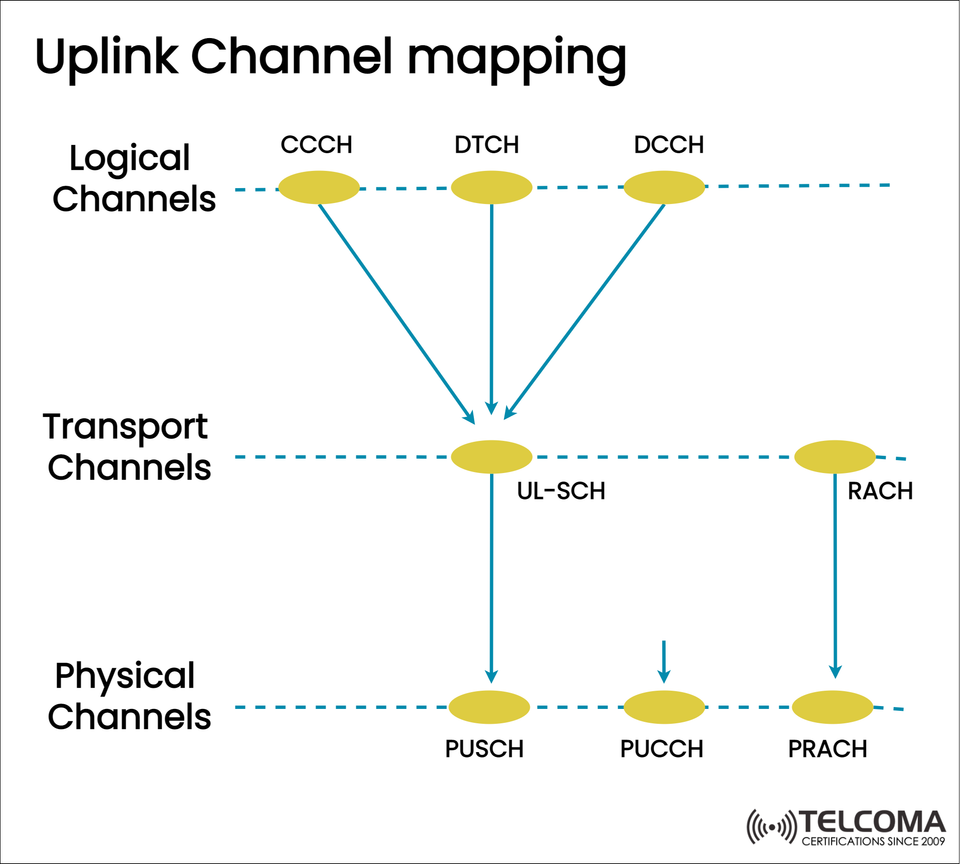
The diagram uploaded gives a visual of how these uplink channels fit together in these layers, so let’s dive into it.
The Three Layers of Uplink Channels
Just like downlink and sidelink channels, LTE's uplink is built on a three-tier structure:
Logical Channels – Specify what type of data is sent.
Transport Channels – Determine how the data is transmitted.
Physical Channels – Indicate where on the radio interface this transmission takes place.
This layered setup allows for better flexibility and efficient management of different types of traffic.
Uplink Logical Channels
Logical channels are all about defining the information type that travels from the UE to the eNodeB. They operate at the highest level in the channel hierarchy.
Key Uplink Logical Channels
CCCH (Common Control Channel): * Used when the UE isn't connected yet. * Carries signally messages, like connection requests.
DTCH (Dedicated Traffic Channel): * Handles user data, such as voice, video, or file uploads. * Dedicated to a specific UE for one-on-one data transfers.
DCCH (Dedicated Control Channel): * Manages control signals between the UE and the eNodeB. * Examples include RRC (Radio Resource Control) messages and mobility commands.
These logical channels get mapped onto transport channels for sending the data.
Uplink Transport Channels
Transport channels decide how the data from logical channels is prepared for sending.
Types of Uplink Transport Channels
UL-SCH (Uplink Shared Channel): * The main channel for uplink data. * Carries both user data (DTCH) and control info (DCCH, CCCH). * Operates through dynamic resource allocation.
RACH (Random Access Channel): * A unique channel used for initial access. * Lets a UE request uplink resources when it first connects. * Specially important for mobility and reconnecting.
These transport channels are then aligned with physical channels.
Uplink Physical Channels
Physical channels are responsible for the actual radio transmission over the LTE air interface.
Key Uplink Physical Channels
PUSCH (Physical Uplink Shared Channel): * Implements the UL-SCH. * For sending user data (DTCH) and signaling (DCCH, CCCH). * Supports adaptive modulation and coding.
PUCCH (Physical Uplink Control Channel): * Carries various uplink control information, including: * HARQ ACK/NACK (feedback for downlink packets). * Scheduling requests. * Channel quality indicators (CQI). * Makes coordination between the UE and eNodeB more efficient.
PRACH (Physical Random Access Channel): * Implements the RACH transport channel. * Used when a UE is first accessing the network or during handovers. * Sends preamble sequences for synchronization.
Uplink Channel Mapping: Bringing It All Together
The diagram illustrates how everything maps out:
Logical Channels → Transport Channels → Physical Channels * CCCH, DTCH, DCCH → UL-SCH → PUSCH * CCCH, DCCH → UL-SCH → PUCCH (for control information) * Initial Access → RACH → PRACH
This structured mapping makes sure that different types of data are effectively managed across the LTE uplink.
Example Scenarios of Uplink Transmission
To grasp uplink channel mapping better, let’s check out some practical examples:
- Initial Network Access
The UE turns on.
The UE sends a RACH request through PRACH.
After granting resources, signaling continues on CCCH → UL-SCH → PUSCH.
- Uploading a File
The UE sends user data (DTCH).
Data flows through UL-SCH → PUSCH.
- Mobility Control
The network sends a mobility command, and the UE responds via DCCH → UL-SCH → PUSCH.
- Feedback to Network
The UE sends ACK/NACK for downlink packets.
This is sent on PUCCH, ensuring proper coordination.
Comparison of Uplink Channels
Layer Channel Purpose Logical CCCH Common control (initial access)DTCH User data (voice, video, apps)DCCH Dedicated control signaling Transport UL-SCH Main uplink transport for data/control RACH Random access (initial connection)Physical PUSCH Implements UL-SCH (data + control)PUCCH Uplink control information PRACH Implements RACH (access requests)
Why Uplink Channel Mapping Matters
Grasping the uplink channel mapping is vital because it:
Boosts Efficiency: Effectively separates user and control traffic.
Ensures Flexibility: Supports various UE states (idle, connected, or initial access).
Enhances Reliability: Guarantees critical signaling, like RACH, always functions.
Improves Performance: Adaptive mapping helps with throughput and latency.
For professionals in telecommunications, mastering these channels is key for network planning, troubleshooting, and optimization.
Challenges in Uplink Communication
Even though LTE uplink is sturdy, it does encounter some challenges, such as:
Resource Allocation Conflicts: Many UEs vying for limited uplink bandwidth.
Interference: Particularly during RACH procedures in crowded areas.
Latency Sensitivity: Real-time apps, like video calls, demand prompt feedback.
Energy Efficiency: UEs need to transmit effectively without draining the battery.
5G aims to tackle some of these challenges with NR uplink enhancements, such as flexible numerologies and grant-free access.
Uplink Evolution in 5G
5G NR builds on the LTE uplink design but introduces:
Grant-Free Uplink (configured grants): Reduces latency by bypassing scheduling.
Massive IoT Support: Optimized uplink for billions of devices.
Enhanced Control Channels: Better reliability for URLLC applications.
Advanced Resource Allocation: Dynamic sharing across slices and services.
So, LTE uplink mapping lays the groundwork for 5G advancements.
Conclusion
The LTE uplink channel mapping framework is a structured, layered system that ensures efficient, reliable, and flexible communication between devices and the network.
Logical Channels (CCCH, DTCH, DCCH): Define what type of information is carried.
Transport Channels (UL-SCH, RACH): Define how it's sent.
Physical Channels (PUSCH, PUCCH, PRACH): Define where it's transmitted.
This design supports everything from initial access and mobility to user data and feedback, forming the backbone of modern LTE networks.
As we step into 5G and beyond, the concepts around uplink remain crucial, evolving to meet the demands of ultra-reliable, low-latency, and massive IoT communication.