
Uplink Layer 2 Structure with Carrier Aggregation Explained: SDAP, PDCP, RLC, and MAC

The Importance of Carrier Aggregation in Uplink
Today’s mobile networks have a strong need for high throughput and low latency to handle demanding applications like HD video calls, gaming, and cloud services. To address these requirements, LTE-Advanced and 5G brought in Carrier Aggregation (CA), which lets us stack multiple frequency carriers together for greater bandwidth.
Most of the time, we hear a lot about downlink CA, but we can’t forget about uplink aggregation—it’s just as vital. It helps ensure that user equipment (UE) can send more data efficiently, which is crucial in situations such as:
Uploading hefty files to the cloud.
Streaming video in real-time.
IoT devices transmitting huge amounts of sensor data.
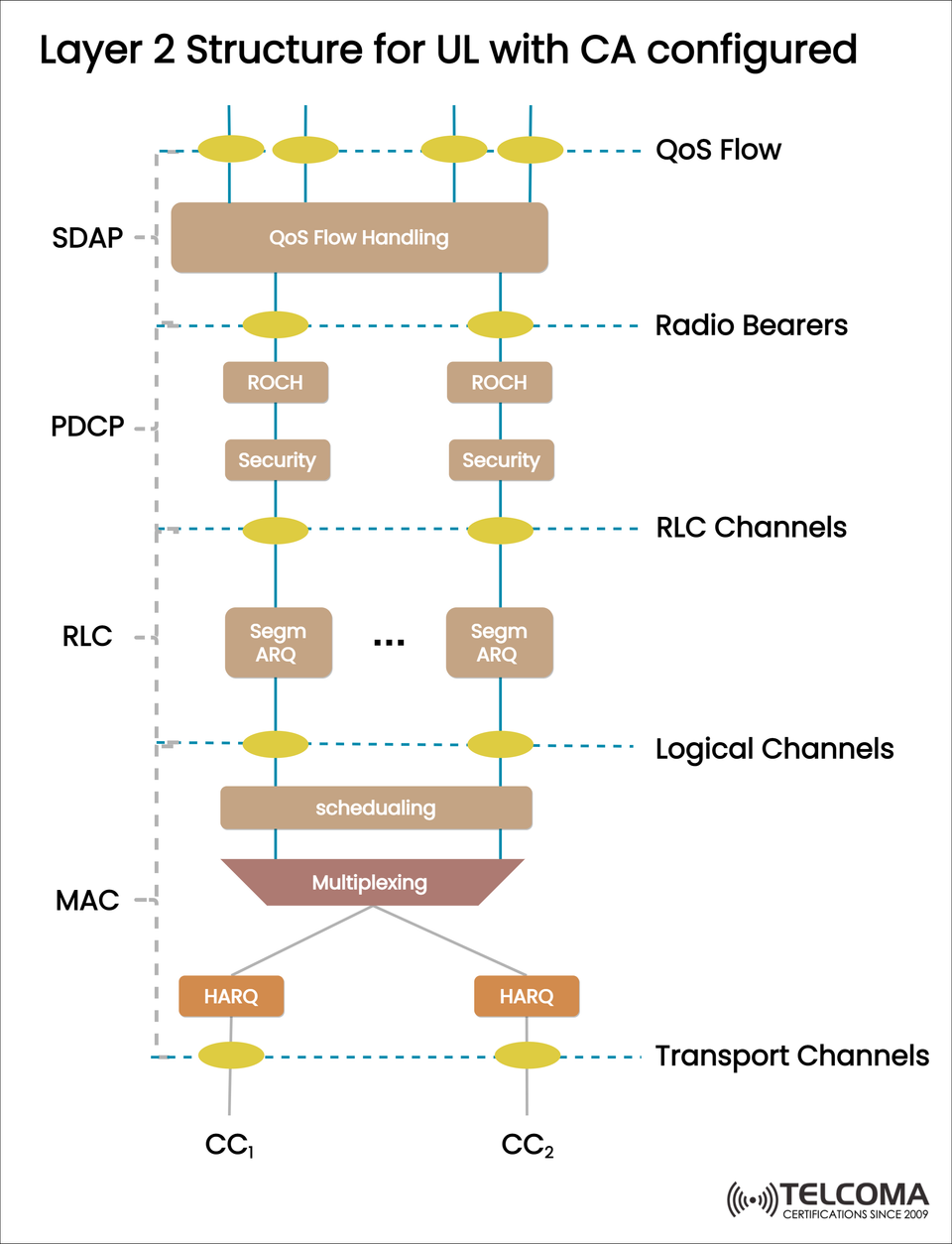
When the Layer 2 (L2) uplink protocol structure with CA is set up, it allows multiple carriers to work together seamlessly while keeping QoS, reliability, and security intact.
Overview of Uplink Layer 2 (L2) in LTE/5G
The uplink L2 protocol stack is positioned between the IP layer (above) and the physical transmission layer (below). Its job is to ensure that user data:
Keeps up with quality of service (QoS) standards.
Stays securely encrypted and protected for integrity.
Is broken down and reassembled as needed.
Is scheduled and multiplexed across the available carriers.
The stack consists of:
SDAP (Service Data Adaptation Protocol)
PDCP (Packet Data Convergence Protocol)
RLC (Radio Link Control)
MAC (Medium Access Control)
With CA configured, MAC takes data and maps it onto multiple transport channels (UL-SCH) over component carriers (CC1, CC2, …).
Step-by-Step Breakdown of the Uplink L2 Structure
- SDAP (Service Data Adaptation Protocol)
New in 5G NR (and LTE-Advanced Pro): Created to manage QoS flows.
Functions:
Links QoS flows to radio bearers.
Differentiates traffic (think video calls vs. background app updates).
Offers flow-based QoS management, which is vital for 5G services like URLLC (Ultra-Reliable Low Latency Communication).
In Uplink with CA:
SDAP organizes data into QoS flows before sending them to PDCP.
Each QoS flow can connect to one or more carriers based on resource distribution.
- PDCP (Packet Data Convergence Protocol)
Functions:
ROHC (Robust Header Compression): Reduces header sizes for IP/UDP/TCP to minimize overhead.
Security: Handles encryption and integrity protection.
Reordering: Keeps packets in the proper sequence.
In Uplink with CA:
PDCP compresses and secures data before RLC segments it.
It ensures continuity and integrity across multiple carriers for a smooth flow.
- RLC (Radio Link Control)
Functions:
Breaks down and reassembles PDCP packets.
ARQ (Automatic Repeat reQuest): Provides error correction by retransmitting when needed.
Supports three modes: Transparent (TM), Unacknowledged (UM), and Acknowledged (AM).
In Uplink with CA:
RLC takes care of PDCP packets and splits them into appropriately sized segments.
Each RLC channel lines up with logical channels that MAC later multiplexes across carriers.
- MAC (Medium Access Control)
Functions:
Scheduling (decides which UE gets resources and which logical channels are used).
Combines multiple logical channels into transport blocks.
HARQ (Hybrid ARQ): Fast retransmission paired with error correction.
Maps logical channels to transport channels.
In Uplink with CA:
The MAC scheduler takes charge of resource allocation across CC1, CC2
Multiplexing fuses traffic from various bearers and QoS flows.
HARQ makes sure deliveries are reliable across the carriers.
Logical, RLC, and Transport Channels
The L2 protocol stack depends on different channels:
QoS Flows → Radio Bearers: Handled by SDAP and PDCP.
Radio Bearers → RLC Channels: Ensure proper segmentation and error correction.
RLC Channels → Logical Channels: Map services like control signaling (CCCH, DCCH) and user data (DTCH).
Logical Channels → Transport Channels: Assigned at MAC to UL-SCH (Uplink Shared Channel).
Transport Channels → Physical Layer (PUSCH): Final data transmission to eNodeB over CC1, CC2, etc.
Example of Uplink with CA
Picture a UE uploading a 4K video stream while also sending data from a messaging app:
SDAP: Segregates the traffic into two QoS flows – one for the high-priority video stream and another for the low-priority chat messages.
PDCP: Compresses headers and secures both flows.
RLC: Segments video data into AM mode for reliability, while messages might use UM mode for less overhead.
MAC:
The scheduler allocates more bandwidth for the video flow.
It multiplexes both flows into transport blocks.
Transport blocks get divided across CC1 and CC2 using carrier aggregation.
HARQ jumps in to ensure retransmission for lost packets.
Transport Channels: Data travels via UL-SCH mapped to PUSCH over two carriers.
Result: You get high-quality, low-latency video streaming while background messages are delivered reliably.
Key Functions by Layer (Summary Table)
Layer Role in Uplink with CA Key Features SDAP Links QoS flows to radio bearers QoS Flow Management PDCP Compresses headers and ensures security ROHC, Encryption RLC Handles segmentation and retrans mission ARQ, AM/UM/TMMAC Manages scheduling, multiplexing, and error recovery HARQ, Carrier Aggregation Transport Moves multiplexed data UL-SCH over CC1, CC2Physical (PHY)Sends over the air PUSCH on various carriers
Benefits of Uplink L2 with CA
Higher Uplink Throughput: Combines bandwidth from multiple carriers.
Efficient QoS Management: SDAP makes sure flows get their deserved priority.
Reliability: The mix of ARQ and HARQ ensures strong data delivery.
Security: Encryption through PDCP keeps communication safe.
Flexibility: It can manage both high-speed broadband and IoT traffic.
Challenges in Uplink Carrier Aggregation
UE Complexity: Requires advanced RF and baseband designs.
Power Consumption: Managing multiple carriers can drain battery life.
Scheduling Overhead: The MAC has a more complicated job scheduling across carriers.
Interference Management: Having more carriers increases the chance of inter-cell interference.
Evolution Toward 5G NR
While LTE rolled out CA, 5G NR takes it further by:
Increasing Component Carriers: Up to 16 carriers compared to 5 in LTE-A.
Dynamic Spectrum Sharing (DSS): Lets LTE and 5G operate simultaneously.
Flexible Numerologies: Better support for low-latency needs.
Grant-Free Uplink Transmission: Cuts down on latency by skipping scheduling requests.
So, uplink L2 with CA in LTE paves the way for advanced uplink structures in 5G.
Conclusion
The Layer 2 structure for uplink with carrier aggregation is a significant advancement in LTE-Advanced and 5G networks.
SDAP takes care of QoS flow management.
PDCP compresses headers and secures data.
RLC segments packets and oversees retransmissions.
MAC is responsible for scheduling, multiplexing, and mapping data to various carriers.
Transport channels (UL-SCH) spread data across component carriers (CC1, CC2) to achieve better efficiency.
With CA, uplink L2 gains higher throughput, enhanced QoS differentiation, and reliable delivery, making it essential for modern mobile broadband and 5G applications.
For those in telecom, getting a grip on this structure is key for network design, troubleshooting, and optimization in both LTE and 5G NR.