
Uplink User Plane Architecture of Layer 2 in 5G NR Explained
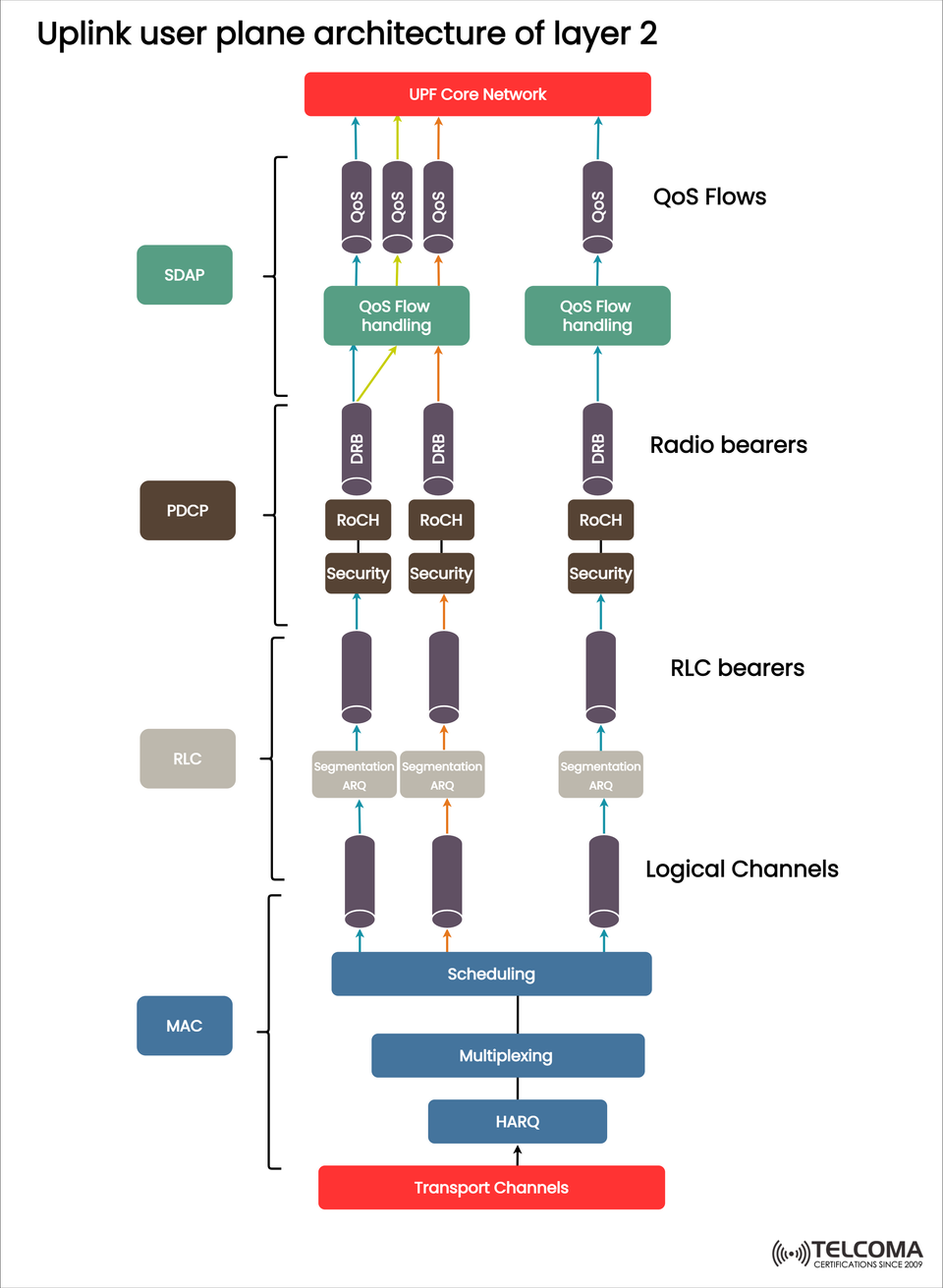

Uplink User Plane Architecture of Layer 2 in 5G NR
The architecture of 5G New Radio (NR) is crafted to provide communication that is not just reliable but also boasts low latency and high throughput. A vital element of this setup is the uplink user plane architecture of Layer 2, which dictates how data travels from user equipment (UE) to the core network of 5G.
In this blog, we’ll break down the uplink user plane protocol stack into its key parts—SDAP, PDCP, RLC, and MAC—using the diagram above as a guide. We’ll take a look at how data packets navigate through different bearers, channels, and layers while keeping Quality of Service (QoS) in check to ensure a reliable and efficient transmission.
Layer 2 in the 5G Protocol Stack
Before we get into the details, it’s helpful to know that Layer 2 (L2) sits in between Layer 1 (the Physical Layer) and Layer 3 (Radio Resource Control).
In 5G NR, L2 is split into several sublayers:
SDAP (Service Data Adaptation Protocol)
PDCP (Packet Data Convergence Protocol)
RLC (Radio Link Control)
MAC (Medium Access Control)
Each of these sublayers has its own specific roles, working together to make sure user data reaches the User Plane Function (UPF) in the core network quickly, securely, and with the right QoS mapping.
QoS Flows – The Foundation of Data Prioritization
For uplink, data comes from various QoS flows that cater to particular services like video streaming, voice calls, or IoT telemetry.
Each QoS flow has its own set of needs, whether it’s about latency, throughput, or reliability.
These flows get mapped to Data Radio Bearers (DRBs) for sending over the air.
The QoS Flow Handling function, managed by SDAP, makes sure QoS flows are accurately mapped to the right radio bearers.
This mapping is essential because it ensures that critical services, like emergency calls, take precedence over less critical tasks, like background app updates.
Role of SDAP (Service Data Adaptation Protocol)
The SDAP layer takes charge of:
QoS Flow Handling – Guarantees that data packets stick to the correct QoS flow.
Mapping QoS flows to DRBs (Data Radio Bearers).
In short, SDAP ensures that the data stream meets the necessary QoS requirements before sending it down to PDCP.
PDCP (Packet Data Convergence Protocol) – Security and Compression
The PDCP layer offers:
Header Compression – Cuts down overhead to save on bandwidth.
Security – Encrypts data to keep it safe and maintains data integrity.
Duplication Handling – Particularly useful for scenarios like dual connectivity.
In the diagram, PDCP handles the data before it reaches RLC. Each DRB goes through security functions and RoCH (Robust Header Compression).
This setup ensures confidentiality and efficiency for uplink communications.
RLC (Radio Link Control) – Segmentation and Reliability
The RLC layer plays a significant role in managing RLC bearers and performs:
Segmentation and Reassembly – Splits or reassembles packets based on available transmission capacity.
ARQ (Automatic Repeat Request) – Makes sure transmission is error-free by resending lost packets.
Modes of operation: * Transparent Mode (TM) * Unacknowledged Mode (UM) * Acknowledged Mode (AM)
In the uplink, RLC ensures reliable delivery of data by fixing packet losses before passing it to MAC.
MAC (Medium Access Control) – Scheduling and Multiplexing
The MAC layer is key to uplink resource management. Its main tasks include:
Scheduling – Determines when and how much data a UE can send based on resource allocation from the gNB (base station).
Multiplexing – Combines multiple logical channels into a single transport block to boost efficiency.
HARQ (Hybrid Automatic Repeat Request) – Offers quick retransmission at the MAC level to address transmission errors.
Then, MAC sends the processed data to the Transport Channels of the physical layer.
Transport Channels – Transition to Physical Layer
Eventually, data packets are directed to transport channels for modulation and transmission through the Physical Layer (Layer 1). This marks the final phase in Layer 2 uplink processing before the data travels over radio waves.
Hierarchical Flow: From QoS to Transport Channels
The journey in the uplink user plane can be summed up as follows:
QoS Flows – Service-specific flows mapped by SDAP.
Radio Bearers (DRB) – Securely carry QoS flows using PDCP.
RLC Bearers – Provide segmentation, reassembly, and reliability.
Logical Channels – Serve as an interface for multiplexing data.
MAC Layer – Manages scheduling, multiplexing, and HARQ.
Transport Channels – Deliver data to the Physical Layer for transmission.
Key Functions by Layer (Quick Reference Table)
Layer Main Function Example Tasks SDAP QoS mapping Maps QoS flows to DRBs PDCP Security & compression Encryption, header compression RLC Reliability & segmentation ARQ, segmentation, reassembly MAC Resource management Scheduling, multiplexing, HARQ Transport Channels Data transfer to PHY Prepares for radio transmission
Why This Architecture Matters
The uplink Layer 2 architecture is crucial for:
QoS Assurance – Making sure services like VR/AR, video calls, and IoT meet strict latency and throughput standards.
Security – Safeguarding user data through PDCP encryption.
Efficiency – Optimizing radio resources with MAC scheduling and multiplexing.
Reliability – Ensuring packet delivery with RLC and HARQ methods.
This layered approach enables 5G to support a wide range of applications, from self-driving cars to ultra-high-definition video streaming.
Conclusion
The uplink user plane architecture of Layer 2 in 5G NR is a well-tuned system that guarantees data from the UE reaches the 5G core network securely, reliably, and with the appropriate QoS.
SDAP maps QoS flows.
PDCP secures and compresses data.
RLC ensures reliability with segmentation and ARQ.
MAC manages scheduling, multiplexing, and HARQ.
Transport Channels send data to the physical layer.
Together, these components enable 5G networks to meet the rising demand for fast, low-latency, and dependable communication.
As 5G keeps growing, this architecture will play a pivotal role in driving forward new technologies like metaverse applications, autonomous vehicles, smart factories, and mission-critical IoT.