
V2X Communication Path Explained: Vehicles, Edge Cloud, and Smart Mobility

The growth of 5G and beyond networks has opened up exciting options for connected mobility. One of the most groundbreaking technologies in this area is Vehicle-to-Everything (V2X) communication. This tech lets vehicles connect not just with each other (V2V), but also with pedestrians (V2P), infrastructure (V2I), and networks (V2N).
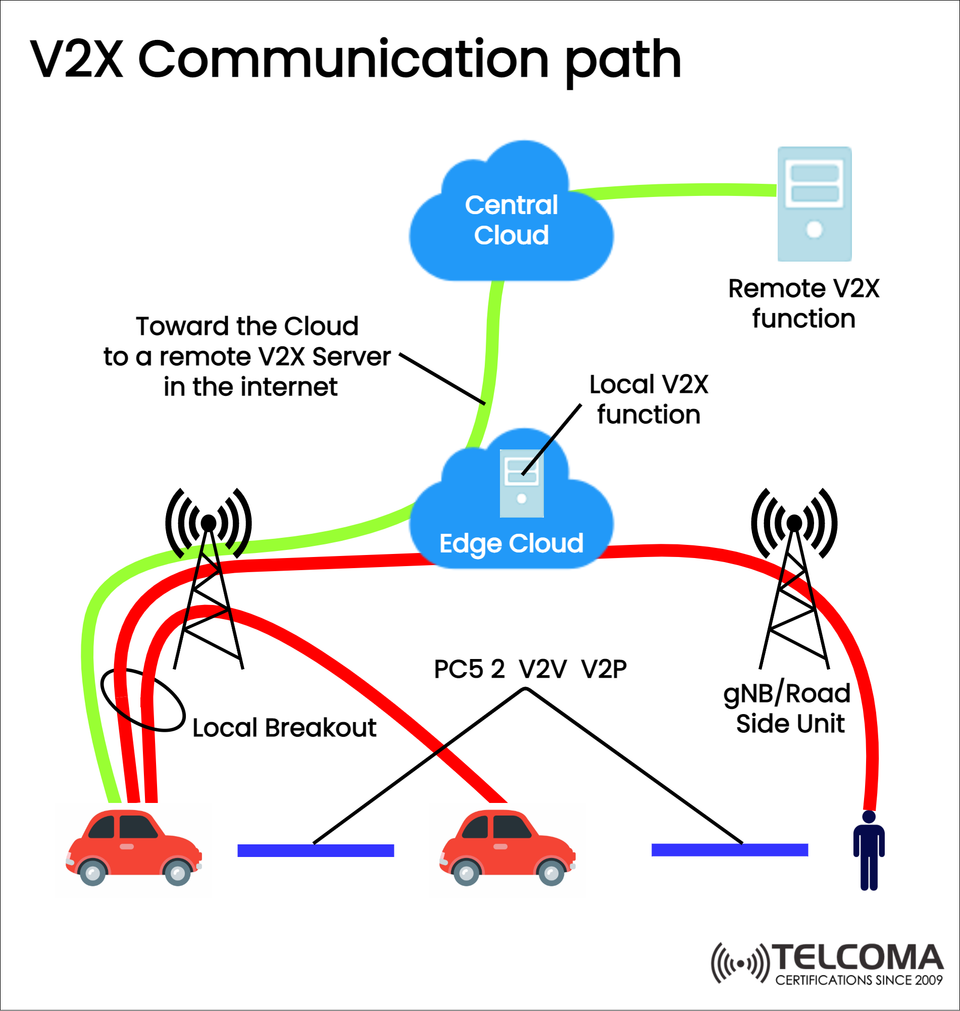
The image that’s been shared shows the V2X communication path, which details how vehicles link with edge cloud, central cloud, roadside units, and even pedestrians. These connections are all about ensuring quick, reliable, and smart exchanges of information that support the backbone of intelligent transportation systems (ITS).
For those in telecom, getting to grips with the V2X communication architecture is essential. It plays a key role in enabling autonomous driving, traffic management, and the development of smart cities. So, let’s take a closer look at how this communication path works.
What is V2X Communication?
V2X (Vehicle-to-Everything) communication is a connected setup that allows vehicles to share information with various entities in real-time. It covers:
V2V (Vehicle-to-Vehicle): Cars directly share info to prevent accidents and coordinate movements.
V2I (Vehicle-to-Infrastructure): Vehicles talk to traffic lights, road signs, and roadside units to improve traffic flow.
V2P (Vehicle-to-Pedestrian): Alerts get sent between vehicles and pedestrians with connected devices.
V2N (Vehicle-to-Network): Vehicles connect to cellular networks and cloud platforms for wider data sharing.
This all-encompassing communication setup boosts safety, efficiency, and user experience, while paving the way for fully autonomous vehicles.
V2X Communication Path: Key Components
The image illustrates how data travels through different layers of the V2X architecture. Here’s a breakdown of each part:
- Edge Cloud
Located near vehicles, the edge cloud handles local V2X tasks.
It makes sure there’s ultra-low latency communication, which is crucial for quick actions like avoiding collisions.
This is where local traffic is managed, allowing vehicles to chat swiftly without relying on faraway central servers.
- Central Cloud
The central cloud connects to remote V2X servers on the internet.
It focuses on big data analytics, machine learning, and long-term decision-making.
While the edge cloud reacts instantly, the central cloud offers broader insights for traffic patterns across cities or regions.
- gNB / Roadside Units (RSUs)
These act as base stations or small roadside access units that pass messages between vehicles and the network.
RSUs serve as gateways connecting local V2X communication to larger cloud services.
They also facilitate direct V2V and V2P communications using 5G’s PC5 interface.
- Direct PC5 Interface
Vehicles and pedestrians can communicate straight through the PC5 interface, skipping the cellular core network.
This is key for ultra-reliable, immediate actions, like warning a pedestrian crossing the street.
- Remote V2X Functions
These functions, set up on central cloud servers, manage non-critical tasks like infotainment, map updates, and traffic management predictions.
Keeping critical safety tasks at the edge helps ensure they have priority, while remote functions can optimize over time.
Communication Scenarios in V2X
The V2X communication path supports a range of real-world situations:
Collision Avoidance (V2V): * As two cars approach an intersection, they share speed and position data. * The edge cloud ensures immediate alerts to prevent accidents.
Pedestrian Safety (V2P): * A connected smartphone alerts both pedestrians and nearby vehicles of possible danger. * Communication via the direct PC5 interface makes this nearly instantaneous.
Traffic Signal Optimization (V2I): * Vehicles connect with roadside units. * Traffic lights adjust in real-time to ease congestion.
Connected Autonomous Vehicles (V2N): * The central cloud sends out map updates and helps with long-term route planning. * This enables autonomous cars to chart safe, efficient paths.
Edge vs. Central Cloud: Why Both Matter
Parameter Edge Cloud Central Cloud Latency Ultra-low (milliseconds)Higher (depends on distance)Use Cases Safety, collision avoidance, V2PAnalytics, infotainment Deployment Location Near gNB / RSU (local)Regional or national data centers Traffic Management Real-time, localized Macro-level, long-term
Having both edge and central clouds in play ensures that safety-critical tasks stay local, while central processing provides broader insights.
Benefits of V2X Communication Path
For telecom experts and city planners, the V2X communication framework brings about several benefits:
Enhanced Road Safety: * Helps prevent accidents through real-time alerts.
Traffic Efficiency: * Adjusts traffic lights dynamically to manage congestion.
Support for Autonomous Driving: * Delivers reliable, low-latency data streams for vehicles.
Better User Experience: * Offers smooth infotainment and navigation services.
Scalability: * The cloud-based setup allows the system to grow with future demands.
Challenges in V2X Deployment
Even with its potential, there are still some challenges to tackle:
Latency Management: Making sure critical communication goes through edge computing.
Standardization: Aligning V2X across different regions (3GPP, ETSI, IEEE standards).
Security: Safeguarding V2X messages from cyber threats and fakes.
Interoperability: Ensuring vehicles from various brands work together seamlessly.
Infrastructure Costs: Setting up gNBs, RSUs, and edge servers in urban areas.
The Role of 5G in V2X
5G networks form the backbone of V2X communication. With URLLC (Ultra-Reliable Low Latency Communication) and network slicing, 5G guarantees:
Dedicated network slices for critical safety applications.
High reliability for communication in autonomous vehicles.
Massive device connectivity for smart city IoT.
As we start to develop 6G, these capabilities will grow even more, paving the way for AI-driven networks and fully autonomous transportation systems.
Conclusion
The V2X communication path is a vital piece in building smarter mobility for the future. By linking vehicles, pedestrians, infrastructure, and networks through edge and central cloud functions, V2X enables safer, smarter, and more efficient transportation systems.
For telecom professionals, this isn’t just about tech advancements — it’s a game-changing chance to shape the next generation of intelligent transport and smart cities.
With 5G rolling out worldwide, V2X is set to evolve from pilot projects to large-scale implementations, ultimately changing how people and vehicles connect in urban areas.