
Virtual Network Functions and Protocols in 5G RAN Explained

Understanding Virtual Network Functions and Protocols in 5G RAN
The rise of 5G Radio Access Networks (RAN) is shaped by concepts like virtualization, disaggregation, and standardization. Unlike the traditional one-size-fits-all base stations, 5G RAN features logical splits and virtual network functions (VNFs), allowing operators to choose from different vendor solutions in an Open RAN (O-RAN) setup.
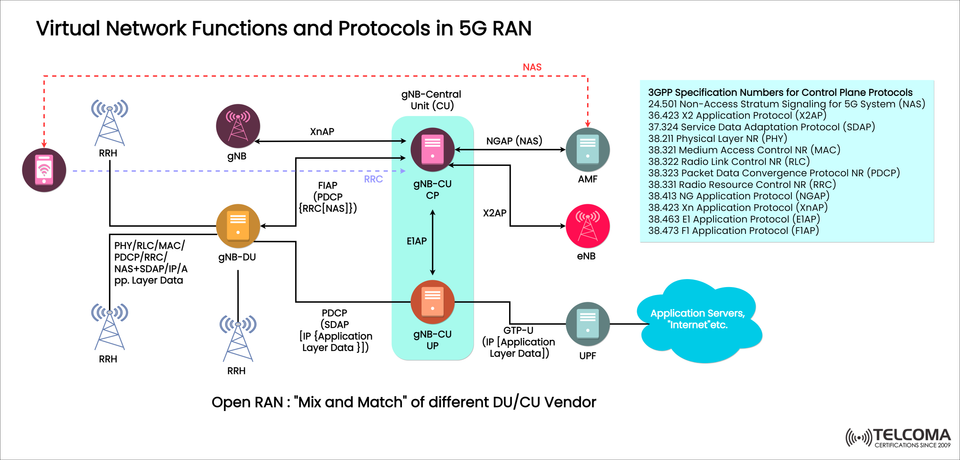
The diagram provided gives a clear view of the 5G gNB architecture, where the control plane (CP) and user plane (UP) functions are kept separate. This setup opens the door for flexible deployment options. Plus, it showcases the protocols set by 3GPP that guarantee different nodes and vendors can work together seamlessly.
In this article, we’ll dive into the architecture, the various protocols, and how they play a role in network optimization, scalability, and interoperability.
The Move Toward Virtualization in RAN
Looking back at older generations (2G to 4G), RAN was tightly knit, which limited choices for vendors. With 5G, a service-based architecture (SBA) and functional splits have emerged, such as:
Central Unit (CU): Takes care of higher-level functions like RRC and SDAP.
Distributed Unit (DU): Manages lower-level functions, such as RLC, MAC, and PHY.
Radio Unit (RU): Connects with antennas for radio frequency transmission.
By virtualizing CU and DU functions, operators can set them up in cloud-native environments, which leads to better scalability, automation, and less reliance on specialized hardware.
The Importance of Virtual Network Functions (VNFs) in 5G RAN
Virtual Network Functions represent a shift from traditional hardware-based network functions to software-based ones.
In 5G RAN, VNFs are essential for several reasons:
Flexibility: CU/DU functions can run on standard commercial servers.
Scalability: Resources can be adjusted on-the-fly based on user demand.
Interoperability: This setup supports multiple vendors to work together within the same RAN.
OPEX Savings: It cuts down on the expensive hardware upgrades.
Overview of 5G RAN Architecture (Referencing the Image)
The image presents key components like:
gNB-DU (Distributed Unit):
Manages lower layers (PHY, RLC, MAC).
Communicates with the Radio Remote Head (RRH).
Links to CU via the F1 interface (F1AP protocol).
gNB-CU (Central Unit):
Divided into CU-CP (Control Plane) and CU-UP (User Plane).
CU-CP oversees RRC, NAS signaling, and control protocols.
CU-UP manages user traffic (PDCP, SDAP).
Interconnected through the E1 interface (E1AP protocol).
Connections to Other Nodes:
NGAP (NG Interface): Links CU-CP to the AMF (Access and Mobility Management Function).
X2/Xn Interfaces: Connect various gNBs and eNBs for interconnectivity and mobility.
GTP-U (User Plane): Transfers user traffic from CU-UP to UPF (User Plane Function).
Key 3GPP Protocols in 5G RAN
The image also highlights the 3GPP specifications for RAN protocols. Here’s a simplified breakdown:
ProtocolPurpose3GPP Spec NASUE to core signaling TS 24.501X2AP/XnAP Inter-gNB and inter-eNB signaling TS 36.423 / 38.423SDAPQoS flow mapping to data radio bearers TS 37.324PHYPhysical layerTS 38.211MACMedium access control TS 38.321RLCRadio link control TS 38.322PDCPPacket data convergence (ciphering, integrity)TS 38.323RRCRadio resource control TS 38.331NGAPControl plane signaling with AMFTS 38.413E1APCU-CP and CU-UP interface TS 38.463F1APDU and CU interface TS 38.473
Control Plane (CP) vs User Plane (UP)
To boost performance and scalability, 5G networks keep CP and UP separate:
Control Plane (CP):
Manages signaling, mobility, and session setups.
Example protocols include RRC, NAS, NGAP.
Located in gNB-CU CP.
User Plane (UP):
Deals with actual user traffic (voice, video, data).
Example protocols comprise PDCP, SDAP, GTP-U.
Found in gNB-CU UP.
This separation allows network operators to scale resources for CP and UP independently, depending on traffic patterns.
Open RAN: Enables 'Mix and Match' among various DU/CU vendors
The Perks of Open RAN:
Vendor diversity: Operators aren't tied to just one supplier.
Cost efficiency: You can get hardware and software from different vendors, which helps to save money.
Innovation: It drives competition and speeds up the rollout of new features.
Flexibility in deployment: The CU can be centralized in cloud data centers, while the DU stays closer to the radio edge.
Data and Signaling Workflow Example
To get a grip on how data moves:
UE connects through the RRH to the gNB-DU.
The DU takes care of PHY, MAC, and RLC processes, then sends data via the F1 interface.
The CU-CP manages RRC/NAS signaling with the AMF using NGAP.
The CU-UP sends user data to the UPF using PDCP/SDAP through GTP-U.
The UPF connects to internet and application servers to provide services to end users.
This setup guarantees an efficient resource use, lower latency, and flexible network deployments.
Why 5G RAN Needs Virtualization and Protocols
The use of virtualized RAN functions and standardized protocols comes with several benefits:
Interoperability: Standards (like F1AP, E1AP, NGAP) make it easy for different vendors to work together.
Cloud-native setup: VNFs operate on scalable, distributed systems.
Reduced latency: DU functions can be placed closer to users; CU functions can be centralized.
Dynamic resource allocation: Network functions can adjust based on user demand.
Future-proofing: It prepares for advancements like network slicing, URLLC, and mMTC.
Challenges in Virtualized 5G RAN
Even with these advantages, operators encounter some hurdles:
Complex integration across different vendors.
Higher synchronization needs for DU-CU splits.
Increased signaling traffic on the control plane.
Security issues with cloud-hosted VNFs.
OPEX and orchestration become more complicated in large-scale deployments.
The Future of Virtual Network Functions in 5G and Beyond
As 5G continues to develop, VNFs will transition into Cloud-Native Network Functions (CNFs) utilizing containers and microservices. This shift will allow for:
Dynamic scaling for each slice or service.
Automation driven by AI/ML for optimizing traffic.
Integration of edge computing for ultra-low-latency services.
A seamless shift to 6G, where disaggregation and virtualization will play an even bigger role.
Conclusion
The shared image on Virtual Network Functions and Protocols in 5G RAN underscores the core aspects of today's mobile networks:
Disaggregation into CU/DU splits.
Separation of control and user planes for better efficiency.
Standardized 3GPP protocols that ensure vendor interoperability.
Open RAN flexibility, allowing for 'mix and match' setups.
For those in the telecom field, grasping these functions and protocols is essential for designing, optimizing, and expanding next-gen networks. As the industry evolves toward cloud-native, open, and smart networks, VNFs in the 5G RAN will continue to be pivotal in driving digital transformation.