
Voice Services Continuity in 5G, LTE, and 3G: VoLTE, VoNR, SRVCC Explained

Voice services are still the backbone of mobile networks, even with 5G New Radio (NR) now in play. Nowadays, data services might take the spotlight, but keeping voice calls steady across 3G, 4G, and 5G networks is key for reliable communication and happy customers.
Switching from Circuit-Switched (CS) voice in 3G to Voice over LTE (VoLTE) in 4G, and now to Voice over New Radio (VoNR) in 5G involves some intricate processes to ensure calls don’t get dropped when users switch between different technologies.
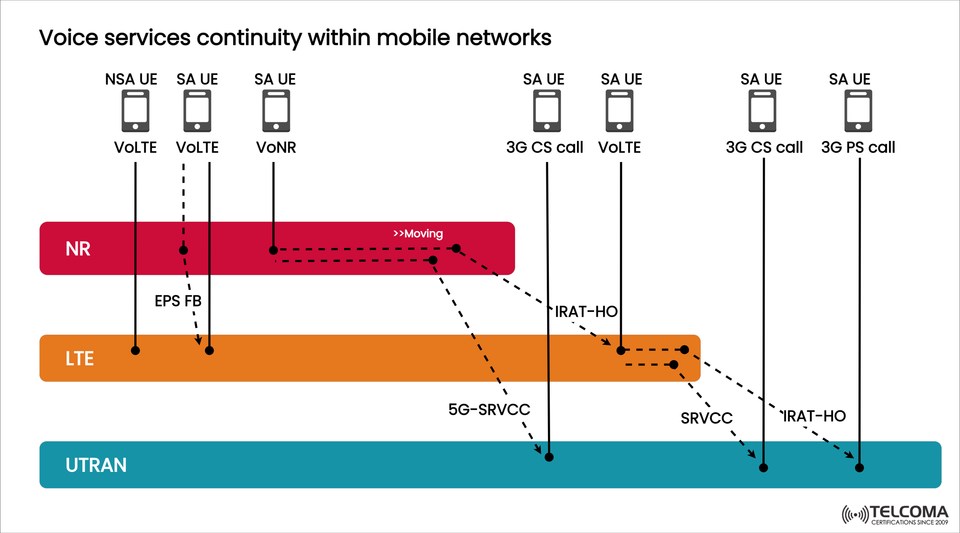
The diagram provided shows these processes, featuring:
VoLTE and VoNR as voice services based on IMS.
EPS Fallback for users on 5G NSA.
Inter-RAT handovers (IRAT-HO) for mobility between LTE and UTRAN.
Single Radio Voice Call Continuity (SRVCC and 5G-SRVCC) for keeping calls going during transitions.
This article dives into each continuity mechanism with the technical details telecom professionals and enthusiasts need.
Evolution of Voice Services
3G: Circuit-Switched (CS) Voice
3G networks used circuit-switched voice via the UTRAN (Universal Terrestrial Radio Access Network).
Calls were anchored in the CS core (MSC).
4G LTE: VoLTE (Voice over LTE)
LTE operates as an all-IP system, leaving behind the circuit-switched domain.
Voice is transmitted through the IMS (IP Multimedia Subsystem) using the VoLTE standard.
Delivers HD voice quality and allows simultaneous voice and data usage.
5G NR: VoNR (Voice over New Radio)
In Standalone 5G (SA) mode, voice is delivered natively through IMS over 5G NR, which we call VoNR.
This brings low latency, improved quality, and full benefits of 5G.
NSA and SA in Voice Continuity
NSA (Non-Standalone) UE: 5G devices that connect via LTE as the main link. Voice typically comes through VoLTE.
SA (Standalone) UE: Can use VoLTE fallback or native VoNR, based on the operator's setup.
Key Voice Continuity Mechanisms
The diagram showcases various methods to ensure voice calls continue smoothly:
VoLTE in NSA and SA
NSA UE: Handles voice calls as VoLTE over LTE, even if data is on 5G NR.
SA UE: Can revert to VoLTE if VoNR coverage isn’t available.
✅ Advantage: It's a well-established system, widely used.
❌ Limitation: Not a true 5G solution.
VoNR (Voice over New Radio)
This is the native voice solution in 5G Standalone networks.
Voice packets move directly through NR to IMS over 5GC.
Lower latency and improved quality compared to VoLTE.
✅ Advantage: Full 5G experience.
❌ Limitation: Needs strong 5G coverage and mature IMS integration.
EPS Fallback (EPS FB)
A 5G UE in SA mode might switch back to LTE VoLTE if VoNR isn’t an option.
This kicks in during the call setup – not while a call is ongoing.
The diagram illustrates this as SA UE → LTE route via EPS FB.
✅ Advantage: It guarantees voice access when VoNR isn't available.
❌ Limitation: Adds some latency during call setup (extra handover time).
SRVCC (Single Radio Voice Call Continuity)
Lets ongoing VoLTE calls be passed off to 3G CS voice.
The diagram indicates this as an LTE → UTRAN handover.
✅ Advantage: Keeps call continuity when LTE coverage starts to dip.
❌ Limitation: Involves complex signaling, which might affect call quality.
5G-SRVCC
Extends SRVCC to allow handover from 5G VoNR to 3G CS voice.
Handy when a device moves out of 5G/LTE coverage into older 3G-only zones.
✅ Advantage: Smooth fallback to legacy networks.
❌ Limitation: Needs coordinated efforts from the network.
Inter-RAT Handover (IRAT-HO)
Used for switching between NR ↔ LTE or LTE ↔ UTRAN while on the move.
The diagram shows multiple IRAT-HO paths to ensure calls don’t drop.
✅ Advantage: Ensures smooth transitions between technologies.
❌ Limitation: There may be brief disruptions during these switches.
Visualizing the Continuity Paths
Looking at the diagram:
VoLTE (NSA UE): Call is anchored in LTE → direct IMS route.
VoLTE (SA UE): Native VoLTE on LTE, even in SA mode.
VoNR (SA UE): Native IMS voice over 5G NR.
EPS Fallback: SA UE switches back from NR to LTE before the call starts.
5G-SRVCC: Moves a VoNR call to 3G CS voice.
SRVCC: Transitions a VoLTE call to 3G CS voice.
IRAT-HO: Facilitates cross-RAT mobility during calls.
Comparison Table: Voice Continuity Techniques
Mechanism Network Scenario Call Setup / Mid-Call Pros Cons Vo LTE LTE/NSA, SA fallback option Setup + mid-call Reliable and mature with IMS support Not a true 5G solution Vo NRSA 5GSetup + mid-call Native 5G with low latency Needs solid 5G coverage EPS Fall back SA 5G without VoNR support Setup only Guarantees voice availability Delay in setup, no mid-call fallback SRVCCLTE → UTRAN (3G CS)Mid-call Seamless legacy fallback Complex processes, possible QoS drops5G-SRVCCNR → UTRAN (3G CS)Mid-call Extends SRVCC to 5GNeeds coordinated network efforts IRAT-HONR ↔ LTE, LTE ↔ UTRAN Mid-call Smooth transitions across RATs Possible short disruptions
Why Voice Continuity Still Matters
Even with the rise of OTT apps like WhatsApp or Teams, it's essential for operators to ensure native voice continuity for several reasons:
Emergency services count on it.
Regulations require dependable CS/IMS voice.
Operators find ways to monetize voice services along with data.
Voice is still vital in rural or low-coverage areas where OTT apps might not work well.
Future Outlook
As 5G Standalone continues to evolve:
VoNR will likely become the main voice solution.
EPS Fallback could fade away once VoNR coverage gets stronger.
SRVCC and 5G-SRVCC will still play roles in legacy areas.
IRAT handovers will keep ensuring mobility between networks until we phase out 3G globally.
Operators are already moving towards IMS modernization and preparing for VoNR, but timelines can vary across regions. Some might still depend on VoLTE + EPS fallback for years, while others will jump straight to VoNR.
Conclusion
Keeping voice services running smoothly in mobile networks represents a multi-layered transition from 3G CS voice → VoLTE → VoNR. The diagram illustrates how mechanisms like EPS fallback, SRVCC, 5G-SRVCC, and IRAT handovers help maintain call quality as users shift between NR, LTE, and UTRAN.
VoLTE stands strong as today’s go-to solution.
VoNR is setting the stage for the future of 5G voice.
Fallbacks (EPS FB, SRVCC, 5G-SRVCC) ensure reliability during this transition.
For telecom professionals, grasping these mechanisms is essential for designing networks that provide uninterrupted voice services, even as we move fully into the 5G era.