
VoLTE vs VoNR: High-Level Architecture Explained for 4G and 5G Networks
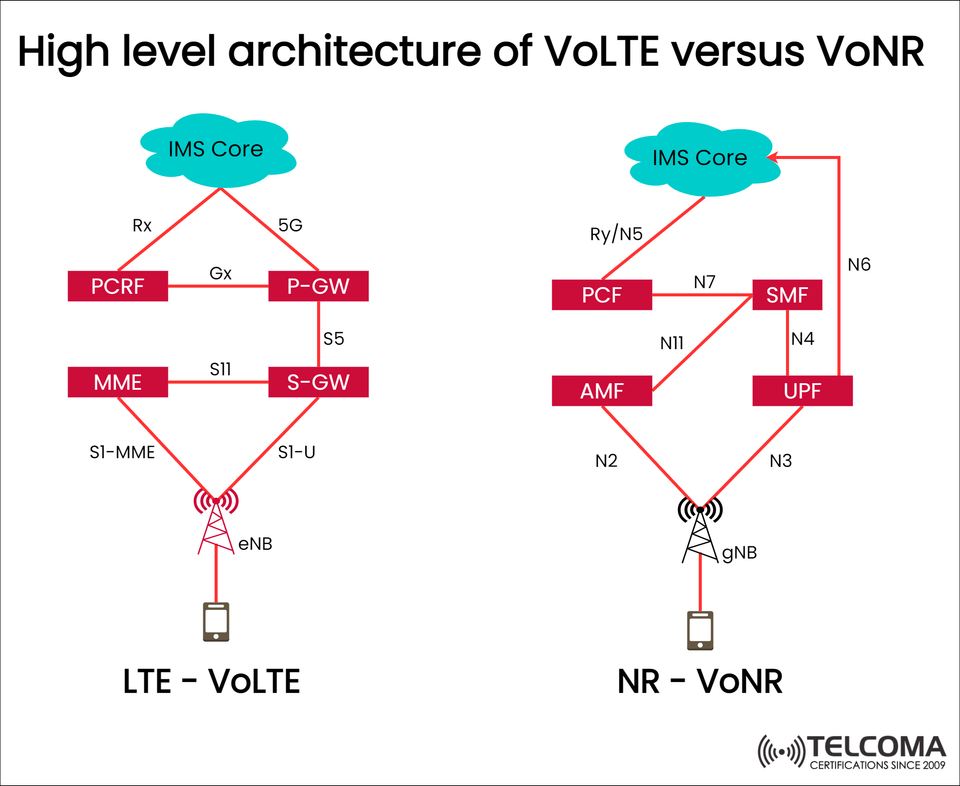

High-Level Overview of VoLTE and VoNR
As mobile networks evolve, voice services are still crucial. While 5G offers incredibly fast data speeds and minimal latency, maintaining reliable and quality voice calls remains just as important. This is where VoLTE (Voice over LTE) and VoNR (Voice over New Radio) come into the picture.
The diagram above shows the high-level architectural variations between VoLTE in LTE networks and VoNR in 5G networks. Both technologies depend on the IP Multimedia Subsystem (IMS) for delivering voice and multimedia services, but the core network architectures and interfaces differ quite a bit.
Let’s take a closer look at how these architectures stack up against each other and what it all means for the telecom landscape.
What is VoLTE?
VoLTE (Voice over LTE) enables voice calls to be transmitted over the 4G LTE packet-switched network, replacing the older 2G/3G circuit-switched methods.
Key Features of VoLTE:
Utilizes the Evolved Packet Core (EPC).
Depends on the IMS Core for call control and session management.
Guarantees HD voice quality, quicker call setup times, and simultaneous voice and data.
Employs QoS bearers to ensure voice performance.
What is VoNR?
VoNR (Voice over New Radio) is the 5G version of VoLTE, allowing for native voice calls over the 5G Standalone (SA) Core Network (5GC).
Key Features of VoNR:
Built entirely on the 5G Core (5GC), using Service-Based Architecture (SBA).
Fully integrates with the IMS Core for voice and multimedia services.
Delivers enhanced QoS and ultra-low latency.
Removes the need for LTE fallback, ensuring a seamless 5G experience.
High-Level Architecture of VoLTE (LTE)
On the left side of the diagram, the VoLTE architecture consists of:
UE (User Equipment) → Connects to the LTE radio network.
eNB (Evolved NodeB) → Provides LTE radio access.
MME (Mobility Management Entity) → Manages mobility and signaling (S1-MME).
S-GW (Serving Gateway) → Routes and forwards user data (S1-U).
P-GW (Packet Data Network Gateway) → Supplies IP connectivity to external networks, including IMS.
PCRF (Policy and Charging Rules Function) → Oversees policy and QoS application.
IMS Core → Delivers call control, registration, and multimedia services.
Interfaces in VoLTE:
S1-MME: eNB ↔ MME (control plane).
S1-U: eNB ↔ S-GW (user plane).
S11: MME ↔ S-GW.
S5: S-GW ↔ P-GW.
Gx: PCRF ↔ P-GW.
Rx: PCRF ↔ IMS Core.
LTE VoLTE is built upon the EPC, with IMS handling the actual voice call services.
High-Level Architecture of VoNR (5G NR)
On the right side of the diagram, the VoNR architecture emphasizes the 5G SA Core.
Key components include:
UE (User Equipment) → Connects to the 5G NR network.
gNB (Next-Generation NodeB) → Provides 5G radio access.
AMF (Access and Mobility Management Function): Oversees UE registration and mobility (via N2).
SMF (Session Management Function): Manages session establishment and UPF (via N4).
UPF (User Plane Function): Routes and forwards user traffic (via N3/N6).
PCF (Policy Control Function): Supplies dynamic policy and QoS control.
IMS Core: Just like in LTE, but connects via the 5GC.
Interfaces in VoNR:
N2: gNB ↔ AMF (control plane).
N3: gNB ↔ UPF (user plane).
N11: AMF ↔ SMF.
N4: SMF ↔ UPF.
N7: PCF ↔ SMF.
Ry/N5: PCF ↔ IMS Core.
N6: UPF ↔ IMS Core.
Unlike VoLTE, VoNR operates natively within the 5G SBA framework, which gives it more flexibility, scalability, and readiness for the cloud.
VoLTE vs VoNR: Architectural Comparison
The table below illustrates the key differences between Vo LTE and Vo NR:
Aspect Vo LTE (LTE)Vo NR (5G NR)Core Network EPC (Evolved Packet Core)5GC (5G Core, SBA-based)Mobility Function MMEAMF Session Control S-GW + P-GWSMF User Plane S-GW + P-GWUPF Policy Control PCRFPCF Voice Path P-GW ↔ IMS Core UPF ↔ IMS CoreInterfacesS1, S5, S11, Gx, RxN2, N3, N4, N6, N7, N11Voice Service Vo LTE Vo NR Latency Low Ultra-low Readiness Mature, widely deployed Emerging, key for full 5G SA
Why Vo NR Matters in 5G
While Vo LTE will still be important in non-standalone (NSA) 5G deployments, Vo NR is critical for true 5G standalone (SA) operation. Here are a few reasons why:
Native 5G Voice: Offers a smooth voice experience without needing to fall back on LTE.
Network Efficiency: Eliminates the need for dual connectivity with LTE.
Superior QoS: Ensures ultra-low latency and enhanced reliability.
Supports Advanced Services: Opens the door for next-gen applications like AR/VR calls, holographic communication, and ultra-HD video calling.
Challenges in VoNR Deployment
Despite the perks, VoNR does have its challenges:
Network Readiness: Needs a fully deployed 5G SA Core and IMS integration.
Device Support: Not all 5G smartphones support VoNR out of the box.
Interoperability: Vendors might interpret 3GPP standards differently.
Coverage: 5G SA coverage is still not as extensive as LTE.
Transition Path: From VoLTE to VoNR
Operators are taking a phased approach to roll out VoNR:
VoLTE as Fallback: Initially, voice calls in 5G NSA use VoLTE (EPS fallback).
Dual Registration: Some devices maintain registration with both EPC and 5GC.
VoNR Rollout: As 5G SA develops, VoNR will become the default voice solution.
Future Evolution: Eventually, VoLTE will be fully replaced by VoNR in mature 5G networks.
This transition guarantees that voice services remain uninterrupted during network evolution.
Future Outlook: Beyond VoNR
As networks gear up for 6G, the role of VoNR will continue to grow. Some key developments we can expect include:
Network Slicing for Voice: Dedicated slices for crucial communications.
Edge Computing Integration: Reducing latency for real-time voice and video services.
AI-Driven QoS: Smart voice quality management that’s dynamic and predictive.
Extended Reality (XR) Calls: Making voice a part of immersive experiences.
VoNR isn't just about replacing VoLTE — it’s a foundation for next-generation communication experiences.
Conclusion
Looking at the VoLTE and VoNR architectures, we can see how voice services have developed alongside mobile networks.
VoLTE operates on EPC with MME, S-GW, P-GW, and PCRF supporting IMS for voice services.
VoNR employs the 5GC SBA model with AMF, SMF, UPF, and PCF, providing a much more flexible and cloud-native integration with IMS.
While VoLTE plays a vital role in 4G and NSA 5G, VoNR stands as the future of 5G SA voice, offering low latency, scalability, and the ability to enable advanced services.
For those in the telecom field, understanding the intricacies of both VoLTE and VoNR is essential for grasping the shift from 4G to full standalone 5G voice services.