
VoNR Call Flow Explained: Step-by-Step Guide to 5G Voice Session Establishment
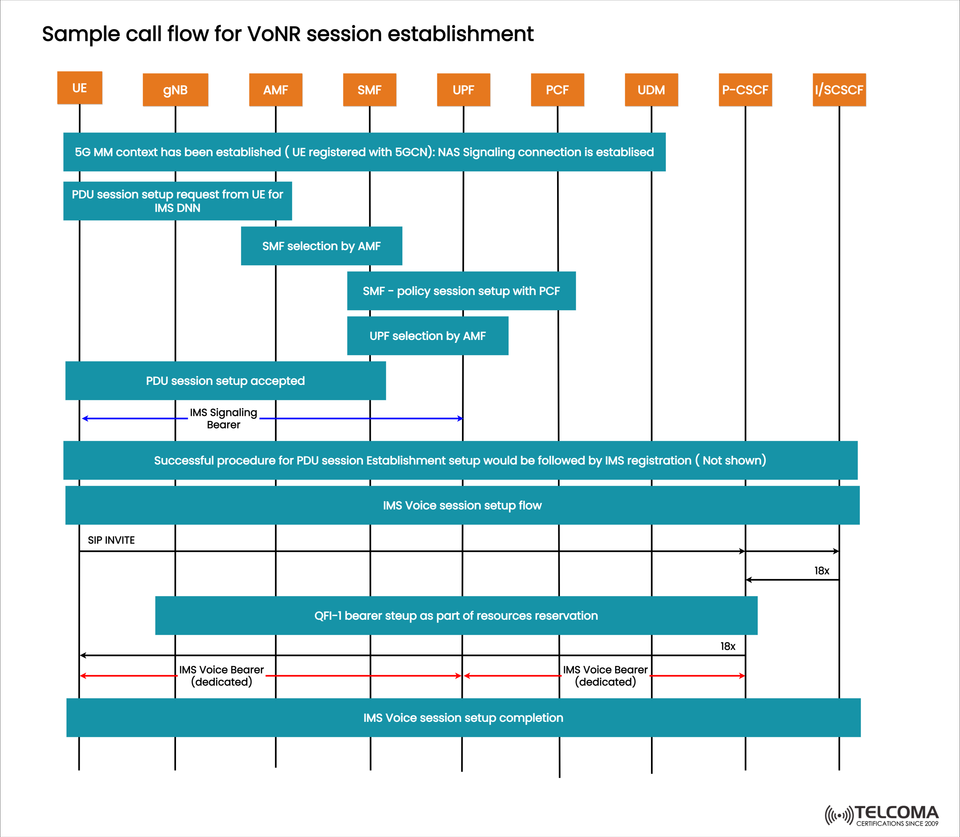

Overview of VoNR Session Establishment Call Flow
As telecom networks make the shift from LTE (4G) to 5G Standalone (SA), voice services need to adapt as well. While VoLTE (Voice over LTE) has been the go-to for 4G voice calls, VoNR (Voice over New Radio) is stepping up as the native solution for 5G voice.
VoNR works seamlessly with the 5G Core (5GC) and the IP Multimedia Subsystem (IMS), ensuring low-latency, high-quality voice calls over 5G. To make this happen, various network functions team up in a specific order, which we call the VoNR session establishment call flow.
The diagram above lays out this flow, illustrating how components like UE, gNB, AMF, SMF, UPF, PCF, and IMS work together to set up a VoNR call.
Key Players in VoNR Call Flow
Before we jump into the details of the sequence, let's clarify who does what:
UE (User Equipment): This is the mobile device making or receiving the call.
gNB (Next-Generation NodeB): Provides the 5G radio interface to the UE.
AMF (Access and Mobility Management Function): Takes care of access, registration, and mobility management.
SMF (Session Management Function): Manages the PDU session setup and oversees the UPF.
UPF (User Plane Function): Handles user plane traffic and forwards packets between the UE and external networks.
PCF (Policy Control Function): Sets up QoS policies and charging rules.
UDM (Unified Data Management): Keeps subscriber info and profiles.
IMS Core (P-CSCF, I-CSCF, S-CSCF): Manages SIP signaling, registration, and call control for voice sessions.
Step-by-Step VoNR Call Flow
The VoNR session establishment follows a structured path, kicking off with PDU session setup and concluding with IMS voice bearer activation.
- Establishing 5G MM Context
The UE registers with the 5G Core Network (5GC) through NAS signaling.
The AMF creates a mobility management context to keep track of the UE’s access status.
- Requesting PDU Session
The UE sends a PDU session establishment request for the IMS Data Network Name (DNN).
This session is crucial for IMS signaling and ultimately delivering voice services.
- SMF Selection and Policy Control
The AMF picks an SMF to manage the PDU session.
The SMF teams up with the PCF to get QoS rules, policies, and charging instructions.
- Allocating UPF
The SMF works with the AMF to assign a suitable UPF.
The UPF will route signaling traffic between the UE and the IMS core.
- Accepting PDU Session Setup
Once the UPF is chosen and set up, the PDU session setup gets confirmed.
Now, the UE has an IMS signaling bearer ready for SIP signaling.
IMS Registration (Not Shown)
In practice, the next step for the UE is to perform IMS registration with the IMS Core (using SIP REGISTER). This step, although not depicted in the diagram, is essential for the UE to begin and receive IMS-based services like voice calls.
Flow of IMS Voice Session Setup
After IMS registration, we move on to setting up the voice session.
- Sending SIP INVITE
The UE sends a SIP INVITE to kick off a voice session.
This INVITE goes through the P-CSCF → I-CSCF → S-CSCF in the IMS Core.
The IMS negotiates session parameters (like codecs and QoS) between the calling and receiving parties.
- Reserving Resources (QFI-1 Bearer)
A dedicated bearer (QFI-1) is set up to guarantee QoS for voice.
This prioritizes voice packets over regular data traffic.
- Establishing IMS Voice Bearer
A dedicated IMS Voice Bearer is set up between the UE and IMS via UPF.
This is indicated by the red arrows in the diagram and ensures high-quality, low-latency transmission.
- Completing the Session
The voice bearer setup gets confirmed.
The IMS voice session wraps up, allowing the UE to exchange real-time voice packets with the other party.
Simplified VoNR Call Flow
To sum it up, the VoNR call establishment can be divided into two main phases:
Phase 1: Session Preparation
Establishing the 5G MM context.
Setting up the PDU session with IMS DNN.
Selecting SMF and UPF.
Establishing IMS signaling bearer.
Phase 2: IMS Voice Session
IMS registration (not shown in the image).
Sending SIP INVITE signaling.
Setting up the QoS bearer (QFI-1).
Activating the IMS voice bearer.
Completing the voice session.
VoNR Call Flow Compared to VoLTE Call Flow
Both VoNR and VoLTE depend on IMS for voice services, but they have different core networks:
Aspect VoLTE (LTE)Vo NR (5G NR)Accesse NBgNB Mobility MMEAMF Session Control S-GW, P-GWSMF, UPF Policy PCRFPCF Voice Bearer Dedicated EPS bearer QoS Flow Identifier (QFI)Latency Low Ultra-Low Scalability Limited by EPC Cloud-native SBA in 5GC
This means VoNR offers a more adaptable, cloud-ready design that ensures speedy voice sessions compared to VoLTE.
Importance of Understanding VoNR Call Flow
Grasping the VoNR call flow is vital for:
Telecom engineers creating and fine-tuning 5G networks.
Operators making the transition from VoLTE to VoNR.
Device makers assuring compatibility with 5G SA rolls.
Researchers looking into end-to-end QoS in contemporary networks.
Challenges with VoNR Call Flow
Dependence on IMS Registration: Successful IMS registration is critical for making calls.
QoS Management: Needs careful handling of bearers to prevent packet loss.
Working with Legacy Networks: EPS fallback to VoLTE might still be necessary in non-standalone (NSA) cases.
Device Compatibility: Not all 5G devices can support VoNR.
Future Outlook for VoNR Call Flow
As 5G evolves, VoNR will facilitate next-gen communication services that go beyond simple voice:
Immersive XR Calls: Merging voice with AR/VR experiences.
Network Slicing for Voice: Creating dedicated low-latency portions for crucial communication.
Integration of Edge Computing: Cutting down latency for voice and video even further.
AI-enhanced Call Optimization: Making predictive QoS tweaks for a better user experience.
Final Thoughts
The VoNR session establishment call flow shows us how 5G networks manage real-time voice communication.
It starts with PDU session setup for IMS connectivity.
Moves on to IMS registration and SIP signaling.
Wraps up with QoS bearer setup and the activation of a dedicated voice bearer.
Compared to VoLTE, VoNR brings a more cloud-native, flexible, and low-latency approach, fully in tune with the 5G Core’s Service-Based Architecture.
For those in the telecom field and enthusiasts alike, getting a handle on VoNR call flows is crucial to understanding how 5G is reshaping voice services and paving the way for advanced communication technologies.