
vRAN vs Open RAN Explained: Architecture, Differences, and the Future of Radio Access Networks

vRAN vs Open RAN: The Future of Flexible and Intelligent Radio Access Networks
As mobile networks progress towards 5G Advanced and eventually 6G, there's a growing need for infrastructure that’s more agile, cost-effective, and intelligent. We're starting to see traditional RAN architectures—known for their proprietary interfaces and vendor lock-in—being replaced by virtualized and open radio access networks (vRAN and Open RAN).
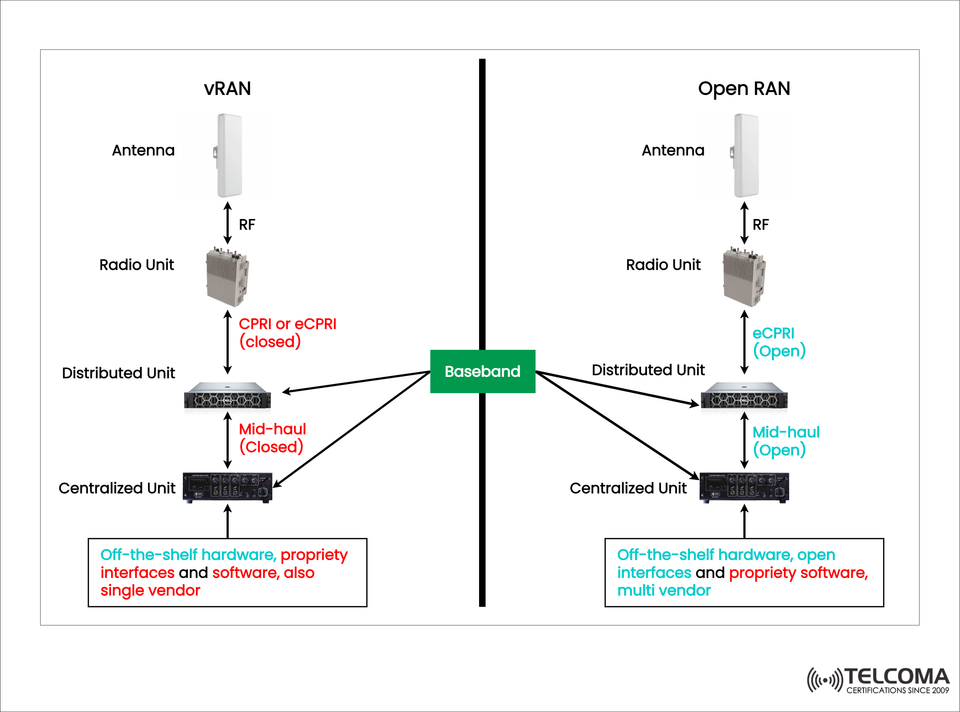
The image provided clearly contrasts the architectural differences between vRAN (Virtualized RAN) and Open RAN, highlighting aspects like interface openness, vendor flexibility, and integration layers. Let’s dive into how these two architectures differ and what they mean for the telecom industry.
Understanding RAN Evolution
What is RAN?
A Radio Access Network (RAN) connects mobile devices to the core network using radio signals. Traditionally, it consists of:
Antenna – This part transmits and receives radio frequency (RF) signals.
Radio Unit (RU) – Responsible for RF signal processing.
Baseband Unit (BBU) – Manages signal modulation, coding, and higher-layer processing.
Over the years, RAN has transformed from hardware-centric systems to software-driven, cloud-native platforms, giving rise to vRAN and subsequently Open RAN.
The vRAN Architecture
On the left side of the image, you can see the vRAN architecture, which introduces virtualization to traditional RAN systems but still sticks with closed, proprietary interfaces.
Key Components of vRAN:
Antenna and Radio Unit (RU):
Connected through RF.
Often uses CPRI or eCPRI, which are closed and exclusive to certain vendors.
Distributed Unit (DU):
Manages lower-layer baseband tasks like MAC and RLC.
Connects to the Centralized Unit (CU) via a Mid-haul (closed) link.
Centralized Unit (CU):
Oversees higher-layer functions (PDCP, RRC).
Aggregates data from several DUs.
Baseband:
Takes care of digital signal processing (DSP), usually integrated into the DU/CU duo.
vRAN Characteristics:
Closed Interfaces: Both CPRI/eCPRI and mid-haul links are vendor-specific.
Single Vendor Dependency: Typically, all parts come from the same manufacturer to ensure they work well together.
Virtualization Benefits: Uses off-the-shelf hardware, leading to cost savings and more flexibility compared to older RAN models.
Proprietary Integration: Hardware might be standardized, but the software is still proprietary.
Advantages of vRAN:
Simplifies deployment and network management.
Provides a relatively easier path for migrating from traditional RAN to cloud-native systems.
Offers better scalability and some flexibility.
Limitations of vRAN:
Vendor lock-in due to proprietary interfaces.
Limited compatibility with different suppliers.
Slower innovation cycles from closed ecosystems.
The Open RAN Architecture
On the right side of the image, we see the Open RAN design, representing the next step in RAN evolution—emphasizing openness, interoperability, and disaggregation.
Key Components of Open RAN:
Antenna and Radio Unit (RU):
Connected via open eCPRI interface.
This allows RUs from one vendor to work seamlessly with DUs from another.
Distributed Unit (DU):
Works with the RU using open fronthaul (based on O-RAN standards).
Linked to the CU through an open mid-haul interface.
Centralized Unit (CU):
Communicates with multiple DUs using standardized mid-haul protocols.
Can be hosted in cloud infrastructure.
Baseband:
Functions are software-defined and interoperable across different vendors.
Open RAN Characteristics:
Open Interfaces: All important connections (eCPRI, mid-haul) use open, standardized protocols as defined by the O-RAN Alliance.
Multi-Vendor Ecosystem: Operators can mix and match RUs, DUs, and CUs from various suppliers.
Off-the-Shelf Hardware: Built with COTS (Commercial Off-The-Shelf) hardware for cost efficiency.
Software Flexibility: Supports AI-driven automation, network slicing, and smart orchestration.
Advantages of Open RAN:
Interoperability: Components from different suppliers can work together without issues.
Cost Efficiency: Lower CAPEX and OPEX thanks to hardware standardization and competition among vendors.
Innovation Acceleration: Encourages smaller companies and new players to contribute niche solutions.
Scalability and Automation: The cloud-native structure lends itself well to automation, orchestration, and AI optimization.
Challenges of Open RAN:
Integration can be complex with systems from multiple vendors.
There may be security and performance concerns during the early stages of adoption.
Requires a skilled workforce for deployment and management.
Key Differences Between vRAN and Open RAN
Feature vRAN Open RAN Interface Type Proprietary (Closed)Standardized (Open)Vendor Ecosystem Single vendorMulti-vendorHardwareOff-the-shelfOff-the-shelfSoftwareProprietaryOpen or hybrid Fronthaul (RU–DU)CPRI/eCPRI (closed)eCPRI (open)Mid haul (DU–CU)Closed Open Interoperability Limited High Innovation Speed Moderate Fast (community-driven)Deployment Flexibility Low High Typical Use Case Transitional 5G networks Open 5G/6G, greenfield and brownfield
This comparison shows that vRAN serves as a transitional step, providing partial virtualization within closed systems, while Open RAN achieves full openness, modularity, and compatibility across different vendors.
The Role of the O-RAN Alliance
The O-RAN Alliance, made up of top telecom operators and vendors, is crucial in defining open RAN specifications. Their mission involves:
Supporting open, intelligent, and interoperable RAN architectures.
Establishing standard interfaces like A1, E2, and O1 for control and management.
Enabling AI-powered RAN automation through near-real-time and non-real-time RICs (RAN Intelligent Controllers).
By adopting O-RAN standards, operators can integrate xApps and rApps for analytics, optimization, and automation across various vendors, boosting overall network intelligence.
How Operators Benefit from Open RAN
a. Reduced Total Cost of Ownership (TCO):
By sidestepping vendor lock-in and using open interfaces, operators can lower their costs for deployment and upgrades.
b. Faster Innovation:
Open RAN fosters an ecosystem where smaller firms and innovators can introduce specialized network components.
c. Cloud-Native and Flexible Deployments:
Operators can dynamically deploy network functions on the cloud or edge, depending on real-time requirements.
d. Enhanced Network Intelligence:
Integrating AI and ML algorithms into the Open RAN architecture enhances efficiency, resource allocation, and predictive maintenance.
Transitioning from vRAN to Open RAN
Many telecom operators are currently using vRAN architectures as a stepping stone towards fully open RAN environments. This gradual evolution includes:
Virtualizing baseband functions in vRAN.
Opening fronthaul interfaces for better interoperability.
Implementing open mid-haul and control layers.
Integrating RIC (RAN Intelligent Controller) for smarter automation.
This hybrid approach allows for a smoother transition without disrupting existing 5G services.
The Future: Open RAN as the Foundation of 6G
As research on 6G ramps up, Open RAN is becoming a foundational architecture for next-gen networks. The flexibility, scalability, and intelligence that open interfaces support are crucial for:
AI-driven network management
Programmable RAN slicing
Cloud-native, distributed infrastructure
The 6G landscape will likely depend on a fully open, software-driven RAN, where interoperability and automation are essential design elements.
Conclusion
The comparison of vRAN and Open RAN showcases the industry's shift toward openness, flexibility, and intelligence. While vRAN virtualizes network functions within closed ecosystems, Open RAN breaks down vendor dependencies through standardized interfaces and multi-vendor collaboration.
This shift empowers telecom operators to create agile, cost-effective, and innovative networks, well-prepared for the challenges of 5G Advanced and beyond. As Open RAN continues to evolve, it’s poised to lay the groundwork for the next-generation 6G infrastructure, spearheading the future of connected intelligence.