
Where Bearer Network Delay Occurs: Understanding E2E Latency in Modern Telecom Networks

Understanding Bearer Network Delay: Diving into Latency in Telecom Systems
In advanced networks like 5G and beyond, speed and reliability are essential, not just optional. With everything from cloud VR gaming to IoT automation and mission-critical apps needing it, ultra-low latency is a key performance indicator.
One of the biggest factors affecting end-to-end (E2E) latency is the bearer network delay. This delay is all about how long it takes for data to travel across the network from the client to the server. It includes various types of delays that can really add up.
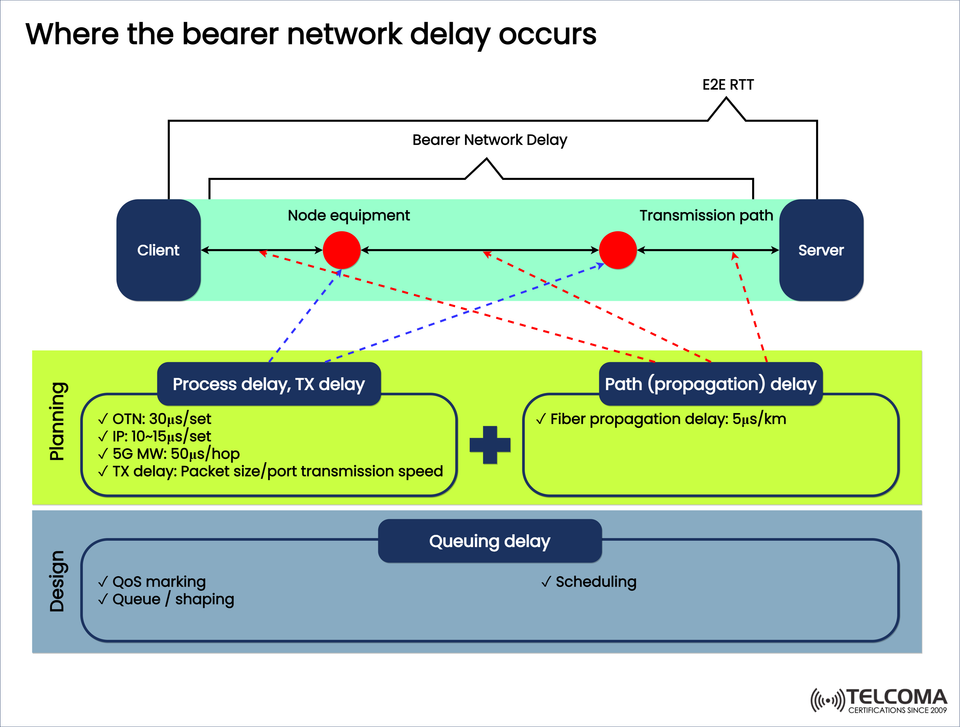
The diagram we’ve included shows where bearer network delays happen, and it breaks it down into process/Tx delay, path (propagation) delay, and queuing delay. For telecom professionals, understanding these elements is crucial when designing networks that need to deliver smooth, real-time services.
What is Bearer Network Delay?
The bearer network acts as the backbone, transporting user traffic from devices to application servers. Any delay that crops up in this transport journey—whether it's due to hardware, propagation, or queuing—adds to the E2E RTT (Round-Trip Time).
To put it simply:
Client → Node Equipment → Transmission Path → Server
Each step adds some level of measurable latency, which affects the Quality of Experience (QoE).
By optimizing bearer network delay, we can keep applications like AR/VR, self-driving cars, and industrial automation responsive.
Key Components of Bearer Network Delay
There are three main parts to bearer network delay:
Process Delay and Transmission (Tx) Delay
This is the time taken for network components to process and send packets. Here are some examples:
OTN (Optical Transport Network): about 30 μs each set
IP Processing: around 10–15 μs each set
5G Microwave (MW): approximately 50 μs per hop
Tx Delay: affected by packet size and port transmission speed
Larger packet sizes and slower speeds increase Tx delay, while high-performing forwarding equipment helps keep it low.
- Path (Propagation) Delay
Even light-speed transmission over fiber optics can add up to a noticeable delay.
Fiber propagation delay: roughly 5 μs per kilometer.
If you have over 100 km of fiber, that’s about 0.5 ms latency—definitely something to consider for applications sensitive to latency.
This shows why edge computing and regional data centers are key: keeping servers closer to users can significantly cut down on propagation delay.
Queuing Delay
This delay happens when packets are stuck waiting due to congestion or specific prioritization rules. It’s influenced by:
QoS Marking: Rules that prioritize certain types of traffic
Queue/Shaping Mechanisms: How packets get scheduled or managed
Scheduling Policies: Techniques like weighted fair queuing (WFQ) or strict priority
Queuing delays can vary a lot and often take over during busy times.
Mapping Delays to E2E RTT
Bearer network delay is a part of the overall E2E RTT. RTT also includes:
Access network latency (wireless/last mile)
Bearer network latency (core + transport)
Server-side processing
So, even if the wireless connection is top-notch, issues with bearer network can slow things down overall.
Why Bearer Network Delay Matters in 5G and Beyond
The next wave of use cases demands strict latency limits:
Cloud VR/AR Gaming: Needs less than 20 ms from motion to pixel
Autonomous Vehicles: Requires under 10 ms for decision-making
Industrial Automation (IIoT): Often aims for less than 1 ms for key control processes
In these situations, even tiny delays in the bearer network can pile up into milliseconds that risk breaking service promises.
Planning Considerations
When planning networks, engineers look at the basic latency brought on by hardware and physical connections:
Choose low-latency OTN/IP gear
Optimize microwave hops for minimal delay
Plan fiber routes wisely to dodge unnecessary lengths and propagation impacts
Align Tx speeds with packet sizes to avoid bottlenecks
Design Considerations
In network design, the focus shifts to traffic management:
QoS Marking: Make sure critical applications like voice, VR, or URLLC traffic get priority over bulk data transfers
Queue and Shaping Policies: Fairly allocate resources while securing real-time flows
Scheduling: Use advanced scheduling methods to find a balance between fairness and latency
Together, these strategies create a latency-optimized transport layer that can meet a variety of service demands.
Practical Example: Fiber + 5G Backhaul
Take a look at an operator setting up 5G backhaul with fiber transport:
Fiber Route: 80 km → 0.4 ms propagation delay
OTN Equipment: 2 hops, 30 μs each → 60 μs
IP Routing: 5 routers, 12 μs each → 60 μs
Microwave Hops (if hybrid): 2 hops, 50 μs each → 100 μs
Total Baseline Bearer Delay ≈ 0.62 ms
If queuing delays add 1–2 ms during busy times, the total bearer delay could shoot past 2 ms, pushing E2E RTT over 10 ms when factoring in wireless and server processing.
This example really highlights why careful planning + design is so important.
Techniques to Reduce Bearer Network Delay
Telecom operators and vendors have several tactics:
Edge Computing (MEC): Bring application servers closer to users to cut down on propagation delay.
Network Slicing: Create dedicated paths for latency-sensitive data.
AI-Driven Traffic Management: Anticipate congestion and adapt scheduling on the fly.
High-Capacity Links: Utilize DWDM, 400G transport, or advanced microwave to limit queuing.
Hardware Acceleration: Use routers and switches designed for fast, low-latency processing.
Future Outlook: 6G and Latency Goals
With 6G coming into view, expectations for latency are getting even tougher:
Sub-millisecond E2E RTT for crucial control systems
Holographic communications that need almost zero delay
AI-led dynamic network management to predict and tackle bearer delays in real-time
The networks of the future will blend optical-wireless convergence, AI-driven operations, and guaranteed low latency, where bearer delays won’t just be minimized—they’ll be entirely predictable.
Summary
Even though bearer network delay might seem like a small piece of the telecom puzzle, it’s vital for determining E2E RTT and service quality.
By breaking it down into process delay, propagation delay, and queuing delay, telecom experts can identify bottlenecks and plan ways to address them.
As the demand for low-latency applications ramps up, the bearer network will be key to driving innovation, ensuring that networks are not only fast but also reliable, predictable, and ready for tomorrow.
To sum it up: Optimizing bearer network delay is crucial for enabling the next wave of immersive, mission-critical, and real-time digital experiences.