
Wi-Fi Technology Evolution: Comparing Wi-Fi 5, Wi-Fi 6, and Wi-Fi 6E
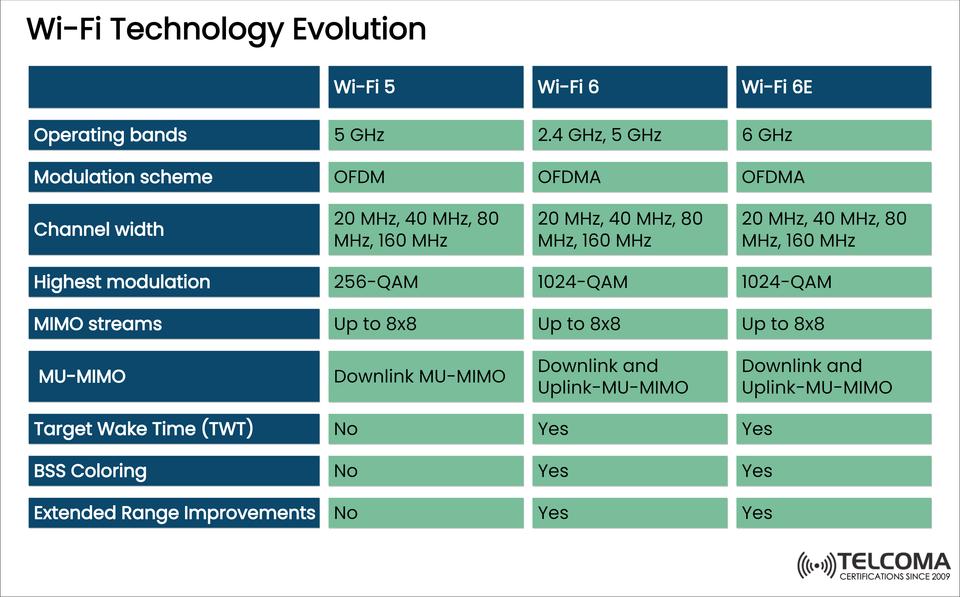

Evolution of Wi-Fi Technology: Wi-Fi 5 to Wi-Fi 6 and 6E
Wi-Fi is evolving continuously: not only in throughput but also in how it deals with dense environments, battery consumption and network performance. We will examine the evolution of Wi-Fi specifications from Wi-Fi 5 (802.11ac) to Wi-Fi 6 (802.11ax) and Wi-Fi 6E, and describe the most important changes for telecommunications professionals and technology enthusiasts.
The comparison chart in the image attached portrays a technical snapshot of how each generation represents a more advanced version of the previous generation.
📊 Side-by-Side Comparison: Wi-Fi 5 vs. Wi-Fi 6 vs. Wi-Fi 6E
Feature Wi-Fi 5 Wi-Fi 6 Wi-Fi 6E
Operating Bands 5 GHz 2.4 GHz, 5 GHz 6 GHz
Modulation Scheme OFDM OFDMA OFDMA
Channel Width 20/40/80/160 MHz 20/40/80/160 MHz 20/40/80/160 MHz
Highest Modulation 256-QAM 1024-QAM 1024-QAM
MIMO Streams Up to 8×8 Up to 8×8 Up to 8×8
MU-MIMO Downlink only Uplink and Downlink supported Uplink and Downlink supported
Target Wake Time (TWT) No Yes Yes
BSS Coloring No Yes Yes
Extended Range No Yes Yes
📡 Key Technology Advances Explained
🆚 OFDM vs. OFDMA
OFDM (Orthogonal Frequency Division Multiplexing): Wi-Fi 5 uses Orthogonal Frequency Division Multiplexing, which is suitable for high throughput, but not as well for multi-user capabilities.
Higher Modulation – 256-QAM Being® Becomes 1024-QAM
256-QAM (Wi-Fi 5) = 8 bits per symbol
1024-QAM (Wi-Fi 6/6E) the same 10 bits per symbol, that is going to increase throughput by ~25%.
MU-MIMO
Wi-Fi 5 - downlink multi-user MIMO (MU-MIMO), which allows data to multiple devices but not in both directions and at the same time.
Wi-Fi 6/6E adds uplink multi-user MIMO (MU-MIMO), enabling devices to send, as well as receive data at the same time. This is something video conferencing, IoT, and real-time gaming would be perfect for.
Target Wake Time (TWT)
Target Wake Time was first introduced in Wi-Fi 6, this feature schedules when devices will wake to send/receive data and since devices will be awake less frequently, they can lead to lower power consumption - this is useful for mostly IoT and mobile devices.
BSS coloring to help reduce interference
A basic service set (BSS) includes everything sent from the access point. The BSS color marks these transmissions from different access points to allow devices to distinguish between their access point signal and those from their neighbors. When the devices interpret the signals, they can make better and well-informed decisions, reducing congestion; hence providing better overall efficiency while operating in a crowded environment.
Extended range
Wi-Fi 6 and 6E have beamforming and better error correction which improve the range and stability of the network connection. This can be especially useful in large homes, enterprise environments, or types of establishments.
Voila! Why Wi-Fi 6E is better!
Wi-Fi 6E takes everything beneficial from the Wi-Fi 6 implementation and expands the idea into the 6 GHz spectrum and gives you:
More non-overlapping channel usage -- up to 14× 80 MHz or 7× 160 MHz.
Less interference -- cleaner spectrum.
Great for high bandwidth devices.
📈 Use Cases for All Generations
Wi-Fi Standard Best Applications
Wi-Fi 5 General consumer (HD streaming, simple home wi-fi)
Wi-Fi 6 Everyday, dense environments (offices, stadiums), IoT, smart homes
Wi-Fi 6E High-performance enterprise applications, AR/VR, 8k media, low-latency gaming
Conclusion: A Straight Path to Future Wi-Fi
The evolution from Wi-Fi 5 to Wi-Fi 6 and 6E, able to adapt to users' ongoing demands for enhancements in speed, effectiveness, latency, and power saving has provided a clear path forward for wi-fi adequately. For telco professionals and infrastructure planners looking to manage next-gen connectivity in higher density environments, implementing new Wi-Fi standards (especially Wi-Fi 6/6E) is crucial.
In any planning scenario for home, campus, or industrial automation, choosing the appropriate wi-fi standard can impact both user experience and operational effectiveness.
📌 Deployment Considerations for Wi-Fi 6 and Wi-Fi 6E
- Hardware Upgrade
As you already read, effective use of Wi-Fi 6/6E requires new hardware, like a router and access points, and client devices, that support the new standards.
While older models can still connect through backward compatibility, they will NOT bring new value streams into the solution ecosystem, for instance, OFDMA; TWT.
- 6 GHz Band Licensing
In many countries, there are approvals underway for band allocation in the 6 GHz spectrum.
Since the deployment of this possible spectrum in wi-fi in many countries is still early days, the telecom operator will need a strategy to keep an eye on spectrum availability as it develops.
🔍 The Future of Wi-Fi
✅ Wi-Fi 7
Wi-Fi 7 (802.11be) is currently under development and will need to meet all specifications in order to be considered Wi-Fi 7. If all goes to plan we should see:
Up to 30 Gbps throughput
Support for 320 MHz channel width
Multi-Link Operation (MLO) for simultaneous aggregation of numerous bands
Deterministic latency and performance for real-time applications
🌐 Wi-Fi vs 5G
Wi-Fi 6/6E and 5G are complementary access technologies, supported in enterprise and residential environments.
5G is significant for licensed wide-area mobile coverage, whereas Wi-Fi 6/6E provides high throughput and low latency for local access, and is commonly used in
Smart factories
Smart homes
Private enterprise networks
🧠 Final Thoughts: Use Case should define the choice
Use Case Recommended Wireless Standard
Basic browsing and streaming Wi-Fi 5
Smart homes Dense offices Wi-Fi 6
Augmented Reality/Virtual Reality (AR/VR), Enterprise, 8K Video Wi-Fi 6E
Use case will affect the wifi generation deployment choice, but performance targets, infrastructure capability, device capability, and environmental factors should all be considered.
For telecom professionals Wi-Fi 6/6E deployment aligned with strategies for 5G, edge, and IoT infrastructure is a way to realize tremendous potential in next-gen networks.