
Wireline Access in 5G with 5G RG: Seamless Convergence of Fixed and Mobile Networks
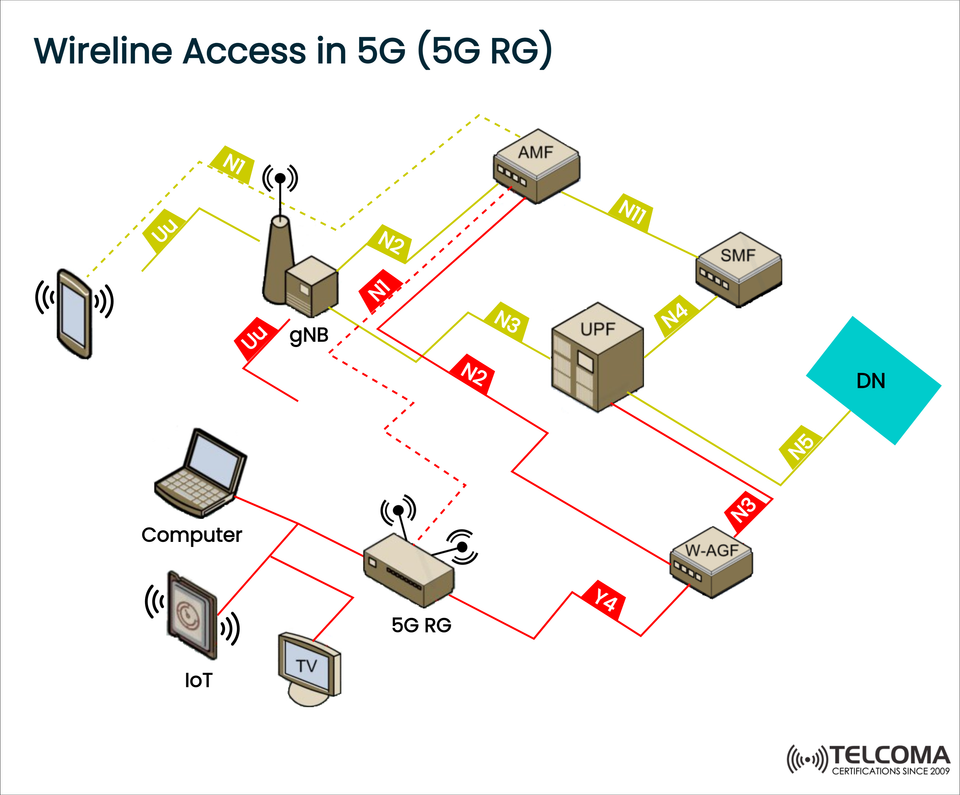

The 5G era is changing the game when it comes to connectivity, creating a bridge between wireless and wireline networks. Most talks around 5G tend to zero in on radio access (wireless), but we shouldn't overlook how important wireline access is within the 5G setup. That's where the 5G Residential Gateway (5G RG) comes in.
In the diagram provided, you can see how wireline access devices—like computers, TVs, and IoT systems—connect through a 5G RG to the 5G core network. This setup shows how fixed broadband services fit right into the 5G environment, utilizing standardized interfaces and functions such as W-AGF (Wireline Access Gateway Function), AMF (Access and Mobility Management Function), SMF (Session Management Function), and UPF (User Plane Function).
In this blog, we’ll dive into the architecture, components, and benefits of bringing wireline access into the mix with 5G, particularly highlighting the essential role of the 5G RG.
What is Wireline Access in 5G?
Wireline access in the 5G framework refers to bringing fixed broadband connections—like fiber, DSL, and cable—into the fold of the 5G core network. Unlike traditional broadband systems that plug into their own separate core, 5G allows for:
A unified architecture for both fixed and wireless users who connect to the same 5G core.
Shared service functions for things like authentication, session management, and policy control.
End-to-end convergence that offers consistent services across mobile and wireline devices.
This kind of convergence breaks down silos between networks, creating a flexible and scalable environment that supports everything from residential broadband to enterprise services and IoT.
The Role of the 5G Residential Gateway (5G RG)
The 5G Residential Gateway (5G RG) serves as the customer-premises equipment (CPE) that links household or enterprise devices—think computers, TVs, and IoT systems—to the 5G core network.
Key Responsibilities of the 5G RG:
Protocol Conversion: Converts wireline signals into formats that the 5G core can handle.
Session Management: Helps smoothly onboard user devices to the 5G network.
Seamless Connectivity: Acts as a single access point for all devices in a home or business.
Hybrid Capabilities: Combines wireline access with wireless options (fixed wireless access) for added reliability.
In a nutshell, the 5G RG is the link that integrates traditional fixed broadband with the cutting-edge 5G ecosystem.
Understanding the Architecture: Wireline Access with 5G RG
The diagram outlines how devices connect to the 5G core through defined reference points (interfaces). Let’s break down the flow.
- End Devices
Computers, IoT devices, TVs, and more connect to the 5G RG via wired Ethernet or Wi-Fi.
These devices rely on the RG to establish a secure session with the 5G core.
- 5G Residential Gateway (5G RG)
Connects user devices to the Wireline Access Gateway Function (W-AGF).
Provides essential support for authentication, routing, and session initiation.
Manages multiple traffic streams at once.
- Wireline Access Gateway Function (W-AGF)
Sits between the 5G RG and the 5G core.
Facilitates the Y4 reference point, linking the 5G RG to the W-AGF.
Converts wireline access into a format that the 5G Access Management Function (AMF) can use.
- Core Network Functions
AMF (Access and Mobility Management Function): Handles registration, authentication, and mobility— even for fixed devices. Connects via the N1 interface to user equipment and N2 to the gNB or W-AGF.
SMF (Session Management Function): Responsible for session establishment and policy enforcement. Communicates with the UPF through the N4 interface.
UPF (User Plane Function): Routes user data traffic to the Data Network (DN), working with both wireless and wireline flows.
- Data Network (DN)
Offers access to internet services, content delivery, enterprise applications, and IoT platforms.
Unified access ensures that all devices—whether wireless or wireline—reach the same network resources.
Key Interfaces in Wireline Access Architecture
The image shows several reference points, each playing a specific role:
Y4: Between 5G RG and W-AGF, supports wireline access signaling.
N2: Links W-AGF (or gNB) to the AMF for control signaling.
N3: Connects W-AGF to the UPF for data forwarding.
N4: Between SMF and UPF, enabling session management.
N5: Connects the UPF to the Data Network.
N11: Links AMF with SMF to coordinate control-plane activities.
This standardized interface framework lays the groundwork for interoperability across different vendors and access types.
Benefits of Wireline Access in 5G with 5G RG
Wireline access within 5G brings substantial advantages for both operators and users:
For Operators
Simplified Core Operations: One unified core for both wireless and wireline connections.
Reduced Costs: No need for parallel infrastructures.
Flexible Service Delivery: Capability to bundle broadband and mobile services.
For Users
Seamless Experience: Consistent services throughout all devices.
High Performance: Low latency and high throughput through 5G Quality of Service (QoS).
Reliability: Hybrid access guarantees a resilient connection.
Wireline Access vs. Wireless Access in 5G
Feature Wireline Access (5G RG)Wireless Access (gNB)Primary Use Case Home broadband, IoT, TV Mobile connectivity, FWA Access Device5G RG Smart phone, 5G modem Gateway Function W-AGF Direct gNB to AMF/UPF Mobility Static (no handover)Full mobility support Latency Very low, stable Low, but varies with radio Integration Via Y4 + W-AGF Direct via gNB interfaces
This comparison highlights that while wireline access isn’t about mobility, it does offer stable, high-capacity, and reliable connectivity, which balances out wireless solutions.
Wireline Access in 5G Use Cases
Residential Broadband: Fiber users can access through 5G RG, allowing integration with mobile subscriptions.
Smart Homes: IoT devices, TVs, and smart gadgets connect directly to the 5G core.
Enterprises: Offices can unify fixed broadband and 5G services for better management.
Hybrid Access: Combining fixed and wireless for redundancy and enhanced performance.
Challenges in Wireline Integration
Legacy Infrastructure: Transitioning from traditional broadband cores needs careful handling.
Interoperability: Deployments with multiple vendors must follow 3GPP standards.
Scalability: Managing massive IoT traffic alongside existing broadband users.
Security: Safeguarding converged networks from cyber threats.
The Future of Wireline Access in 5G
As 5G continues to evolve, wireline access is set to play an even bigger role:
Network Slicing: Allows dedicated slices for broadband, IoT, and enterprise needs.
Edge Computing: Facilitates low-latency services closer to users.
6G Roadmap: Convergence will intensify, with AI-driven orchestration across both wireline and wireless.
The 5G RG will remain essential, ensuring smooth integration and evolution of the networks.
Conclusion
Wireline access in the 5G landscape, driven by the 5G Residential Gateway (5G RG), acts as a fundamental part of network convergence. By linking fixed broadband into the 5G core via the W-AGF and standardized interfaces, telecom operators can provide seamless, unified, and future-ready services.