
X-Haul Evolution in 5G Networks: Fronthaul, Midhaul, and Backhaul Explained
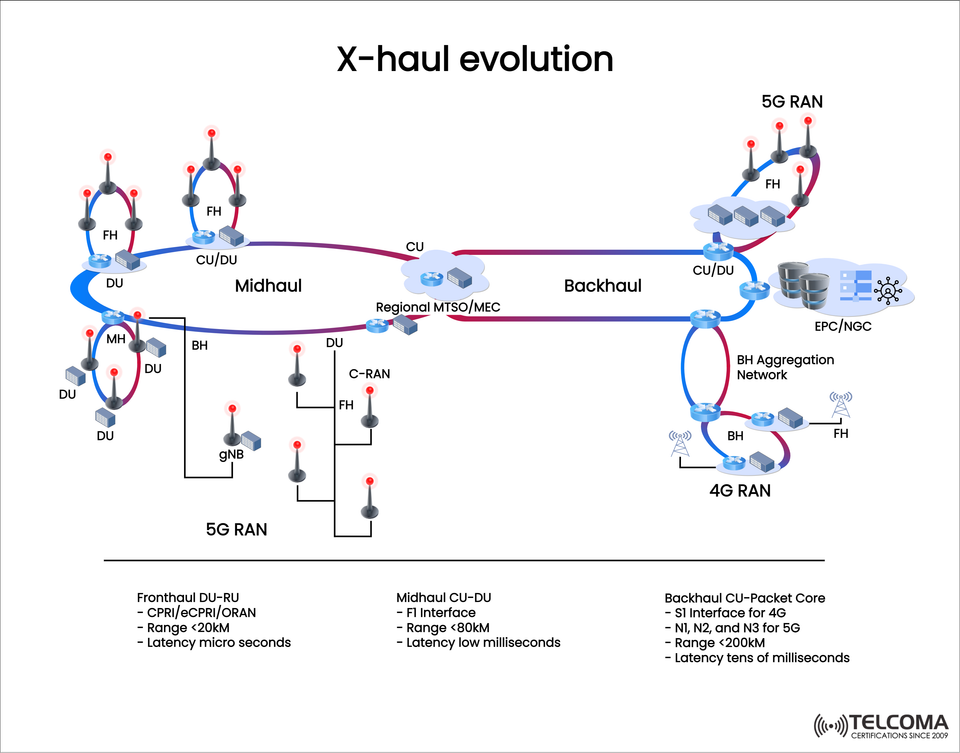

Understanding X-Haul in 5G Networks: An Overview of Fronthaul, Midhaul, and Backhaul
As 5G networks roll out globally, the need for high-capacity, low-latency transport is more crucial than ever. Traditional backhaul alone just can't handle the complex and disaggregated architecture of 5G, which breaks down the radio access network (RAN) into distributed units (DU), central units (CU), and radio units (RU).
This is where X-haul comes into play—a comprehensive transport framework that encompasses fronthaul, midhaul, and backhaul, designed for flexible, scalable, and efficient connectivity. The diagram titled “X-haul Evolution” provides a clear picture of how these components interact to support both 4G and 5G RANs, along with their respective interfaces and latency requirements.
In this post, we’ll take an in-depth look at the X-haul concept, trace its evolution, dissect its components, and see how it’s transforming telecom networks for the 5G era and beyond.
What is X-Haul?
X-haul is a broad term that covers the various types of transport links needed in modern mobile networks:
Fronthaul (FH): Links Radio Units (RU) to Distributed Units (DU).
Midhaul (MH): Connects Distributed Units (DU) with Central Units (CU).
Backhaul (BH): Links Central Units (CU) to the core network (EPC/NGC).
X-haul is vital for 5G because the network is disaggregated, meaning functions are divided among RU, DU, and CU. Each part has its own capacity, latency, and distance needs.
Why the Evolution of X-Haul is Important
With 5G RAN disaggregation and cloud-native setups, transport networks need to adapt to handle:
Huge Bandwidth: Necessary for enhanced mobile broadband (eMBB).
Ultra-Low Latency: Key for URLLC (Ultra-Reliable Low-Latency Communication).
Flexibility: Must support multiple interfaces like CPRI, eCPRI, and ORAN.
Scalability: Required for thousands of small cells in crowded urban settings.
Convergence: Bringing together 4G and 5G transport over shared infrastructure.
X-Haul Components Explained
The diagram showcases three main segments: fronthaul, midhaul, and backhaul. Let’s break each one down further.
- Fronthaul (DU-RU Connection)
Definition:
Fronthaul links connect the Distributed Unit (DU) to the Radio Unit (RU).
Key Features:
Interfaces: CPRI, eCPRI, ORAN
Range: Less than 20 km
Latency: Microseconds
Why It Matters:
It demands ultra-low latency since it carries real-time radio signals directly.
Very bandwidth-heavy, especially with massive MIMO and 5G NR.
Transitioning from legacy CPRI to eCPRI/ORAN supports packet-based transport, enhancing scalability.
Use Case:
Ideal for dense urban 5G setups with high throughput demands, such as cloud VR or AR gaming.
- Midhaul (DU-CU Connection)
Definition:
Midhaul connects the DU to the CU, often through regional MTSO (Mobile Telephone Switching Office) or MEC (Multi-access Edge Computing) nodes.
Key Features:
Interface: F1 interface (defined by 3GPP)
Range: Less than 80 km
Latency: Low milliseconds
Why It Matters:
It manages non-real-time RAN functions like scheduling and data aggregation.
Balances performance and cost by allowing centralized CU processing.
Supports MEC integration, which cuts down latency for edge applications.
Use Case:
Great for applications that need moderate latency, such as video streaming, connected vehicles, or smart city initiatives.
- Backhaul (CU-Core Connection)
Definition:
Backhaul links connect the Central Unit (CU) with the packet core (EPC in 4G or 5G Core/NGC).
Key Features:
Interfaces: S1 (4G), N1/N2/N3 (5G)
Range: Less than 200 km
Latency: Tens of milliseconds
Why It Matters:
It’s less sensitive to latency compared to fronthaul, but it needs to handle large traffic volumes.
Essential for providing internet access, cloud services, and enterprise applications.
Typically constructed using fiber optics, microwave, or satellite links, especially in rural settings.
Use Case:
Connects RAN to the core for all subscriber and enterprise traffic.
Comparing X-Haul in 4G vs 5G
Parameter4G Transport5G Transport (X-Haul)Architecture Primarily backhaul Fronthaul, Midhaul, BackhaulInterfacesS1, CPRI e CPRI, ORAN, F1, N1/N2/N3Latency Needs Tens of ms Microseconds to ms Bandwidth Demand Moderate (LTE)Extremely high (5G NR, mMIMO)Flexibility Limited Highly flexible, disaggregated
Challenges of X-Haul Evolution
While X-haul offers the needed flexibility for 5G, it comes with its own set of challenges:
High Cost of Fiber Deployment – Especially in less populated areas.
Maintaining Latency Guarantees – Difficult for fronthaul over longer distances.
Complex Integration – Ensuring multi-vendor compatibility with ORAN.
Power and Space Limitations – At DU/CU sites.
Security Risks – Broader attack surface in a distributed RAN setup.
The Role of ORAN in X-Haul
Open RAN (ORAN) is changing the game for fronthaul and midhaul with:
Disaggregated, open interfaces for easier multi-vendor setups.
Packet-based fronthaul (eCPRI) for better efficiency.
Cost savings by decreasing vendor lock-in.
Cloud-native integration with MEC and virtualized CU/DU functions.
The Future of X-Haul: A Look Toward 6G
X-haul will keep evolving as networks make the leap to beyond 5G (B5G) and 6G. Expect to see:
AI-driven transport optimization for smarter traffic management.
Terahertz spectrum for ultra-high-capacity wireless fronthaul.
Satellite integration for global coverage.
End-to-end network slicing across all transport layers.
Key Takeaways
X-haul = Fronthaul + Midhaul + Backhaul → a unified transport for 5G.
Fronthaul: Needs ultra-low latency (<20 km).
Midhaul: Flexible and supports MEC integration (<80 km).
Backhaul: Provides a high-capacity link to the core (<200 km).
The evolution of 5G necessitates transport networks that are scalable, disaggregated, and latency-aware.
In Conclusion
The progression of X-haul transport is crucial for the success of 5G. By breaking down the RAN and integrating fronthaul, midhaul, and backhaul, telecom operators can effectively address the challenges of latency, capacity, and scalability.
For those in the telecom field, understanding the X-haul architecture is vital for constructing robust and future-ready 5G networks. As ORAN, MEC, and AI continue to influence this transformation, X-haul will be a key driver of next-gen mobile connectivity—paving the way for the 6G era.