
XG-PON1 Wavelength Allocation Explained: Spectrum Bands for Fiber Networks

With the growing demand for broadband, Passive Optical Networks (PONs) have stepped up, increasing their capacity and improving how they work alongside older systems. A significant upgrade from GPON is XG-PON1, which has been standardized by ITU-T. It can handle 10 Gbps for downloads and 2.5 Gbps for uploads, all while staying compatible with existing GPON setups and RF video services.
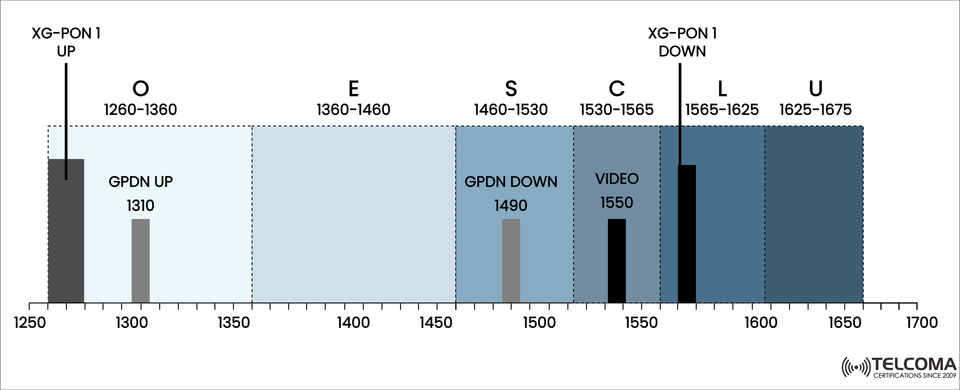
The image attached gives a clear picture of how various wavelength bands are designated for upstream and downstream data, along with GPON and video services within the optical fiber spectrum.
Wavelength Bands in Optical Networks
The optical fiber spectrum has multiple wavelength bands that help separate different types of transmissions. These bands are defined as follows:
O-band (1260–1360 nm): The original band used for upstream.
E-band (1360–1460 nm): An extended band.
S-band (1460–1530 nm): A short wavelength band.
C-band (1530–1565 nm): The conventional band that’s widely utilized for long-haul DWDM.
L-band (1565–1625 nm): A long wavelength band.
U-band (1625–1675 nm): An ultra-long wavelength band, which is not used as often.
Each band carries different PON signals, preventing interference and allowing services to coexist.
XG-PON1 Spectrum Allocation
The diagram below compares the wavelength allocation of XG-PON1 with older GPON and video services:
- XG-PON1 Upstream (1260–1280 nm)
Found in the O-band.
Narrow range to minimize overlap with GPON upstream (1310 nm).
Designed for low dispersion transmission in single-mode fiber.
- XG-PON1 Downstream (1575–1580 nm)
Located in the L-band.
This range avoids overlap with GPON downstream (1490 nm) and video overlay (1550 nm).
Ensures enough separation for coexistence filters in Optical Line Terminals (OLTs).
- GPON Upstream (1310 nm)
Situated in the O-band.
Well-established in current networks, still functioning alongside XG-PON1.
- GPON Downstream (1490 nm)
Found in the S-band.
Active during the coexistence period to assist legacy users.
- RF Video Overlay (1550 nm)
Located in the C-band.
Utilized for both analog and digital broadcast video services.
Still important for operators providing IPTV or mixed broadcast/IP services.
Coexistence of GPON and XG-PON1
A main goal of XG-PON1 was to ensure it could coexist smoothly with GPON. Operators can't just replace millions of Optical Network Terminals (ONTs) all at once. Instead, they use coexistence elements like WDM filters at the OLT to separate signals from GPON and XG-PON1.
Upstream coexistence: GPON at 1310 nm, XG-PON1 at 1260–1280 nm.
Downstream coexistence: GPON at 1490 nm, XG-PON1 at 1575–1580 nm, and video at 1550 nm.
This separation of wavelengths allows both technologies to operate simultaneously on the same fiber network.
Advantages of XG-PON1 Wavelength Plan
The wavelength plan has several perks for both operators and users:
✅ Backward compatibility – GPON and XG-PON1 can coexist without issues.
✅ Efficient spectrum usage – Uses non-overlapping bands for upstream and downstream communications.
✅ Support for video services – Keeps the 1550 nm band available for RF video.
✅ Future-ready – Leaves space for future upgrades, like XGS-PON (10 Gbps symmetrical).
Technical Parameters of XG-PON1
FeatureXG-PON1 Value GPON Value Downstream Wavelength1575–1580 nm (L-band)1490 nm (S-band)Upstream Wavelength1260–1280 nm (O-band)1310 nm (O-band)Downstream Rate10 Gbps2.5 Gbps Upstream Rate2.5 Gbps1.25 Gbps Video Overlay1550 nm (C-band)1550 nm (C-band)
This table illustrates how XG-PON1 delivers higher bandwidth while keeping compatibility with GPON and video services intact.
Practical Deployment Considerations
For telecom operators looking to upgrade to XG-PON1, they should keep in mind:
WDM filters: Needed to separate GPON, XG-PON1, and video wavelengths.
ONT upgrades: Customers still using GPON will eventually need to switch to XG-PON1 ONTs.
OLT upgrades: XG-PON1 requires new OLT line cards that include wavelength-specific optics.
Fiber plant compatibility: Standard single-mode fiber (SMF-28) can support the XG-PON1 bands without needing changes.
Evolution Beyond XG-PON1
Though XG-PON1 is a major step forward, there are already plans in place for further advancements:
XGS-PON: Offers symmetrical 10 Gbps for both downloads and uploads, using the same wavelength plan as XG-PON1.
NG-PON2 (TWDM-PON): Allows multiple wavelengths per direction, achieving aggregate rates exceeding 40 Gbps.
25G/50G PON: In development for next-gen ultra-broadband access.
XG-PON1 vs XGS-PON: Wavelength Allocation and Performance
XG-PON1 was a significant advancement in technology, but it didn't take long for the industry to recognize the importance of symmetrical bandwidth. This realization paved the way for XGS-PON, which is standardized under ITU-T G.9807.
So, how do XG-PON1 and XGS-PON stack up against each other?
FeatureXG-PON1XGS-PONDownstream Wavelength1575–1580 nm (L-band)1575–1580 nm (L-band)Upstream Wavelength1260–1280 nm (O-band)1260–1280 nm (O-band)Downstream Data Rate10 Gbps10 GbpsUpstream Data Rate2.5 Gbps10 GbpsSymmetryAsymmetric (10/2.5 Gbps)Symmetric (10/10 Gbps)Coexistence with GPONYesYesTarget Use CasesHigh-speed residential + SMBEnterprise + Mobile Backhaul
Key Takeaway
XG-PON1: Ideal for residential broadband where the need for upstream bandwidth isn't so high.
XGS-PON: More suitable for enterprises, cloud services, and 5G backhaul, where you need equal traffic in both directions.
Conclusion
The wavelength allocation of XG-PON1 plays a crucial role in transitioning from GPON to newer fiber networks. By separating the upstream and downstream signals into distinct wavelength bands, XG-PON1 makes sure to:
Maintain backward compatibility with GPON.
Coexist alongside video services.
Utilize fiber spectrum effectively.
Provide a scalable route to higher-capacity PON technologies.
For those in telecom, grasping this wavelength plan is key when planning network upgrades, strategies for coexistence, and future-proofing fiber deployments. As the hunger for broadband continues to grow, this wavelength setup will remain vital for PON advancements.