
ZSM Example of Network Slice as a Service Explained

With the arrival of 5G and beyond, we're seeing the introduction of network slicing. This allows operators to build several logical networks on a shared infrastructure. Each of these slices is specifically designed for various uses, like ultra-reliable low-latency communication (URLLC), enhanced mobile broadband (eMBB), or massive IoT (mMTC).
However, managing these network slices on a large scale is quite complicated. This is where the Zero-touch Service Management (ZSM) framework comes into play. By automating the creation and management of slices throughout their lifecycle, ZSM lets operators provide Network Slice as a Service (NSaaS).
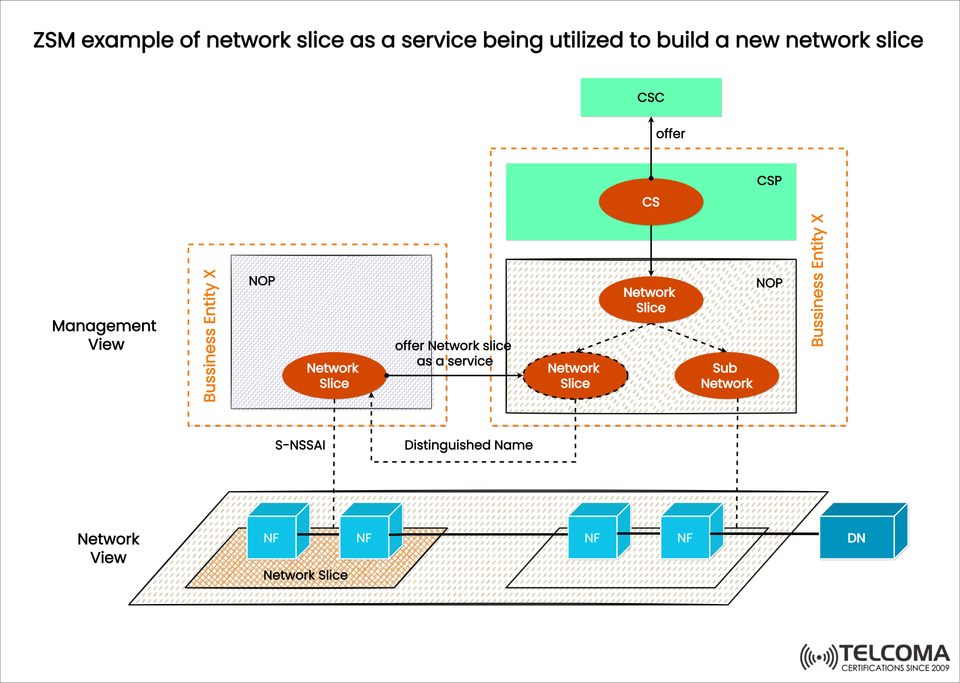
The diagram you uploaded shows how a network slice can be offered as a service to create a new slice, linking the business and management perspectives with the network perspective. Let's break it down step by step.
Understanding the ZSM Framework
The Zero-touch Service Management (ZSM) initiative, led by ETSI, aims to fully automate service and network management. Its main objectives are:
Get rid of manual configurations.
Allow for dynamic and on-demand network slices.
Ensure end-to-end automation in multi-vendor and multi-domain setups.
In this framework, network slicing as a service is provided through an orchestrated and automated approach that guarantees efficiency, scalability, and adherence to service level agreements (SLAs).
Key Components in the Diagram
To understand the diagram, we can focus on two primary perspectives:
Management View (Business-driven orchestration)
Network View (Infrastructure and functions)
Management View
The management view showcases the business entity and orchestration functions. It highlights how network slice instances are created, offered, and overseen.
Business Entity X: Represents the operator or service provider that manages the slices.
NOP (Network Operator Platform): The platform in charge of offering and managing slices.
Network Slice (Service Representation): The logical entity that signifies a slice.
CS (Customer Service): The service perspective presented to the customer.
CSP (Communication Service Provider): The entity that provides slices to customers.
CSC (Customer): The end-user who requests and uses the slice.
Offer Relationship: Network slices are available as a service (NSaaS) for customers or other providers.
Identifiers (S-NSSAI, Distinguished Name): These are used for uniquely identifying and distinguishing slices.
Essentially, the management view simplifies complexity and presents network slices as easily consumable services.
Network View
The network view reveals the underlying infrastructure and resources.
NF (Network Function): These are the virtualized or physical network functions that make up the slice. Examples include AMF, SMF, and UPF in 5G Core.
Sub-Network: A smaller segment of the network used in slice building.
DN (Data Network): External networks, like the Internet or private enterprise networks.
Network Slice (Technical Realization): The actual implementation of logical slices aligned with infrastructure.
The network view ensures that the service intent from the management side gets translated into network configurations and functions.
ZSM Example of Network Slice as a Service
The diagram illustrates how a network slice can be offered as a service to create or compose new slices. This concept introduces nested and hierarchical slicing.
Step-by-Step Explanation
Slice Request from Customer (CSC):
The customer puts in a request for a new service (like IoT connectivity).
This request is sent to the CSP.
Customer Service (CS) Layer:
This layer defines the requested service in business terms (like SLA, QoS).
It also maps the service to one or more network slices.
Network Slice Offered as a Service:
Existing network slices can be used as building blocks for new slices.
For instance, a URLLC slice can be used to develop a smart factory slice.
Management & Orchestration (NOP):
The NOP handles the creation, modification, and management of slices.
It utilizes identifiers like S-NSSAI and Distinguished Name to keep track of slices.
Translation into Network View:
The definitions of network slices are converted into network function (NF) deployments.
Resources such as computing power, storage, and bandwidth are allocated accordingly.
End-to-End Connectivity:
Network functions (NF) connect to the data network (DN).
The slice is now live and can be accessed by the customer.
Benefits of Network Slice as a Service (NSaaS)
Benefit Description Agility Fast creation of new slices using existing components. Scalability Multiple tenants can use slices independently. Resource Efficiency Reusing network functions across slices. Flexibility Supports varied sectors like healthcare, IoT, and automotive. Automation Closed-loop automation reduces the need for manual work.
Real-World Applications
Smart Manufacturing (Industry 4.0):
A factory operator can request a dedicated slice specifically for robots and sensors.
The CSP builds it using earlier created slices for URLLC and private connectivity.
Healthcare:
A hospital may ask for a secure, low-latency slice for remote surgeries.
The operator combines eMBB (for video) and URLLC (for control).
Entertainment:
For live events or AR/VR gaming, temporary slices can be requested.
Operators deliver slices on demand and free up resources afterward.
Challenges in Implementing NSaaS
Complex Orchestration: Operating across multiple domains and vendors requires robust orchestration tools.
Interoperability: To prevent vendor lock-in, standardized APIs and descriptors are a must.
Security & Isolation: Every slice needs to stay fully isolated to avoid data leaks.
Dynamic SLA Enforcement: Continuous monitoring is essential to ensure quality of service (QoS).
How ZSM Overcomes These Challenges
The ZSM framework guarantees:
Closed-loop automation with real-time monitoring and quick fixes.
Standardization through ETSI-defined interfaces.
AI/ML integration for predictive scaling and optimization.
Multi-domain support allowing for coordination across RAN, Core, and transport networks.
With these features in place, ZSM not only makes NSaaS viable but also efficient and secure.
Conclusion
The ZSM example of network slice as a service shows how slices can act as building blocks for new services. By connecting the management view with the network view, operators can deliver customized services to clients while effectively managing their infrastructure.
For telecom professionals, grasping this model is essential for utilizing 5G network slicing in sectors like manufacturing, healthcare, and entertainment.
As networks advance, automation, closed-loop management, and service exposure will be critical for achieving scalable and profitable network slicing.