
ZSM Example of Network Slice as a Service Explained

The rise of 5G and beyond has introduced a game-changing innovation in telecom networks: network slicing. This allows operators to divide a shared infrastructure into various logical networks, or slices, each tailored for a specific purpose like massive IoT, ultra-reliable low-latency communication (URLLC), or enhanced mobile broadband (eMBB).
But trying to create and manage these slices manually? That would be a hassle and likely lead to mistakes. That’s where Zero-touch Service Management (ZSM) steps in. ZSM takes care of slice orchestration and lifecycle management automatically, enabling operators to offer Network Slice as a Service (NSaaS).
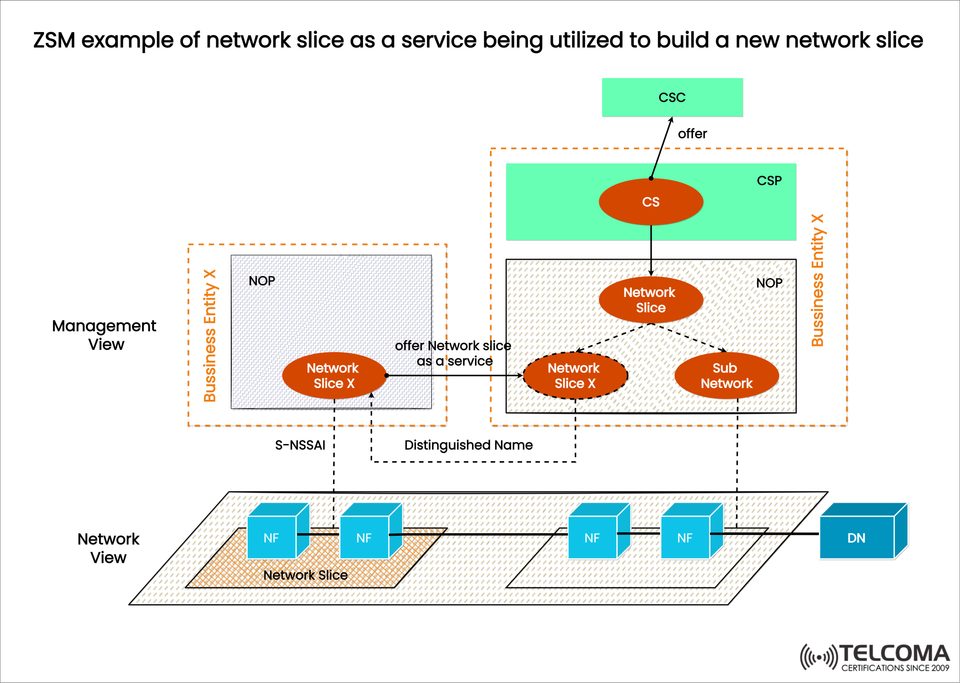
The diagram provided shows how a network slice can be offered as a service and highlights how it can serve as a building block for constructing new slices. This blog will break down the diagram into its management and network views, clarifying how ZSM enables smooth slice automation.
Zero-touch Service Management (ZSM): The Basics
The ETSI ZSM framework is all about achieving end-to-end automation in network and service management. Here are its main goals:
No manual work – everything runs automatically.
Service-focused view – treat slices as services, not just infrastructure.
Cross-domain orchestration – bring together radio access networks (RAN), transport, and core.
Closed-loop operations – monitor in real-time and optimize with AI.
In this setup, network slice as a service becomes a key component for providing flexible, scalable, and customer-oriented 5G services.
Understanding the Diagram
The diagram illustrates an example of ZSM where network slice as a service is being used to build a new slice. It has two main layers:
Management View (Service abstraction and orchestration)
Network View (Technical realization)
- Management View
This layer simplifies the technical details and presents slices as services that can be consumed.
Key components include:
Business Entity X – The operator or service provider in charge of managing and offering slices.
NOP (Network Operator Platform) – Oversees the lifecycle of slices to ensure they meet service level agreements (SLAs).
Network Slice X – An existing slice that's ready to be offered as a service.
CS (Customer Service) – This represents the service from the customer’s viewpoint.
CSP (Communication Service Provider) – Delivers the service to the customer.
CSC (Customer) – The end user or business that requests the slice.
Offer Relationship – Existing slices, like Slice X, can be turned into services to create new slices.
Identifiers (S-NSSAI, Distinguished Name) – Ensure that slices are recognized uniquely across different domains.
Overall, the management view translates business needs into service definitions that link back to the underlying network.
- Network View
This layer shows how slices are actually implemented with network functions and infrastructure.
Key components include:
NF (Network Functions): These can be virtualized or physical functions (for example, AMF, SMF, UPF in 5G Core).
Sub Network: A smaller network segment that contributes to a larger slice.
DN (Data Network): External connections, such as the Internet or private enterprise networks.
Network Slice: The logical representation of the slice that’s been mapped to the necessary infrastructure resources.
Here, the service intent from the management view is turned into real deployments of network functions.
Example Flow: Creating a New Slice
Here's how the process of building a new slice using an existing one as a service generally works:
Customer Request (CSC → CSP): The customer asks for a service, like secure IoT connectivity, and the CSP receives it.
Service Definition (CS Layer): The CSP outlines what the service needs (like latency, throughput, isolation) and checks which existing slices can fulfill that or if new ones are needed.
Offering Existing Slice (Network Slice X): An already available slice, like a URLLC-enabled slice, is offered as a service and becomes a building block.
Creating the New Slice: The NOP combines Network Slice X with Sub-Network(s), using identifiers (like S-NSSAI) to ensure everything is distinct.
Instantiation in Network View: Resources are allocated to the Network Functions, and connectivity is set up with the DN.
Service Delivery: The new slice is then delivered to the customer (CSC) while meeting the required SLAs.
Management View vs. Network View Comparison
Aspect Management View Network View Focus Business abstraction, service intent Technical realization Actors CSP, CSC, NOP, Business Entities Network Functions, Sub-Networks, DN Objects Customer Service, Slice X (as-a-service)NF instances, logical slices Identifiers S-NSSAI, Distinguished Name Resource allocation, NF mapping Outcome Service-level offering Infrastructure-level implementation
Advantages of Network Slice as a Service
Reusability: You can reuse existing slices to create new services.
Efficiency: It optimizes how resources are allocated across various users.
Flexibility: Supports a wide range of sectors, from IoT to healthcare and beyond.
Scalability: You can easily grow existing slices to meet new demands.
Automation: Cuts out the manual work of designing and managing slices.
Real-World Uses
Industry 4.0 (Smart Factories): A factory may need a dedicated slice for robotic automation, so the operator uses an existing URLLC slice to create a private slice.
Healthcare: Hospitals might need low-latency, secure slices for remote surgeries, leading to a new slice built with eMBB and URLLC components.
Entertainment (AR/VR): Event organizers could ask for temporary slices to support high-bandwidth AR experiences, and CSPs can quickly deliver those slices using NSaaS.
Challenges with NSaaS
Multi-vendor Integration: Making sure everything works together across different vendors.
SLA Enforcement: Keeping track of performance and ensuring compliance at scale.
Security and Isolation: Protecting against data breaches between slices.
Complex Orchestration: Automating the creation of slices can still be quite challenging.
How ZSM Tackles These Challenges
The ZSM framework offers:
Closed-loop automation – allows for real-time monitoring and adjustments.
Standardized APIs – ensuring easy compatibility across various vendors.
AI/ML-driven management – enables predictive scaling and anticipatory optimization.
Cross-domain orchestration – providing unified control across RAN, Core, and Transport.
This guarantees that NSaaS can be effectively implemented without sacrificing either performance or security.
Wrap-Up
The ZSM example highlighting network slice as a service shows how existing slices can be utilized as fundamental components to create new ones. By connecting the management view, which focuses on service abstraction, with the network view, which tackles infrastructure realization, operators can craft flexible, scalable, and automated slices designed to meet a wide array of customer needs.
For professionals in telecom, this marks a significant move towards customer-focused, automated 5G networks. With ZSM, operators can seamlessly deliver Network Slice as a Service, paving the way for new applications across fields like IoT, healthcare, manufacturing, and entertainment.