
ZSM Example of Network Slice as a Service in 5G

With the rise of 5G networks, network slicing has become a game-changer. It lets operators divide a shared infrastructure into various logical slices that cater to specific needs like enhanced Mobile Broadband (eMBB), ultra-reliable low latency communications (URLLC), or massive IoT applications.
However, trying to manage these slices by hand just isn’t feasible in today’s hyper-connected world. That’s where Zero-touch Service Management (ZSM) comes in. As defined by ETSI, ZSM guarantees the end-to-end automation of network and service management, making it easier for operators to provide Network Slice as a Service (NSaaS) without a hitch.
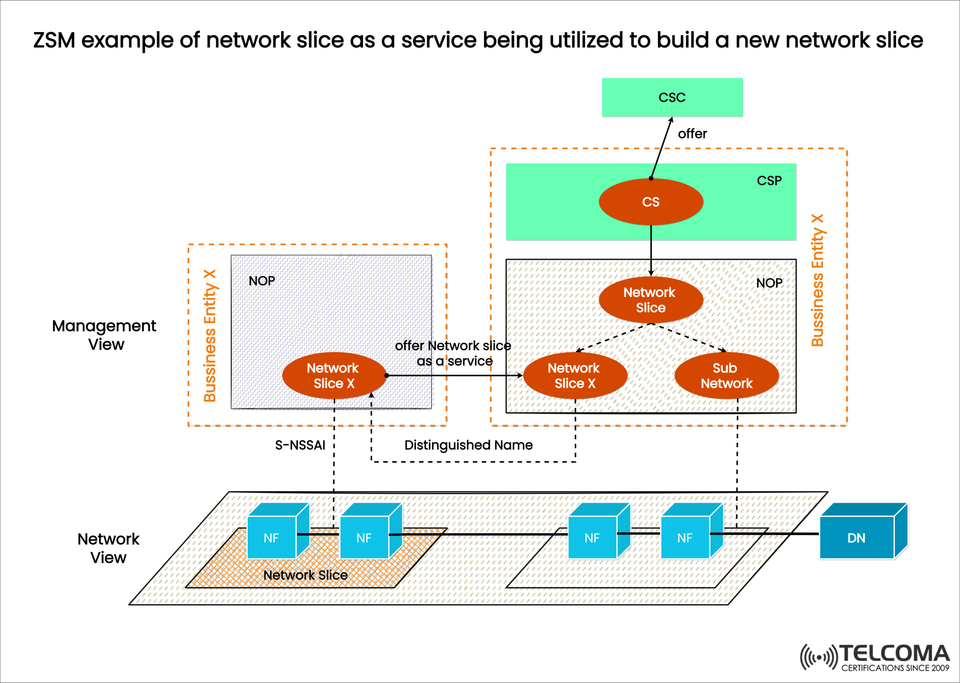
The diagram included shows an example of NSaaS. It depicts how an existing slice can be offered as a service and used as a building block for creating a new network slice. This blog will unpack that image, looking at both the management and network perspectives, and clarify how ZSM connects business goals with actual network execution.
What is Zero-touch Service Management (ZSM)?
ZSM is a framework developed by ETSI to facilitate fully automated service and network management. Its main features include:
An automation-first approach that minimizes the need for human intervention.
Service-centric abstraction, which focuses on managing networks at the service level instead of just resources.
Closed-loop automation that involves real-time monitoring and fixes using AI/ML.
Cross-domain orchestration for unified control over RAN, transport, and core.
Programmability that supports Network-as-a-Service (NaaS) and Slice-as-a-Service (SlaaS) models.
This framework is crucial for 5G and beyond since dynamic service demands require flexible and intelligent management.
Breaking Down the Diagram
The diagram, titled “ZSM example of network slice as a service being utilized to build a new network slice,” provides a two-tier view:
Management View (business and service abstraction)
Network View (technical realization of slices)
- Management View
This upper layer gives a business-driven, service-oriented perspective. It simplifies the technical details, allowing operators and customers to interact based on services instead of network components.
Key elements:
CSC (Customer): The one requesting a network service.
CSP (Communication Service Provider): The provider of services, interacting with NOP.
CS (Customer Service): Represents the customer's request in service terms.
Business Entity X: The operator entity managing the slices.
NOP (Network Operator Platform): Manages the life cycle of slices.
Network Slice X: An existing slice that can be reused and offered as a service.
Sub Network: Smaller segments that make up the slice composition.
Identifiers (S-NSSAI & Distinguished Name): Used to uniquely identify and manage slices across domains.
This view illustrates how Network Slice X can be presented as a service by the NOP and combined with other sub-networks to create a new network slice.
- Network View
The lower layer showcases the actual technical implementation.
Key elements:
NF (Network Functions): These are virtualized or physical functions such as AMF, SMF, or UPF in 5G.
Network Slice: A logical instantiation achieved by coordinating NFs.
DN (Data Network): Provides external connectivity to the internet or enterprise networks.
Here, the service request from the management layer is translated into infrastructure-level actions, ensuring SLA compliance and connecting as needed.
Example Flow: Building a New Slice with NSaaS
The image outlines how to create a new slice using an existing one:
Customer Request: The CSC sends a service request to the CSP.
Service Abstraction: The CSP translates the request into a Customer Service (CS).
Offering Existing Slice (Network Slice X): Business Entity X offers Network Slice X as a service, identified by S-NSSAI and Distinguished Names.
Composition of New Slice: The NOP merges Network Slice X with other sub-networks to create a new Network Slice that meets service needs.
Realization in Network View: NFs are activated, and connectivity to DN is set up.
Service Delivery: The new slice is delivered to the customer, meeting the defined SLAs.
Comparison: Management View vs. Network View
Aspect Management View Network View Focus Service abstraction, business logic Technical realization, infrastructure Actors CSP, CSC, NOP, Business Entity X Network Functions, DN Objects CS, Network Slice X (as-a-service), Sub-networks NF instances, logical slices Identifiers S-NSSAI, Distinguished Name Resource allocation and mapping Outcome Customer-facing service Network-level implementation
Benefits of Network Slice as a Service
Reusability: Existing slices can be employed as services for new slices.
Efficiency: Resource allocation is optimized across multiple tenants.
Scalability: Slices can be easily expanded to meet increasing demands.
Flexibility: It can support various industries like IoT, healthcare, and AR/VR.
Automation: Facilitates zero-touch creation and management of slices.
Real-World Applications of NSaaS
Smart Manufacturing (Industry 4.0): Reuse an ultra-low latency slice for robotic automation in factories.
Healthcare: Build a dedicated medical slice from secure URLLC-enabled slices.
Entertainment & AR/VR: Provide temporary high-bandwidth slices for live events.
Smart Cities: Merge existing IoT slices with sub-networks to manage traffic and utilities.
Challenges in NSaaS
While promising, NSaaS does have its challenges:
Interoperability: Integrating slices across multiple vendors and domains.
SLA Assurance: Ensuring latency, throughput, and reliability.
Security: Keeping slices well-isolated from each other.
Complexity: Managing slice composition across different infrastructure layers.
How ZSM Addresses These Challenges
The ZSM framework tackles these challenges through:
Closed-loop automation for proactive monitoring and correction.
AI/ML-driven orchestration to enhance slice performance.
Standardized APIs for better interoperability.
End-to-end orchestration covering RAN, transport, and core.
This approach makes Network Slice as a Service both practical and scalable in the era of 5G and beyond.
Conclusion
The diagram highlights a key use case in Zero-touch Service Management (ZSM): Network Slice as a Service (NSaaS). By reusing existing slices as services, operators can efficiently create new network slices tailored to changing customer needs.
By distinguishing between the management view (business abstraction) and the network view (technical realization), NSaaS ensures clarity, automation, and scalability. This makes NSaaS a vital component for the future of 5G service delivery and empowers industries like healthcare, manufacturing, AR/VR, and smart cities to thrive with programmable, automated networks.