
ZSM Example of Network Slice as NOP Internal Explained

Introduction: The Importance of ZSM in Network Slicing
Zero-touch network and Service Management (ZSM) is shaking things up in the world of telecom networks. This approach focuses on automation from the ground up, managing services, slices, and network operations without needing any manual input. As 5G, IoT, and cloud-native frameworks gain traction, network slicing has become crucial for offering customized services across various industries and use cases.
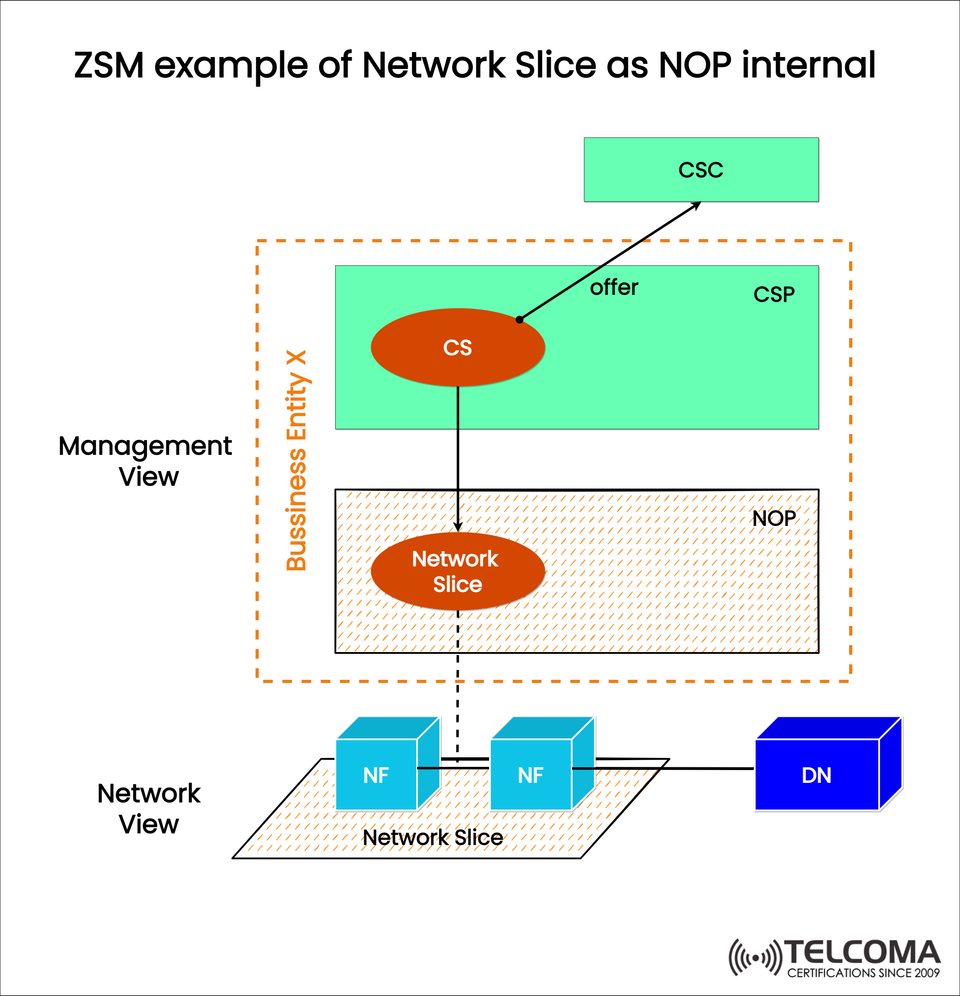
The diagram above gives a glimpse into how ZSM works with Network Slice as an NOP (Network Operator) internal, showing the interaction between management and network perspectives. To grasp this architecture fully, we need to dive into its components and what they each do.
What’s Network Slicing in 5G?
Network slicing allows us to break down a physical network into several virtual slices. Each slice caters to a specific service need, like:
eMBB (Enhanced Mobile Broadband): Great for high-definition video streaming and AR/VR.
URLLC (Ultra-Reliable Low-Latency Communication): Essential for critical services like self-driving cars or healthcare.
m MTC (Massive Machine-Type Communication): Designed for IoT applications that support a ton of devices.
Basically, a network slice acts as an end-to-end logical network, covering radio, transport, core, and service layers.
The ZSM Framework in Network Slicing
The ZSM framework is all about automating every facet of network and service management. Its core design principles are:
Automation & Zero-Touch: Gets rid of manual configurations.
Modularity: Components can change independently.
Service-Based Architecture (SBA): Flexible operations driven by APIs.
AI/ML Integration: Uses predictive analytics and self-healing mechanisms.
When we apply ZSM to network slicing, it guarantees that each slice is set up, monitored, and adjusted automatically based on business or service demands.
Decoding the Diagram: ZSM Example of Network Slice as NOP Internal
The diagram splits into two key perspectives:
Management View (Business Entity X & CSP interaction)
Network View (Real network functions and resources)
Let’s break down each part:
- Management View
CSC (Customer Service Consumer): Represents the customer or service consumer who wants a network slice. Think of an enterprise needing a dedicated 5G slice for IoT devices.
CSP (Communication Service Provider): The entity providing network slicing services. It connects with the CSC and makes the service offer.
CS (Communication Service): The specific service instance agreed upon by the CSP and CSC, detailing what the network slice must deliver (like bandwidth, latency, reliability).
Business Entity X: Defines the boundaries of the business that manages the network slice, outlining how the CSP fulfills its commitments to the CSC.
Network Slice (under NOP): Within the CSP’s realm, the Network Operator (NOP) oversees the slice internally, aligning resources and functions with the promised service.
- Network View
NF (Network Functions): The essential building blocks, such as AMF (Access and Mobility Management Function), SMF (Session Management Function), or UPF (User Plane Function).
DN (Data Network): Represents external networks or application servers the slice interfaces with (like the internet or enterprise networks).
Network Slice Realization: The logical slice defined at the management level connects to actual network functions and resources here.
How ZSM Connects Management and Network Views
The power of ZSM lies in bridging business intent with technical execution:
CSC places a service request.
CSP translates that request into a communication service.
The Network Operator (NOP) creates and manages a network slice that meets the agreed service.
Network Functions (NFs) are allocated, monitored, and adjusted automatically.
End-to-end service is delivered without much human intervention.
This process makes sure that service-level agreements (SLAs) are met while using resources efficiently.
Key Advantages of ZSM in Network Slice Management
End-to-End Automation: No more manual provisioning needed.
Agility: Speedier rollout of new slices and services.
Resource Optimization: Better use of NF resources.
Dynamic Adjustments: AI/ML can adjust slices in real-time.
Scalability: Easily supports massive IoT and industry-specific slices.
Customer-Centricity: Tailored services for sectors like healthcare, automotive, or smart cities.
Real-World Uses of ZSM-Enabled Network Slicing
Industry Use Case Benefit of Network Slice + ZSM Healthcare Remote surgery Ultra-low latency, reliable URLLC slice Automotive Autonomous driving High reliability and mobility support Smart Cities IoT sensors, utilities Massive scalability via m MTC slice Media & Entertainment8K streaming, AR/VR High throughput with e M B B Enterprises Private 5G networks Dedicated slices for security and Q o S
Technical Hurdles in Implementing ZSM for Network Slices
Even with its potential, ZSM-driven network slicing has its challenges:
Interoperability: Different vendors and old systems might not mesh well together.
Security: Each slice needs to be isolated and secure.
Complexity: Managing multiple slices with varying QoS requirements is tricky.
Standardization: Ongoing efforts in ETSI ZSM and 3GPP are vital for ensuring global consistency.
The Future of ZSM and Network Slicing
The telecom industry's future is leaning heavily on automation. With AI, ML, and intent-based networking, ZSM will keep evolving:
Self-Healing Networks: Automating fault detection and correction.
Predictive Resource Allocation: AI forecasting demand spikes and prepping slices ahead of time.
Cross-Domain Orchestration: Managing slices spanning multiple operators and cloud environments.
Full Zero-Touch 6G Networks: Extending ZSM principles into 6G for even more complex applications.
Conclusion
The ZSM example of Network Slice as NOP internal illustrates how automation is changing telecom operations. By connecting customer intent (CSC) with technical execution (NFs and DN) through CSPs and NOPs, ZSM is creating a dynamic, efficient, and customer-focused network environment.
For telecom operators and businesses, mastering ZSM-enabled network slicing has shifted from being optional to essential. As we head toward 6G and beyond, zero-touch, automated, slice-based architectures will set the standard for delivering unique, high-performance services.