
3GPP Release 18 Timeline Explained: The Journey to 5G-Advanced

3GPP Release 18 Timeline: The Roadmap to 5G-Advanced
The 3rd Generation Partnership Project (3GPP) has been a vital player in global mobile communication standards for over twenty years, leading the way from 2G GSM all the way to 5G New Radio (NR). Now, as networks gear up for 5G-Advanced, we’re focusing on 3GPP Release 18, which marks the official start of this exciting new phase.
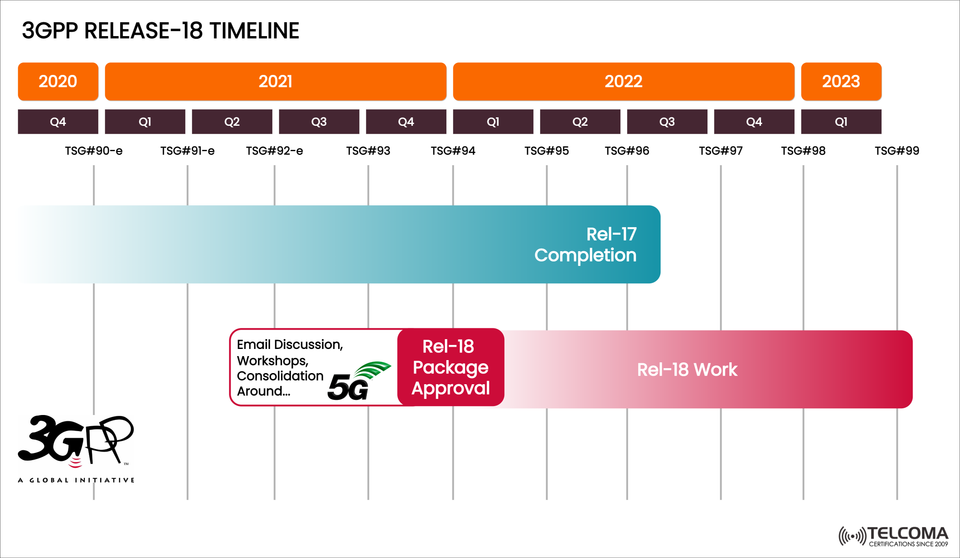
The uploaded image lays out the 3GPP Release-18 timeline, showing the path from Release 17’s completion to the kickoff and ongoing work of Release 18. It highlights how 3GPP has effectively managed the evolution of 5G into this advanced stage through teamwork, standardization, and innovation.
Let’s dig into what this timeline signifies, how Release 18 came about, and what we can expect as we move toward 5G-Advanced.
Understanding the 3GPP Release Cycle
Before we take a closer look at Release 18, it’s good to understand how 3GPP organizes its standardization process.
Each “Release” outlines a set of features, capabilities, and specifications that network vendors, operators, and device manufacturers need to follow in order to ensure everything works smoothly together and keep advancing the ecosystem.
Release 15: Laid the groundwork for 5G (both Non-Standalone and Standalone 5G NR).
Release 16: Brought improvements to 5G, including URLLC, V2X, and industrial IoT.
Release 17: Took 5G further by exploring new areas like satellite integration (NTN), RedCap devices, and extended reality (XR).
Release 18: Officially kicks off 5G-Advanced, with a focus on AI, energy efficiency, network intelligence, and vertical integration.
The Timeline Overview: From Release 17 to Release 18
The timeline image gives a clear visual of the evolution and overlap of 3GPP’s key releases from 2020 to 2023, organized around Technical Specification Group (TSG) meetings.
Year Key MilestoneDescription2020 (Q4)TSG#90-eStart of the finalization for Release 172021 (Q1–Q3)TSG#91–#93Workshops and discussions, focusing on the 5G-Advanced scope2021 (Q4)TSG#94Release 18 Package Approval – the official green light for 5G-Advanced development2022 (Q1–Q3)TSG#95–#96Launch of active Release 18 work, while finishing up tasks from Release 172023 (Q1)TSG#99Release 18 continues moving towards completion and a specification freeze
This timeline shows that 3GPP managed to ensure seamless continuity — completing Release 17 while also planning for Release 18 at the same time.
Release 17 Completion: The Bridge to 5G-Advanced
Release 17 Overview
Wrapped up between 2020 and early 2022, Release 17 built on previous 5G versions by branching out into new fields:
Non-Terrestrial Networks (NTN): Merging satellite communication with 5G.
Extended Reality (XR): Tailoring 5G for VR/AR/MR applications.
Reduced Capability Devices (RedCap): Delivering power-efficient connections for IoT.
Positioning Enhancements: Achieving centimeter-level accuracy for industrial and vehicle needs.
Why It Matters
Release 17 is the final piece of the initial 5G deployment and lays the foundation for Release 18 — and the entirety of 5G-Advanced.
It introduced crucial enablers like network automation, low-latency interfaces, and satellite integration, which 3GPP is now leveraging for future projects.
The Birth of Release 18: From Concept to Approval
In the timeline, the second major milestone is the Release 18 Package Approval, shown by a red section labeled “Email Discussion, Workshops, Consolidation Around 5G”.
Phase 1: Email Discussions & Workshops
Throughout 2021, 3GPP kicked off global discussions involving its technical groups, operators, and vendors to pinpoint the key themes for 5G-Advanced.
Phase 2: Package Approval (TSG#94 – Q4 2021)
By the end of 2021, after thorough collaboration, 3GPP officially approved the Release 18 package, marking it as 5G-Advanced.
This approval phase included:
Prioritizing AI/ML-based network automation.
Enhanced support for extended reality (XR).
Improvements in energy efficiency and sustainability.
Stronger non-terrestrial (satellite) integration.
This moment was a shift — moving from just better connectivity to intelligent, context-aware networks.
Active Release 18 Work (2022–2023): 5G-Advanced Takes Shape
Once approved, work on Release 18 officially kicked off in early 2022, in sync with 3GPP meetings TSG#95 to TSG#99. This time was marked by extensive specification and feature development, involving multiple working groups (RAN, SA, and CT).
Key Focus Areas of Release 18
AI and Machine Learning Integration
Adding AI/ML into the RAN Intelligent Controller (RIC).
Predictive resource optimization for better user experience and network performance.
Network Energy Efficiency
Smart sleep modes for base stations.
AI-driven load balancing for saving power.
Extended Reality (XR) Support
Adaptive network slicing to manage changing XR traffic.
Better latency and jitter management for immersive experiences.
Enhanced Mobility and Coverage
Boosting uplink performance and advanced beamforming.
Improved coverage for IoT and Red Cap devices.
Non-Terrestrial Network Evolution
Bringing together satellite and high-altitude platform networks.
Smooth transitioning between ground and space-based links.
Security and Reliability Enhancements
Strengthened identity management.
Robust cybersecurity for AI-powered systems.
Why It Matters
Release 18 signifies the first step toward 5G-Advanced (Phase 1), establishing the groundwork for intelligent, resilient, and sustainable communication systems.
The Broader Significance of the Release 18 Timeline
The timeline visualization is more than just a historical account — it shows 3GPP’s strategic rhythm in developing global telecom standards.
Highlights:
Continuous Evolution: 3GPP makes sure there’s no downtime between releases, fueling constant innovation.
Global Collaboration: Input from over 700 organizations globally ensures standard harmonization.
Future-Oriented Planning: The start of Release 18 overlaps with the end of Release 17, showcasing 3GPP’s efficiency and forward-thinking approach.
Impact on the Industry
Operators use Release 18 to get their networks ready for upgrades to 5G-Advanced.
Vendors align their R&D efforts to integrate new features into hardware and software.
Regulators utilize the release timeline for spectrum planning and policy adjustments.
This structured approach allows the telecom ecosystem to evolve in a predictable and collaborative manner, ensuring every release adds real value.
What Comes Next: Beyond Release 18
While Release 18 lays the groundwork for the first phase of 5G-Advanced, future releases (19 and beyond) will keep building on this base.
Expected Themes for Release 19 and 20
Fully AI-native networks that can self-optimize and self-repair.
Integration with 6G pre-standard research (sub-THz frequencies, sensing).
Quantum-safe communications for ultra-secure data exchange.
Enhanced network sensing for smarter environments and autonomous mobility.
So, Release 18 is really the launchpad for 6G development, bringing together intelligence, sustainability, and wide-reaching coverage.
Conclusion: 3GPP Release 18 — The Dawn of 5G-Advanced
The 3GPP Release-18 timeline is more than just a series of dates and milestones — it symbolizes a transformational journey for global telecommunications. From the completion of Release 17 in early 2022 to the official start of work on 5G-Advanced, the industry is moving towards smarter, greener, and more adaptable networks.
Key takeaways:
Release 18 started with strategic planning and global collaboration.
It emphasizes AI, XR, NTN, and energy-efficient innovations.
It sets the stage for 5G-Advanced and future 6G developments.
As work on Release 18 progresses, it marks the beginning of a new era where connectivity evolves into intelligent infrastructure — the backbone of the digital society.