
3GPP Solution for Reduced Handover Interruption Time in 5G Networks Explained
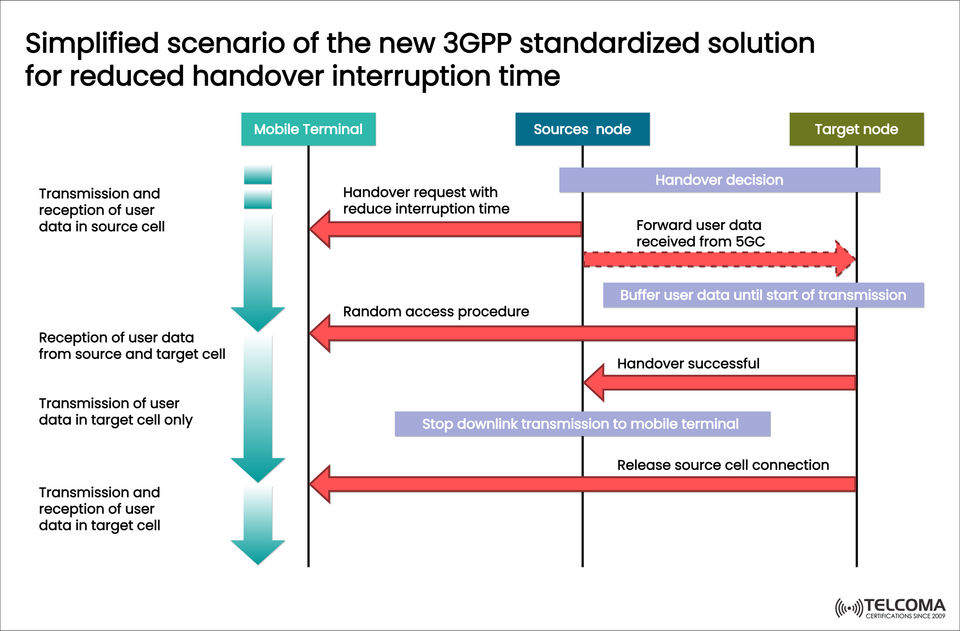

Simplified 3GPP Standardized Solution for Reducing Handover Interruption Time in 5G
When it comes to mobile communication, handover (HO) is a vital process that ensures users stay connected as they move from one network cell to another. In older technology like 4G LTE, even short interruptions during handovers could be quite noticeable and lead to service issues.
With the advent of 5G NR (New Radio), the 3rd Generation Partnership Project (3GPP) has rolled out new methods designed to cut down on handover interruption time (HIT) — that brief period when a mobile device isn’t able to send or receive data during the transition between cells.
The image above illustrates a simplified example of how the 3GPP has optimized the handover process to lessen the disruption for users.
Understanding Handover Interruption Time
Handover Interruption Time (HIT) can be described as:
“The duration during which a mobile device is unable to send or receive user data packets while moving from one cell (source) to another (target).”
This time frame is especially crucial for applications that require ultra-reliable low latency (URLLC), such as:
Autonomous driving
Industrial automation
Augmented and virtual reality
Cloud gaming and remote surgery
5G's goal is to achieve an interruption of less than 20 milliseconds, ensuring users enjoy continuous and reliable service, even when they’re on the move.
- Data Transmission and Reception in the Source Cell
Initially, the mobile terminal (UE) is connected to the source node, carrying out normal data transfer.
All packets are routed through the source gNodeB, which manages:
PDCP (Packet Data Convergence Protocol)
RLC (Radio Link Control)
MAC (Medium Access Control)
PHY (Physical Layer)
- Handover Request with Reduced Interruption Time
Once the UE detects that a neighboring cell has better signal quality, the source node sends a handover request to the target node, highlighting the “reduced interruption time” parameter.
This prompts the target cell to prepare resources in advance, setting the stage for a quick handover.
Handover Decision and Data Forwarding
After the target node gets the handover request:
It makes a decision regarding the handover.
The source node starts forwarding user data (from the 5G Core) to the target node over the Xn interface.
This is a crucial step — it keeps data packets flowing even while the UE is switching cells.
The data forwarding lets the target cell pre-buffer packets, ready for immediate delivery as soon as the UE connects.
- Buffering User Data at the Target Node
The target node holds onto the forwarded user data until it’s ready to start transmitting to the mobile terminal.
This helps to:
Prevent packet loss during the handover
Ensure data is immediately available once the random access is done
Basically, this buffering technique fills the gap between when the handover starts and when transmission can actually begin.
- Random Access Procedure
The UE performs the random access (RACH) procedure to sync with the target cell. This establishes:
Timing alignment
Physical uplink shared channel (PUSCH) resources
RRC connection continuity
While RACH is happening, the source cell can still send downlink packets to the UE, which helps further reduce data interruption.
- Successful Handover
When the random access procedure wraps up, the handover is deemed successful.
At this stage:
The target cell begins sending both the buffered and new user data to the UE.
The UE resumes full data transmission and reception with minimal delay.
- Cease Downlink Transmission from Source Node
Once the target node confirms that the handover was successful, the source node stops sending downlink transmissions to the UE. This helps avoid duplication and makes sure all future packets come directly from the target cell.
- Release Source Cell Connection
Finally, the source node releases the UE context, freeing up network resources.
At this point, the UE is entirely served by the target node and continues with regular data exchanges.
Now, the handover interruption time — which in older systems might have lasted 50-100 ms — is cut down to below 20 ms or even less, depending on how well the network is optimized.
Key Innovations in the 3GPP Solution
The latest 3GPP approach features a number of innovations that work together to lower handover interruption time:
- Data Forwarding from Source to Target
User-plane packets are proactively sent from the source node to the target.
This helps eliminate data gaps during the transition.
- Buffering at the Target Node
The target cell preloads incoming data from the 5GC.
This allows for immediate downlink delivery once the UE connects.
- Simultaneous Data Reception
The UE can receive data from both the source and target nodes at the same time during the transition.
This ensures a smooth user experience.
- Smart Handover Decisions
Handover triggers depend on real-time radio conditions, latency requirements, and the type of service.
This optimizes switching for applications that are critical to performance.
Technical Summary of Key Events
Stage Source Node Action Target Node Action Mobile Terminal State Pre-Handover Transmits and receives user data Waits for handover request Normal communication Handover Request Sends request with reduced interruption Prepares buffers and resources Starts handover Data Forwarding Forwards packets from 5GCBuffers packets Still linked to source Random Access Maintains downlink Completes RACH Syncing with target Handover Complete Stops downlink Starts transmission Data continuity achieved Post-Handover Releases resources Serves UE fully Communication stable
Benefits of the 3GPP Reduced Handover Interruption Time Solution
This upgraded 5G handover method comes with several clear advantages:
Ultra-low latency (<20 ms interruption)
Seamless mobility, even at high speeds (think trains or cars)
Better reliability for voice and data sessions
Enhanced Quality of Experience (QoE)
Efficient resource usage via predictive buffering
For operators, these improvements mean better network performance and happier customers, especially when it comes to 5G-connected IoT and real-time communication services.
Real-World Applications
5G Smart Mobility: Lower HIT allows for uninterrupted vehicle-to-everything (V2X) communication.
Industrial Automation: Keeps robotic systems and sensors connected while moving.
Healthcare and Remote Surgery: Avoids drops in critical sessions during handovers.
AR/VR Experiences: Maintains continuity for immersive low-latency applications.
Conclusion
The 3GPP standardized solution aimed at reducing handover interruption time is a significant advancement towards achieving seamless 5G mobility. By utilizing techniques like data forwarding, target buffering, and simultaneous data reception, 5G networks greatly minimize downtime during cell transitions.
This innovation guarantees that the mobile terminal stays connected with minimal latency, fulfilling one of 5G’s main promises — ultra-reliable, low-latency connectivity.
As networks transition to 6G, these foundational handover methods will continue to evolve, pushing the next generation of always-connected intelligent systems.