
5G NR-ARFCN Explained: Understanding Frequency Bands and Channel Mapping (FR1 < 6GHz)
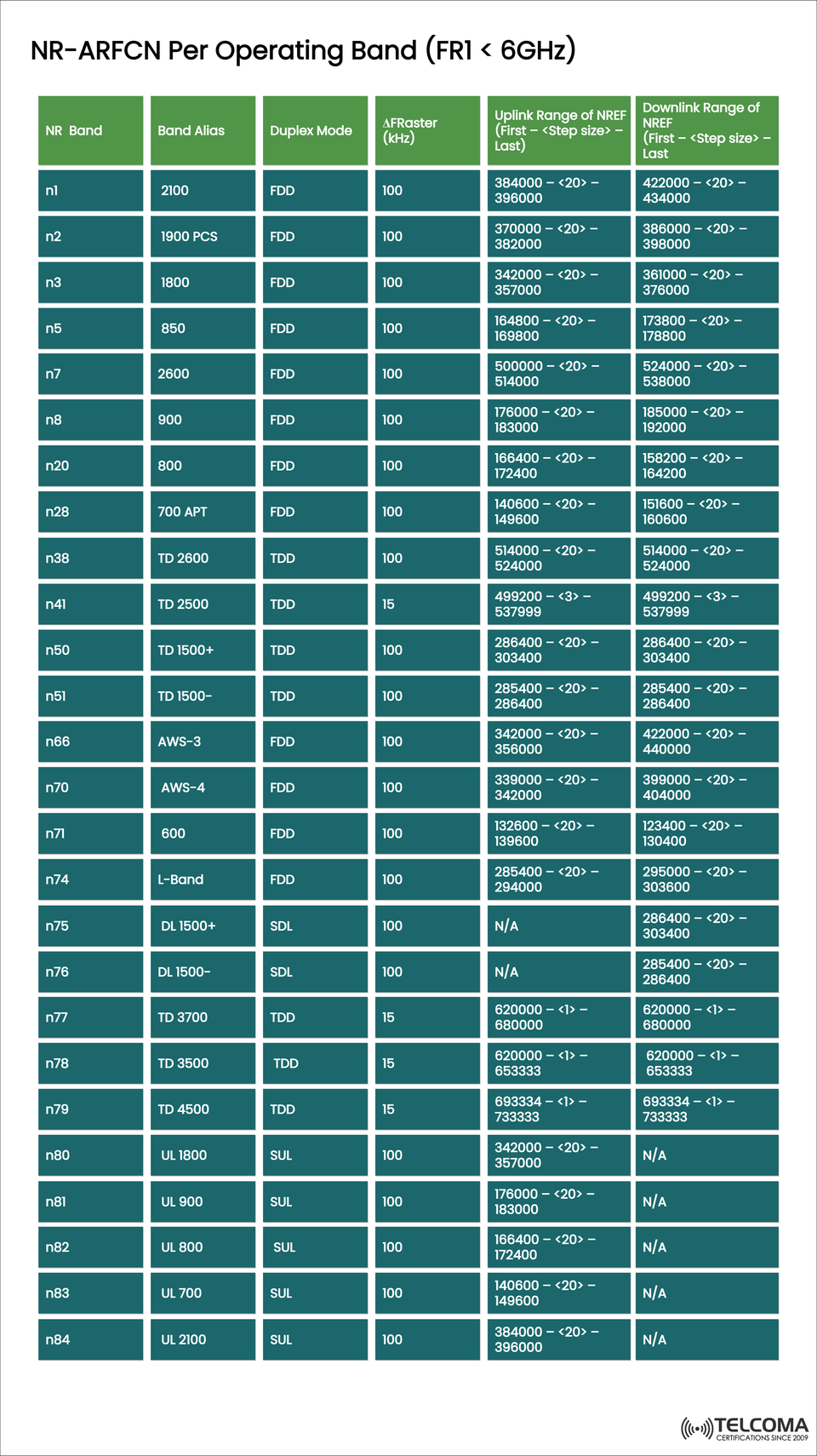

Getting to Grips with NR-ARFCN Per Operating Band (FR1 < 6GHz): A Handy Guide for Telecom Professionals
As 5G networks keep evolving, getting a handle on the basics of NR-ARFCN (New Radio Absolute Radio Frequency Channel Number) is key for network engineers and other industry folks. The chart attached — “NR-ARFCN Per Operating Band (FR1 < 6GHz)” — gives you a clear look at how different 5G frequency bands are set up below 6 GHz, detailing their duplex modes, uplink/downlink ranges, and frequency raster values.
This breakdown comes from the 5G NR (New Radio) framework that's defined by 3GPP (3rd Generation Partnership Project) in Release 15, which sets the standard for how 5G operates globally.
What’s NR-ARFCN?
ARFCN is short for Absolute Radio Frequency Channel Number — it's a number that points to the center frequency for a 5G carrier. In 5G NR, ARFCN takes the place of the older EARFCN and UARFCN used in LTE and UMTS, respectively.
Simply put:
NR-ARFCN assigns a unique number to every radio frequency used by a 5G cell, enabling devices and networks to sync up exactly.
How to Calculate NR-ARFCN
The formula that connects ARFCN to the actual frequency (FREF) in MHz looks like this:
FREF=FREF−Offs+0.001×(ARFCN−NREF−Offs)F ext {REF} = F ext {REF-Offs} + 0.001 imes (ARFCN - N ext {REF-Offs})FREF=FREF−Offs+0.001×(ARFCN−NREF−Offs)
Where:
FREF-Offs = Reference frequency offset for each band
NREF-Offs = NR-ARFCN offset for the band
ARFCN = Absolute Radio Frequency Channel Number
This equation makes sure that every 5G channel is uniquely identifiable, no matter the spectrum band or duplex mode.
Frequency Ranges for 5G: FR1 and FR2
5G mainly operates in two frequency ranges:
Range Designation Frequency Span Use CaseFR1Sub-6GHz410 MHz – 7125 MHz Wide-area coverage, suburban/rural 5G, mid-band capacityFR2mmWave24.25 GHz – 71 GHz Ultra-high capacity, low latency, dense urban areas
The attached image focuses on FR1 (<6GHz), which is vital for achieving nationwide 5G coverage and good indoor service.
Diving Into the NR-ARFCN Table (FR1 < 6GHz)
The image showcases various NR operating bands (n1–n84) employed in global 5G setups. Here's a breakdown of each parameter:
- NR Band
Every NR band (like n1, n3, n78) outlines a specific range of radio frequencies that 3GPP has standardized for global or regional use.
- Band Alias
This indicates the traditional name or the LTE equivalent for that band (e.g., 2100 MHz for n1, 1800 MHz for n3). This is helpful for maintaining compatibility with existing LTE setups.
Duplex Mode
This term explains how uplink (UL) and downlink (DL) transmissions function:
FDD (Frequency Division Duplex): Different frequencies for UL and DL.
TDD (Time Division Duplex): A shared frequency, separated by time slots.
SDL (Supplemental Downlink): DL-only carrier to boost capacity.
SUL (Supplemental Uplink): UL-only carrier to improve uplink coverage.
- ΔFRaster (Frequency Raster)
This shows the channel spacing or raster size, typically 100 kHz or 15 kHz, defining the smallest frequency step between channels.
- Uplink/Downlink ARFCN Range
This indicates the range of ARFCN values assigned for uplink and downlink. Each ARFCN is linked to a specific center frequency within the band.
Main Points from the NR-ARFCN Table
- Popular FDD Bands in 5G FR1
NR Band Frequency (MHz)Duplex Mode Use Casen1 (2100)1920–2170FDDLegacy refarm from UMTS, global coveragen3 (1800)1710–1880FDDCommon re-farmed LTE bandn7 (2600)2500–2690FDDUrban capacityn28 (700 APT)703–748 / 758–803FDD5G coverage and rural deploymentsn66 (AWS-3)1710–2200FDDNorth America coverage
These FDD bands enable operators to reuse existing LTE spectrum, speeding up the 5G rollout via Dynamic Spectrum Sharing (DSS).
- Key TDD Bands
NR Band Frequency Range Duplex Typical Deploymentn38 (TD 2600)2570–2620TDDDense urban capacityn41 (TD 2500)2496–2690TDDUsed by Sprint (USA) and China Mobilen77 (TD 3700)3300–4200TDDGlobal mid-band 5G backbonen78 (TD 3500)3300–3800TDDWidely adopted in Europe and Asian79 (TD 4500)4400–5000TDDHigh-capacity urban 5G
Among these, n77 and n78 are the most important for 5G NR deployments around the globe, striking a good balance between coverage, capacity, and throughput.
SUL and SDL Bands
Some bands are created to enhance uplink or downlink performance without full-duplex operation:
NR Band Type Duplex ModePurposen75, n76DownlinkSDLBoosts DL data ratesn80–n84UplinkSULEnhances UL coverage for cell-edge users
This flexibility allows network operators to dynamically balance uplink and downlink throughput, especially in cases of uneven traffic.
Examples of ARFCN Range and Frequency Mapping
Let's see how ARFCN values match up with actual frequencies:
For Band n78 (TD 3500): * ΔFRaster = 15 kHz * ARFCN Range: 620000–653333 * Frequency Range: 3300–3800 MHz * Each ARFCN step = 15 kHz spacing
So, ARFCN 620000 is about 3300 MHz.
For Band n28 (700 APT): * ΔFRaster = 100 kHz * UL Range: 140600–149600 * DL Range: 151600–160600
Why NR-ARFCN is Important in 5G Network Design
Getting ARFCN right is crucial for:
Spectrum Planning: Helps operators decide how to allocate carriers across available frequency bands.
Interference Management: Keeps neighboring cells or carriers from overlapping.
Carrier Aggregation (CA): Lets you combine multiple NR bands (like n78 + n28) to boost throughput.
Dynamic Spectrum Sharing (DSS): Allows 4G and 5G to share the same frequencies using shared ARFCN mapping.
Device Compatibility: Makes sure user equipment (UE) can function on standardized frequency channels worldwide.
FDD vs. TDD in FR1 Comparison
Feature FDDTDD Spectrum Use Separate UL/DL frequencies Shared UL/DL frequency (time slots)Latency Slightly lower Slightly higher due to switching Deployment Type Legacy, coverage-oriented New, capacity-focused Example Bandsn1, n3, n28n41, n77, n78
TDD-based mid-band (n77/n78) has become the sweet spot for 5G NR, providing huge capacity and balanced propagation traits.
FR1’s Role in 5G Evolution
While FR2 (mmWave) steals the spotlight for ultra-fast speeds, FR1 (<6GHz) serves as the backbone of nationwide 5G coverage because of its:
Wider range
Better building penetration
Compatibility with existing LTE networks
With C-band (n77/n78) as a global anchor and 700 MHz (n28) for coverage, operators can achieve the ideal 5G trifecta: coverage, capacity, and reliability.
Wrap-Up
The NR-ARFCN per operating band (FR1 < 6GHz) lays down the foundation for modern 5G frequency planning. By understanding ARFCN mapping, duplex modes, and spectrum features, telecom pros can craft efficient, interference-free, and scalable 5G networks.
As the industry gears up for 5G Advanced (Release 18), getting ARFCN configuration down pat will be essential for:
Advanced carrier aggregation
Network slicing
Dynamic spectrum operations
Smooth FR1–FR2 coexistence
In short, ARFCN isn’t just a frequency number — it’s the digital marker of 5G performance, directing how every device, base station, and service connects in the next wave of wireless communication.