
5G NR Channel Coding Explained: LDPC vs Polar Codes and HARQ Operations

5G NR Channel Coding: LDPC and Polar Codes in Next-Gen Networks
One of the key improvements in 5G New Radio (NR) compared to LTE is its channel coding scheme. As mobile networks aim for faster speeds, super low latency, and massive connectivity, having effective error correction methods is crucial for keeping performance and reliability up to par.
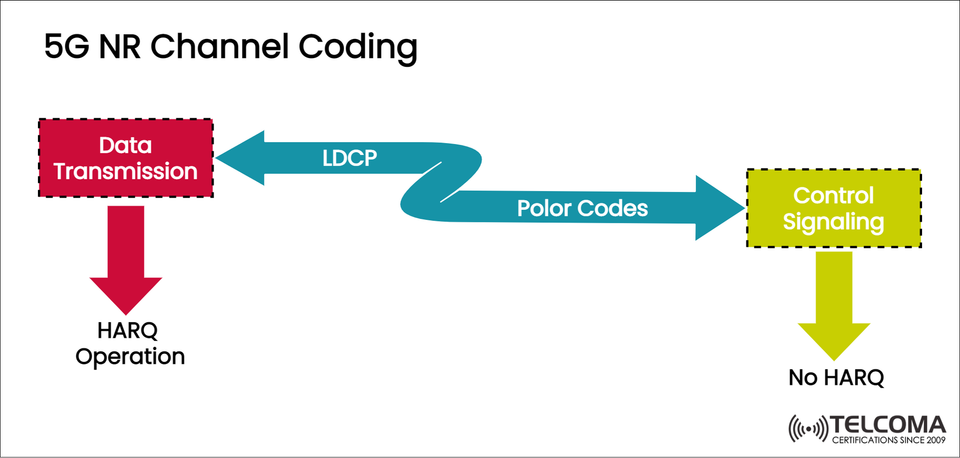
The diagram provided by Telcoma illustrates this concept clearly:
Data Transmission utilizes LDPC coding and incorporates HARQ (Hybrid Automatic Repeat Request).
Control Signaling employs Polar Codes, but does not use HARQ.
Let’s dive into what this means, why 5G went with these methods, and how they boost the overall network performance.
Understanding Channel Coding in 5G NR
Channel coding is the technique of adding extra bits to data being transmitted to help identify and fix errors caused by noise, fading, or interference in wireless communication channels.
Why Channel Coding Is Important in 5G
5G networks are built for:
Enhanced Mobile Broadband (eMBB)
Ultra-Reliable Low Latency Communications (URLLC)
Massive Machine-Type Communications (mMTC)
Each of these applications demands:
High throughput
Strong error resilience
Minimal latency
So, 5G NR needed new coding methods that are better than LTE’s Turbo Codes in terms of both efficiency and decoding speed.
LTE Turbo Codes vs 5G NR LDPC & Polar Codes
Feature LTE Turbo Codes5G NR LDPC Codes5G NR Polar Codes Used For Data & Control Data (PDSCH/PUSCH)Control (PDCCH/PUCCH)Structure Concatenated convolutional Sparse matrix-based Recursive channel polarization Decoding Iterative (complex)Iterative (fast, parallelizable)Successive cancellation Performance Excellent at low rates Excellent at high rates Good for short blocks Latency Moderate to high Low Very low HARQ Support Yes Yes No (not typical)
This shift marked a major achievement in 3GPP Release 15, highlighting 5G’s progress toward flexible, efficient, and scalable error correction.
LDPC Coding in 5G NR Data Channels
The left side of the image, labeled Data Transmission → LDPC → HARQ Operation, outlines the channel coding process for data.
What Is LDPC (Low-Density Parity-Check)?
LDPC is a linear block code characterized by a sparse parity-check matrix. It gets performance quite close to the Shannon limit while keeping decoding complexity low through parallel processing.
Why 5G Picked LDPC for Data
5G uses LDPC for data channels (PDSCH and PUSCH) because it:
Delivers great error-correcting performance for large data blocks.
Is ideal for parallel decoding—a perfect match for today’s multi-core processors and baseband chips.
Offers flexibility with various code rates and block sizes.
LDPC Structure in 5G
5G LDPC employs:
Base graph 1 (BG1) for high code rates and large block sizes (eMBB).
Base graph 2 (BG2) for low code rates and smaller blocks (URLLC or small packets).
This dual-graph strategy optimizes performance across a range of 5G scenarios.
HARQ with LDPC
The diagram shows how Hybrid Automatic Repeat Request (HARQ) works closely with LDPC. If an error happens:
The receiver calls for a retransmission.
The retransmitted data is soft-combined with what was received earlier.
Decoding is tried again for a better success chance.
This setup keeps communication strong and reliable, especially for larger payloads.
Polar Codes in 5G Control Channels
The right section of the image highlights Polar Codes used for Control Signaling (like PDCCH, PUCCH, PBCH).
What Are Polar Codes?
Created by Erdal Arıkan (2008), Polar Codes are the first error-correcting codes shown to reach channel capacity for symmetric binary-input channels using a method known as channel polarization.
Simply put, Polar Codes convert a group of unreliable channels into a combination of totally reliable and totally unreliable sub-channels, transmitting data only through the reliable ones.
Why 5G Uses Polar Codes for Control Channels
Control channels send important yet short messages like:
Scheduling grants
HARQ feedback
System information
Random access responses
Polar Codes were selected because they:
Excel for short block lengths.
Have low encoding and decoding latency.
Are hardware-efficient, suitable for real-time control signaling.
Offer high reliability even without HARQ retransmissions.
No HARQ in Control Channels
The diagram points out “No HARQ” for control signaling, and here’s why:
Control messages are brief and time-sensitive.
Retransmissions could cause unwanted latency.
Reliability is ensured instead through power boosting, repetition coding, and Polar Code design.
The Role of HARQ in 5G NR
HARQ (Hybrid Automatic Repeat Request) combines error correction coding (FEC) with error detection (CRC) and retransmission methods.
How HARQ Works
Encoding: Data gets encoded using LDPC.
Transmission: It’s sent through the wireless channel.
Decoding: The receiver tries to decode. * Success → ACK (Acknowledgment) * Failure → NACK (Negative Acknowledgment)
Retransmission: The sender sends the data again (or adds incremental redundancy).
Soft Combining: The receiver blends old and new signals for better decoding.
5G HARQ Enhancements
Shorter round-trip times (RTT) for URLLC.
Up to 16 HARQ processes (compared to 8 in LTE).
Code block segmentation—allows for parallel HARQ decoding of large payloads.
This system guarantees dependability, efficiency, and low-latency performance for crucial applications.
Why Turbo Codes Were Replaced
LTE relied on Turbo Codes, which worked well but came with some downsides:
High decoding complexity for larger code blocks.
Poor parallelization (not suitable for today’s hardware).
High latency from iterative decoding.
Subpar for massive MIMO and mmWave speeds.
LDPC and Polar Codes addressed these challenges by:
Allowing parallel hardware implementation.
Offering better scalability across frequencies and applications.
Lowering decoding delays—essential for real-time 5G services.
The Future of Channel Coding Beyond 5G
As 6G research progresses, we might see new coding methods such as:
Spatially Coupled LDPC (SC-LDPC) for better convergence.
Non-binary Polar Codes for greater spectral efficiency.
Machine learning–aided decoding, adjusting on the fly to channel conditions.
Quantum error correction principles applied to advanced PHY designs.
Still, LDPC and Polar Codes will stay foundational due to their proven efficiency and adaptability.
Conclusion
The image highlights one of the major tech upgrades from LTE to 5G NR:
LDPC Codes drive data transmission, ensuring high throughput, robustness, and HARQ-based reliability.
Polar Codes provide ultra-reliable control signaling while keeping complexity and delays low—without using HARQ.