
5G NR Numerology Explained: Subcarrier Spacing, Symbol Duration, and Scheduling Intervals

5G NR Numerology: The Foundation of 5G Flexibility
The 5G New Radio (NR) standard, as defined by 3GPP, brings forth a flexible waveform structure called numerology. This concept allows 5G to adjust dynamically to different frequencies, bandwidths, and latency needs — which previous generations like LTE struggled to manage effectively.
In 5G, numerology refers to a set of parameters that dictate how OFDM (Orthogonal Frequency Division Multiplexing) signals are organized, including aspects like subcarrier spacing, symbol duration, and cyclic prefix.
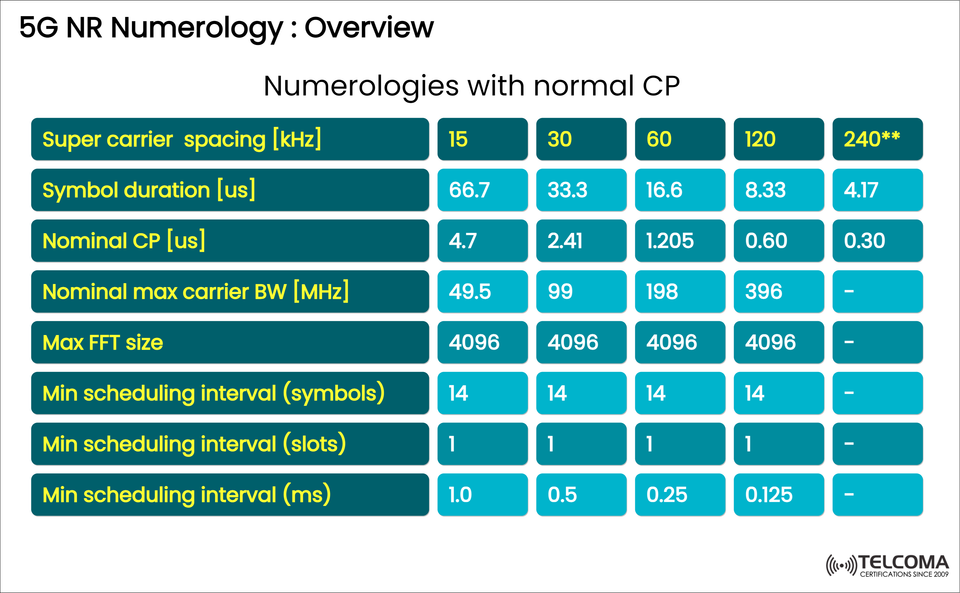
The image above (by TELCOMA) provides a useful snapshot of the various numerology configurations in 5G NR. Let's break them down a bit and see how they play a role in delivering super-fast, low-latency connections.
What is 5G NR Numerology?
Simply put, 5G NR Numerology defines how tightly packed the subcarriers are within a channel. Each numerology (marked as μ) doubles the spacing between subcarriers compared to the previous one.
Mathematically, this is expressed as:
Δf = 15 × 2^μ kHz
Where:
Δf = subcarrier spacing
μ = numerology index (0, 1, 2, 3, 4)
So:
μ = 0 → 15 kHz
μ = 1 → 30 kHz
μ = 2 → 60 kHz
μ = 3 → 120 kHz
μ = 4 → 240 kHz
Each numerology has its own use case and frequency range, balancing between coverage, latency, and bandwidth.
5G NR Numerology Overview (Based on TELCOMA Chart)
Parameter15 kHz30 kHz60 kHz120 kHz240 kHz Symbol Duration [µs]66.733.316.68.34.17Nominal CP [µs]4.72.41.20.60.3Nominal Max Carrier BW [MHz]49.599198396-Max FFT Size4096409640964096-Min Scheduling Interval (Symbols)14141414-Min Scheduling Interval (Slots)1111-Min Scheduling Interval (ms)1.00.50.250.125-
This table shows that as the subcarrier spacing increases, the duration of symbols and latency decrease — making higher numerologies better suited for high-frequency, low-latency situations, like mmWave.
Key Components of 5G NR Numerology
Let's take a closer look at each parameter and its significance.
- Subcarrier Spacing (Δf)
Subcarrier spacing is the frequency gap between two adjacent OFDM subcarriers.
15 kHz: Used for low-band (FR1) frequencies below 3 GHz. Offers wide coverage and good tolerance for Doppler shifts.
30 kHz: Applied in mid-band 5G (3.5–6 GHz). It finds a balance between throughput and latency.
60 kHz: Ideal for higher sub-6 GHz or lower mmWave bands.
120 kHz: Commonly used in mmWave setups for ultra-low latency.
240 kHz: Primarily reserved for synchronization signals in FR2 (mmWave).
Wider subcarrier spacing improves time resolution but reduces coverage — so there's a trade-off between bandwidth efficiency and latency.
- Symbol Duration
The symbol duration is inversely related to subcarrier spacing:
T symbol = 1/Δf
From the table:
15 kHz → 66.7 µs
30 kHz → 33.3 µs
60 kHz → 16.6 µs
120 kHz → 8.33 µs
Smaller symbols (with higher spacing) mean quicker scheduling and lower latency, which is great for enhanced Mobile Broadband (eMBB) and Ultra-Reliable Low-Latency Communication (URLLC) applications.
- Cyclic Prefix (CP)
The cyclic prefix is a bit of each OFDM symbol that's added to avoid inter-symbol interference (ISI) in environments with multiple path signals.
As subcarrier spacing increases, CP duration goes down:
Δf (kHz)CP Duration (µs)154.7302.4601.21200.62400.3
In rural settings (low-frequency), longer CPs are handy because signals reflect over longer distances. Meanwhile, mmWave areas benefit from shorter CPs since paths are shorter and more direct.
- Nominal Maximum Carrier Bandwidth
This specifies how much spectrum can be used for each numerology.
15 kHz → 49.5 MHz
30 kHz → 99 MHz
60 kHz → 198 MHz
120 kHz → 396 MHz
It’s clear that larger subcarrier spacing allows for wider bandwidths, which is essential for mmWave 5G, where wider channels (up to 400 MHz) are accessible.
- FFT Size (Fast Fourier Transform)
The FFT size indicates how many subcarriers can be processed at the same time. For most 5G NR numerologies (15–120 kHz), the max FFT size is 4096 — ensuring enough spectral resolution across bandwidths up to 400 MHz.
Having a consistent FFT size streamlines hardware implementation and allows for dynamic switching between numerologies.
- Scheduling Intervals
Scheduling intervals determine how often the base station (gNB) can assign new resources to users.
From the chart:
Minimum scheduling interval (ms):
15 kHz → 1.0 ms
30 kHz → 0.5 ms
60 kHz → 0.25 ms
120 kHz → 0.125 ms
At 120 kHz spacing, this means 5G can make scheduling decisions every 125 microseconds, which is crucial for applications needing real-time responsiveness like autonomous driving and remote surgery.
How Numerology Enables 5G Flexibility
The flexible numerology framework makes 5G NR capable of adapting to a range of deployment situations:
Deployment Type Frequency Range Typical Numerology Key Objective Macro Cell (Wide Coverage)< 2 GHz15 kHz High coverage, mobility Urban Mid-Band3–6 GHz30 kHz / 60 kHz Balance between speed and coverage Small Cell / mmWave24–40 GHz120 kHz / 240 kHz Low latency, high throughput
This flexibility is what lets 5G NR support three major service types:
eMBB (Enhanced Mobile Broadband) — high data speeds using wide bandwidths
URLLC (Ultra-Reliable Low-Latency Communication) — low latency and dependability
mMTC (Massive Machine-Type Communication) — broad coverage and power efficiency
Comparison Between LTE and 5G NR Numerology
ParameterLTE5G NR Subcarrier Spacing Fixed 15 kHz Variable (15–240 kHz)Symbol Duration Fixed Scalable Frame Structure Fixed 10 ms Flexible Latency≥ 1 ms As low as 0.125 ms Frequency Range< 6 GHz Up to 100 GHz
5G NR’s scalable OFDM numerology makes it suitable for both low-frequency rural coverage and high-frequency urban or indoor scenarios, which contrasts with LTE’s fixed structure.
Impact of Numerology on Network Performance
Latency: Higher subcarrier spacing means shorter symbols lead to lower transmission latency.
Coverage: Lower spacing allows for longer symbols, enhancing delay spread tolerance and coverage.
Mobility: Smaller subcarrier spacing improves tolerance to Doppler shift, which is key for high-speed mobility.
Throughput: Larger spacing supports wider bandwidth and quicker data rates.
In practice, 5G dynamically selects numerology based on frequency bands and service types—ensuring top performance for every user scenario.
Practical Example:
Urban 5G eMBB deployment:
Frequency: 3.5 GHz
Numerology: 30 kHz
Latency: 0.5 ms
Bandwidth: up to 100 MHz
mm Wave 5G deployment:
Frequency: 28 GHz
Numerology: 120 kHz
Latency: 0.125 ms
Bandwidth: up to 400 MHz
This shows how flexible numerology allows operators to efficiently deliver a range of 5G applications.
Conclusion
5G NR numerology is at the heart of 5G’s flexibility, offering a scalable framework that adapts to every kind of deployment — whether it’s broad rural coverage or super-fast mm Wave cells.
By tweaking subcarrier spacing, symbol duration, and scheduling intervals, 5G can achieve:
High coverage at low frequencies
Massive throughput at high frequencies
Ultra-low latency for critical services
The TELCOMA chart highlights this adaptability nicely, showing how the flexible design of 5G NR is ushering in a new era of network intelligence, speed, and scalability.