
5G NR Slot Options Explained: Downlink, Uplink, and Mixed UL-DL Slot Configuration in 5G

5G NR and the Importance of Slot Flexibility
5G New Radio (5G NR) is all about providing incredible flexibility for a variety of deployment scenarios, whether it’s enhanced mobile broadband (eMBB), ultra-reliable low-latency communications (URLLC), or massive IoT (mMTC). To make this happen, 5G introduces a slot-based resource allocation system that helps manage time and frequency resources efficiently.
Unlike LTE, which had a pretty fixed duplexing setup, 5G NR comes with a frame structure that supports multiple numerologies and flexible slot configurations. This means that you can use the same frequency channel for either uplink (UL) or downlink (DL) within the same timeframe based on what kind of traffic is coming in.
Overview of 5G NR Frame and Slot Structure
Before we get into slot options, it’s good to have a quick refresher on the 5G frame hierarchy:
Parameter | Description
Frame Duration | 10 ms
Subframe Duration | 1 ms
Slot Duration | Depends on Subcarrier Spacing (SCS): 1 ms / (2^μ)
Symbols per Slot | 14 OFDM symbols (normal cyclic prefix)
5G NR employs Orthogonal Frequency Division Multiplexing (OFDM) for both downlink and uplink. The slot structure changes with the numerology (μ) — a higher numerology means shorter slot durations, which is great for low-latency transmissions.
What Are 5G NR Slot Options?
In 5G NR, a slot serves as a basic time unit for scheduling transmissions. Each slot can handle downlink, uplink, or mixed traffic, depending on how the gNodeB (base station) sets it up.
This kind of flexibility is especially important for Time Division Duplex (TDD) systems, where uplink and downlink share the same frequency band but operate at different times.
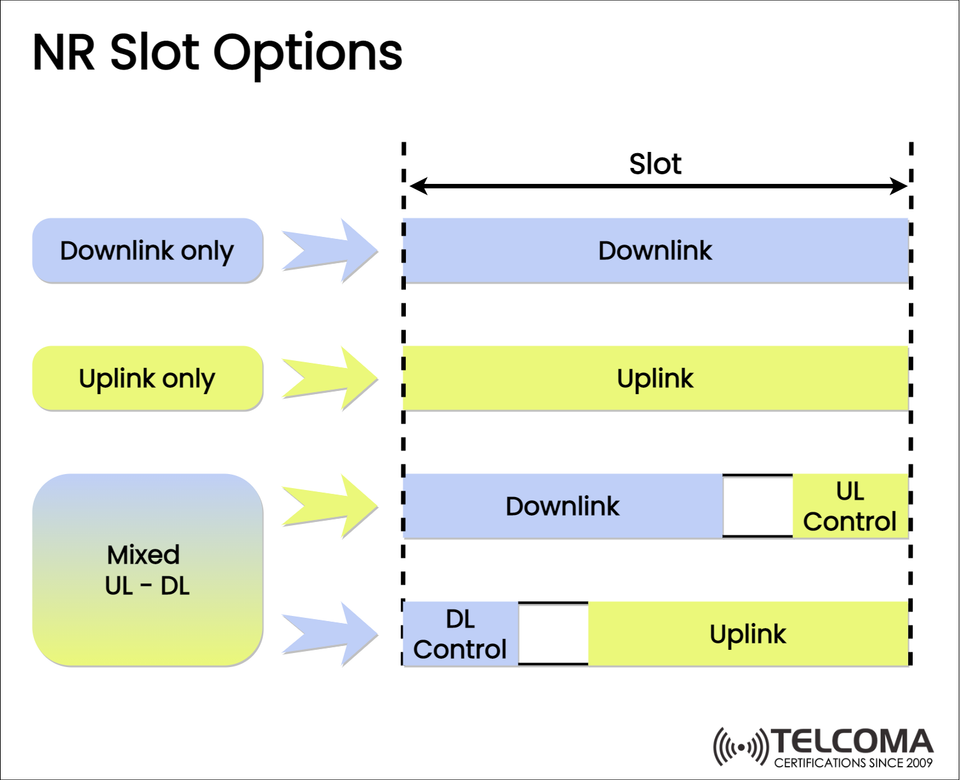
Main Slot Types (as shown in the image):
Slot Type | Direction | Description
Downlink Only | gNodeB → UE | Entire slot designated for downlink data/control.
Uplink Only | UE → gNodeB | Entire slot reserved for uplink data/control.
Mixed UL-DL | Both | Slot shared among downlink, uplink control, and uplink data.
Downlink Only Slot
Definition
A Downlink-only slot is entirely dedicated to downlink transmissions from the gNodeB to the UE. This includes various control and data channels, such as:
PDCCH (Physical Downlink Control Channel)
PDSCH (Physical Downlink Shared Channel)
PBCH (Physical Broadcast Channel)
Use Cases
High downlink traffic situations (think video streaming, file downloads).
Broadcast transmissions like system information blocks (SIBs).
Messages for synchronization and paging.
Technical Behavior
The entire duration of the slot is filled with downlink OFDM symbols.
No uplink transmission happens during this time.
UEs stay in receive mode for the entire slot.
Benefits
Maximizes spectral efficiency in heavy downlink scenarios.
Simplifies scheduling for multicast/broadcast uses.
Uplink Only Slot
Definition
An Uplink-only slot is fully reserved for UE-to-gNodeB transmissions, which may involve:
PUSCH (Physical Uplink Shared Channel) for data.
PUCCH (Physical Uplink Control Channel) for feedback and acknowledgments.
SRS (Sounding Reference Signals) for channel estimation.
Use Cases
High uplink traffic scenarios (like sensor networks, file uploads, video conferencing).
Uplink control signaling and channel measurements.
Technical Behavior
The UE transmits throughout the entire slot while the gNodeB listens in.
No downlink transmission occurs during this slot.
Benefits
Perfect for uplink-centric applications such as industrial IoT.
Cuts down on interference by keeping uplink resources separate.
Mixed UL-DL Slot (Flexible Slot)
Definition
The Mixed UL-DL slot (or Flexible Slot) merges both downlink and uplink transmissions within one slot. It can include:
Downlink symbols for data/control.
Uplink symbols for data or control.
Guard Period (GP) symbols for transitioning between DL and UL.
This hybrid setup allows for dynamic duplexing, adjusting in real time to changing traffic conditions.
Common Mixed Configurations (illustrated in the image):
Downlink → Uplink Control: Begins with downlink data, wraps up with uplink control (ACK/NACK, CSI).
Downlink Control → Uplink: Starts with control signaling, followed by uplink data transmission.
Use Cases
TDD networks where the demand for downlink and uplink varies significantly.
Low-latency communication, allowing UEs to respond in the same slot.
Beam management and control signaling in 5G mmWave bands.
Technical Behavior
The slot boundary comes with a guard period (GP) to prevent interference when switching from downlink to uplink.
The gNodeB sets how many OFDM symbols go to DL, UL, and GP using slot configuration parameters.
Benefits
Offers maximum flexibility for adapting to traffic.
Lowers latency by supporting self-contained subframes.
Boosts spectral efficiency in uneven traffic patterns.
TDD Slot Configuration and Patterns
In 5G NR Time Division Duplex (TDD), the balance of downlink and uplink slots can change dynamically, managed through TDD slot configuration tables established by 3GPP TS 38.211.
Slot Format Indicator (SFI)
Each slot has an SFI that indicates whether each OFDM symbol in the slot is meant for DL, UL, or GP.
The network can adjust SFI patterns in real time based on load and quality of service needs.
Dynamic TDD Example:
Time Slot | Type
Slot 0 | Downlink Only
Slot 1 | Downlink Only
Slot 2 | Mixed UL-DL
Slot 3 | Uplink Only
Slot 4 | Mixed UL-DL
This allows for asymmetric traffic handling, like prioritizing downlink slots during video streaming or giving more uplink slots when video conferencing.
The Advantages of Slot Flexibility in 5G NR
The flexible slot structure is a standout feature of 5G, providing the adaptability necessary to satisfy various application demands.
Key Benefits
Dynamic Resource Allocation: Smoothly switch between DL and UL based on network load.
Reduced Latency: Enables immediate ACK/NACK feedback within the same slot.
Improved Spectrum Efficiency: Adaptable to uneven data flows.
Universal Use Case Support: Works for eMBB, URLLC, and mMTC all at once.
Boosted Network Efficiency: Minimizes idle times and maximizes resource usage.
Real-World Applications
Operators use dynamic TDD scheduling based on slot options to balance traffic needs. For instance:
Urban 5G networks often emphasize downlink slots due to heavy content consumption.
Industrial private 5G networks might lean more towards uplink slots for machine data.
Mixed slots are common in mmWave setups, allowing for real-time adjustments.
In Standalone 5G (SA) mode, the gNodeB scheduler employs AI/ML algorithms to forecast user behavior and modify slot configurations in real-time, ensuring optimal throughput and latency.
Conclusion
The NR Slot Options — Downlink only, Uplink only, and Mixed UL-DL — lie at the core of 5G’s versatile frame structure. They enable networks to adjust dynamically to user needs and application types with unmatched efficiency.
Downlink-only slots optimize downlink throughput.
Uplink-only slots enhance sensor and IoT uploads.
Mixed UL-DL slots provide adaptability and low latency.
Together, they position 5G NR as an intelligent, software-driven air interface, ready to tackle the diverse and demanding needs of a connected future — from smart cities to self-driving cars and beyond.