
5G Waveform Evolution: From Release 15 to Beyond 71 GHz

Understanding the Evolution of 5G Waveforms: From Release 15 to Beyond 71 GHz
The 5G waveform is crucial for how data gets sent, modulated, and received over the air. Unlike 4G LTE, which mainly used OFDMA (Orthogonal Frequency Division Multiple Access), 5G brings in flexible numerologies and advanced designs that work well across a variety of frequencies—from sub-6 GHz all the way up to millimeter-wave (mm Wave) and even terahertz (THz) bands.
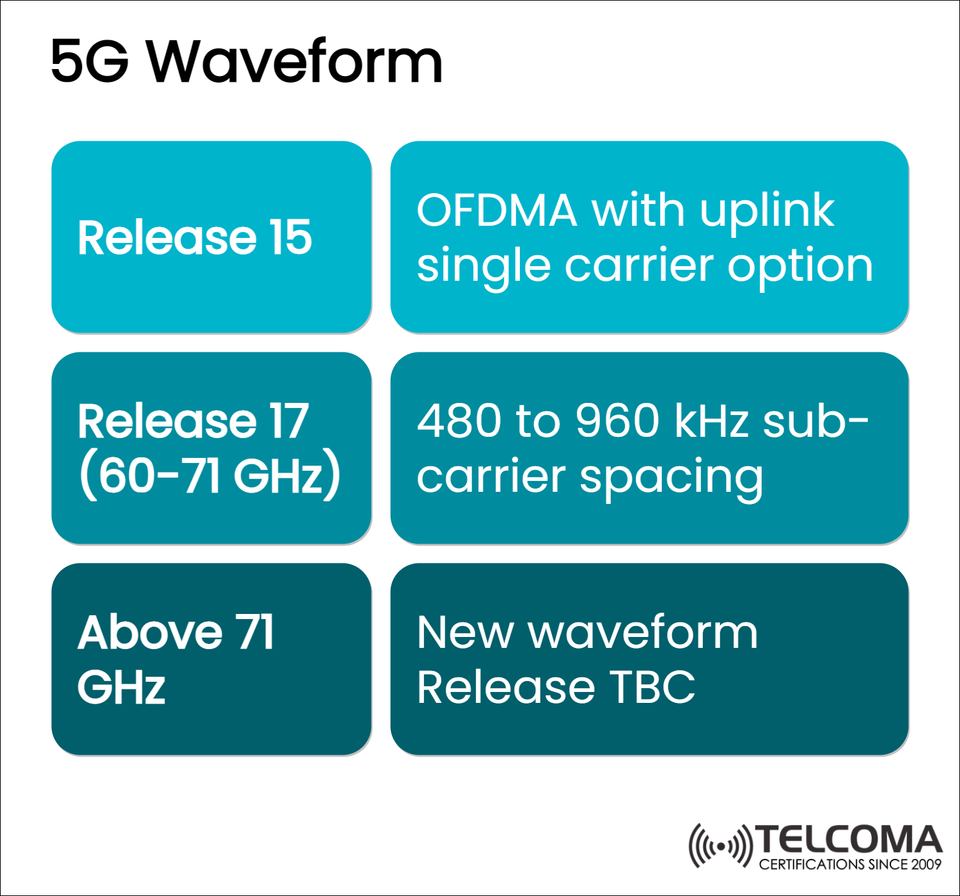
The image above (courtesy of TELCOMA) shows this evolution through the different 3GPP Releases 15, 17, and what's coming next. Let’s take a closer look at how the 5G waveform is evolving to keep up with future network demands.
- The Role of Waveform in 5G
A waveform defines how digital bits get converted into physical radio waves for transmission. In the context of 5G, the design of the waveform has a direct impact on:
Spectral efficiency (how well bandwidth is utilized)
Latency and throughput performance
Interference resistance and synchronization
Ability to support massive MIMO and beamforming
So, choosing the right waveform is vital for achieving 5G's three pillars:
Enhanced Mobile Broadband (eMBB)
Ultra-Reliable Low-Latency Communication (URLLC)
Massive Machine-Type Communication (mMTC)
- 5G NR Waveform in Release 15
Release 15, which wrapped up in 2018, marked the debut of 5G New Radio (NR). The waveform introduced was OFDMA, a well-known technology from LTE, but with added flexibility and efficiency.
Downlink Waveform: OFDMA
Reason for Choice: It’s got great spectral efficiency, works well with MIMO, and supports scalable numerologies.
Key Benefit: allows simultaneous transmissions from the base station to multiple users using orthogonal subcarriers.
Uplink Waveform: Two Options
OFDMA (Multi-user Uplink) – used for eMBB and flexible access.
DFT-s-OFDM (Single-Carrier Option) – cuts down on Peak-to-Average Power Ratio (PAPR), making it more energy-efficient for uplink devices.
Features of Release 15 Waveform
Scalable Subcarrier Spacing: 15, 30, 60, 120, and 240 kHz.
Support for TDD and FDD modes.
CP-OFDM (Cyclic Prefix OFDM) to handle multipath fading better.
Advantages
High spectral efficiency.
Low implementation complexity.
Works well with massive MIMO and beamforming technologies.
In short, Release 15 set the stage with its adaptable OFDM-based waveform, capable of covering a wide range of 5G frequencies—from below 6 GHz up to 52.6 GHz.
- 5G NR Waveform Enhancements in Release 17 (60–71 GHz)
As 5G began moving towards higher frequency bands (60–71 GHz), Release 17 introduced refinements to subcarrier spacing and waveform parameters to boost performance at these extreme frequencies.
Why Adjust the Waveform for 60–71 GHz?
At these high frequencies, things like phase noise, Doppler shifts, and propagation losses are more noticeable. To keep things reliable and reduce inter-symbol interference, we need shorter symbol durations and wider subcarrier spacing.
Key Release 17 Enhancements
Frequency Range: 60 GHz to 71 GHz (an extension of FR2 band).
Subcarrier Spacing: 480 kHz to 960 kHz (a big jump from Release 15).
Waveform Type: OFDM is still the main player but fine-tuned for short symbol durations and reduced latency.
Benefits of Wider Subcarrier Spacing
Better handling in high Doppler scenarios (think moving vehicles or drones).
Less sensitivity to phase noise.
Enables super-fast URLLC and low-latency backhaul.
Technical Adjustments
Parameter Release 15Release 17Frequency Range<52.6 GHz60–71 GHz Subcarrier Spacing15–240 kHz480–960 kHz Symbol Duration Long Short (optimized for high-frequency)Use Case e MBB, URLLC High-frequency, ultra-dense networks
Release 17's changes mark the start of 5G's journey into near-terahertz communications, setting the path for even greater throughput and smaller cells.
- Above 71 GHz: The Future 5G (and 6G) Waveform
The image refers to “Above 71 GHz – New waveform (Release TBC),” indicating frequencies extending into the D-band (110–170 GHz) and possibly into THz (terahertz) regions.
Why a New Waveform Is Needed
Once you go beyond 71 GHz, traditional OFDM can face challenges due to:
Super short symbol durations that complicate synchronization.
High phase noise and hardware nonlinearity.
Greater path loss and beam alignment difficulties.
As a result, 3GPP and research groups are looking into new waveform options to tackle these issues.
Potential Candidates for Future Waveforms
Filtered OFDM (f-OFDM): Adds sub band filtering to cut down on out-of-band emissions and works well for dynamic spectrum use.
Universal Filtered Multicarrier (UFMC): Combines the perks of OFDM and single-carrier waveforms, improving spectral containment for broken-up spectrum use.
Filter Bank Multicarrier (FBMC): No cyclic prefix means higher spectral efficiency, which is great for asynchronous or machine-type communication.
Single Carrier Frequency Division Multiple Access (SC-FDMA): Good for energy efficiency in uplink and simplifies the power amplifier design for mm Wave devices.
Time-Frequency Packed OFDM (TFP-OFDM): This compresses symbols in both time and frequency for ultra-dense modulation.
Expected Features of the Future Waveform
Terahertz compatibility (100–300 GHz)
Ultra-low latency (<0.1 ms)
Enhanced spectral efficiency (>10 bps/Hz)
Support for AI-driven dynamic waveform adaptation
These innovations will not only pave the way for 5G-Advanced (Release 18/19) but also for 6G, where intelligent reconfigurable waveforms will be key.
- Comparative Overview of 5G Waveform Evolution
3GPP Release Frequency Range Waveform Type Subcarrier Spacing Key Feature Release 15Up to 52.6 GHz OFDMA (DL) + DFT-s-OFDM (UL)15–240 kHz Flexible numerology, scalable CP Release 1760–71 GHz Enhanced OFDM480–960 kHz Optimized for high-frequency mm Wave Future (>71 GHz)>71 GHz (THz bands)New waveform (TBC)TBD Designed for ultra-high capacity & 6G readiness
This comparison illustrates how each waveform generation adapts to frequency challenges while keeping OFDMA's core benefits—orthogonality, flexibility, and high throughput.
- The Engineering Behind Subcarrier Spacing Choices
Trade-offs in Subcarrier Spacing
Narrower spacing (15–60 kHz): Good for long-range communication and low-frequency bands. More resistant to multipath fading.
Wider spacing (120–960 kHz): Best for high-frequency, low-latency applications. Reduces symbol duration to manage quick channel changes.
Ultimately, 5G's numerology flexibility allows the same waveform design to work from rural coverage (700 MHz) to ultra-high-capacity small cells (70 GHz).
- Why OFDMA Still Dominates 5G
Even with all the talk about future waveforms, OFDMA continues to be the backbone of 5G because it provides:
Orthogonal subcarriers that minimize interference.
Simple equalization with Fast Fourier Transform (FFT).
Compatibility with massive MIMO and beamforming.
Efficient resource allocation through scheduling.
Until new waveforms can prove they’re better in terms of performance and cost, OFDMA will remain the gold standard for both uplink and downlink.
- What Lies Ahead: 5G-Advanced and Beyond
The upcoming 3GPP Release 18 and what follows (5G-Advanced) will probably:
Bring in dynamic waveform adaptation for various frequencies and use cases.
Include AI-based optimization for real-time waveform selection.
Support joint communication and sensing—a major enabler for 6G.
With bands reaching above 100 GHz, waveform design will be a core differentiator between 5G-Advanced and early 6G implementations.
Conclusion
The evolution of the 5G waveform from Release 15’s OFDMA to future high-frequency designs highlights just how adaptable 5G technology is.
Release 15 laid the groundwork with flexible OFDMA and DFT-s-OFDM choices.
Release 17 expanded 5G’s capabilities to 60–71 GHz, optimizing performance with increased subcarrier spacing.
Future releases will reshape waveform design for bands above 71 GHz, potentially introducing entirely new waveforms tailored for ultra-wide bandwidths and ultra-low latency.
As 5G continues to evolve into 5G-Advanced and 6G, waveform innovation will stay at the forefront of next-gen communication systems—helping us move from gigabit to terabit connectivity.