
Architectural Innovations in 6G Networks: Energy Efficiency, Virtualized RAN, and Beyond
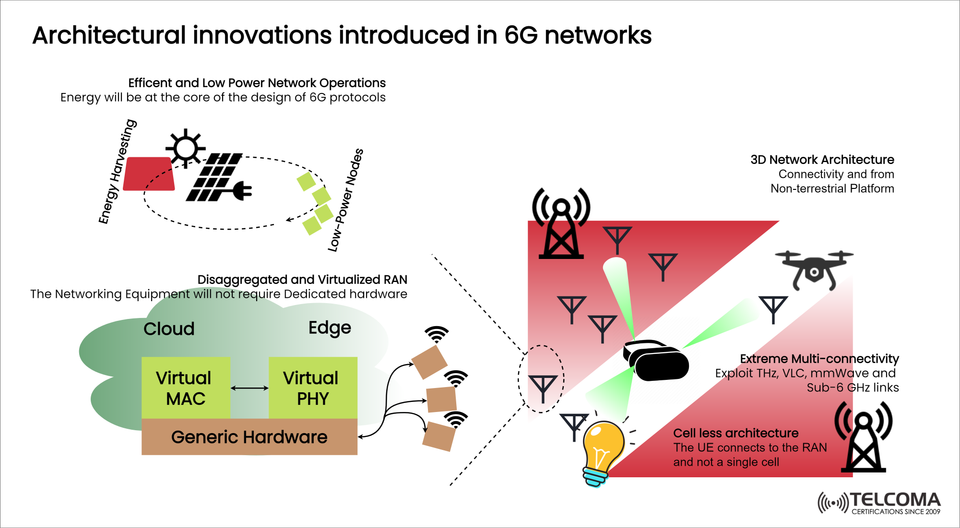

Innovations in 6G Network Architecture
As the telecom sector shifts its focus from 5G, 6G networks are set to change not just performance standards but also the fundamental structures of how we communicate. While 5G introduced features like low latency, enhanced mobile broadband, and extensive IoT connectivity, 6G aims to take things further by integrating intelligence, sustainability, and adaptability into its design.
The image provided showcases some important architectural innovations anticipated in 6G, including energy harvesting, virtualized RAN, and cell-less architecture, all of which will make 6G significantly more energy-efficient and scalable. This will enable support for next-gen applications such as holographic communication, extended reality, and autonomous systems.
- Efficient and Low-Power Network Operations
Energy Harvesting
Sustainability is a major focus for 6G, centered around its energy harvesting capabilities. These mechanisms will let devices and network nodes absorb energy from environmental sources like:
Solar energy at remote base stations.
Radio frequency (RF) harvesting for IoT devices.
Kinetic energy generated by wearables or mobile devices.
By relying less on conventional energy, energy harvesting helps meet green networking objectives and cuts down on operational expenses.
Low-Power Nodes
6G will include low-power nodes that consume minimal energy yet maintain connectivity. They're especially beneficial for:
IoT devices in smart cities.
Remote sensors monitoring the environment.
Wearables and health tech applications.
Combining energy harvesting with low-power designs really puts energy efficiency front and center in 6G protocols, keeping telecom networks in line with global sustainability efforts.
- Disaggregated and Virtualized RAN
The traditional Radio Access Networks (RAN) depend on specific hardware, which can limit both scalability and flexibility. 6G will instead offer a disaggregated and virtualized RAN (vRAN).
Key Features:
Generic Hardware: Say goodbye to costly proprietary devices.
Virtual MAC & Virtual PHY: Software-defined layers allow for greater flexibility.
Cloud-Edge Collaboration: Functions can be allocated dynamically between cloud and edge locations.
Benefits:
Cost Efficiency: Reduces both capital and operational costs.
Scalability: Networks can grow or shrink based on demand.
Programmability: Operators can easily update or tailor services.
This setup sets the stage for AI-driven, software-defined networks that adjust in real-time to various traffic patterns and user needs.
- 3D Network Architecture
Unlike the primarily two-dimensional (ground-focused) approach of 5G, 6G will adopt a 3D network architecture.
Features of 3D Networks:
Terrestrial Base Stations working in tandem with satellites, UAVs, and HAPS (High-Altitude Platform Stations).
Seamless Coverage reaching isolated areas as well as oceans and the skies.
Integration of Non-Terrestrial Networks (NTN) with ground-based infrastructure.
Benefits:
Global connectivity, even in regions that lack infrastructure.
Reliable communication for air, sea, and emergency services.
An enabler for space-air-ground integrated networks (SAGIN).
This development is crucial for fostering hyper-connectivity in future societies, ensuring that every area can stay connected.
- Extreme Multi-Connectivity
6G will extend beyond conventional spectrum usage by harnessing multiple frequency bands and technologies at once.
Technologies Involved:
THz (Terahertz) for extremely high data rates.
VLC (Visible Light Communication) for short-range, high-capacity links.
mmWave and Sub-6 GHz for adaptable coverage and mobility.
Advantages of Multi-Connectivity:
Ultra-reliable links via a combination of communication channels.
Dynamic switching to enhance performance based on environmental conditions.
Support for demanding applications like holographic telepresence and XR.
This approach guarantees that users and devices can enjoy smooth, high-performance connectivity no matter where they are.
- Cell-Less Architecture
A groundbreaking idea in 6G is the cell-less architecture. Rather than connecting a User Equipment (UE) to a single cell, 6G seeks to allow direct connections to the entire RAN.
How it Works:
Devices can access the best available nodes in real time.
This eliminates frequent handovers between cells.
It creates a cohesive network fabric for user mobility.
Benefits:
No handover disruptions, perfect for high-speed transport scenarios like autonomous vehicles and high-speed trains.
Enhanced QoS (Quality of Service) through seamless resource allocation.
Simplified network management.
This new architecture is anticipated to greatly enhance ultra-reliable, low-latency communications (URLLC).
Table: Key Innovations in 6G Architecture
Innovation Description Benefits Energy Harvesting Capture energy from solar, RF, or kinetic sources Sustainable, cost-efficient Low-Power Nodes Nodes optimized for minimal energy use Ideal for IoT and wearables Virtualized RAN Disaggregated hardware with virtual layers Scalable, flexible, cost-efficient3D Architecture Terrestrial + non-terrestrial integration Global coverage, space-air-ground connectivity Multi-Connectivity Use of THz, VLC, mmWave, sub-6 GHz links Ultra-reliable, high capacity Cell-Less Design UE connects to the RAN, not a single cell Seamless mobility, no handovers
Challenges Ahead
Despite these promising innovations, there are still several challenges to tackle:
Energy Harvesting Limitations: Efficient capture and storage remains difficult.
Hardware Standardization: vRAN needs industry-wide compatibility.
Spectrum Management: THz and VLC require new regulations.
Complex Orchestration: Managing 3D and cell-less networks will need advanced AI.
Security Concerns: More nodes and layers increase vulnerability to cyber threats.
The Road to 6G: A Sustainable, Intelligent Network
The innovations highlighted here are not just small upgrades but rather major changes. By focusing on energy efficiency, disaggregated setups, 3D architecture, and seamless multi-connectivity, 6G is set to be the first truly intelligent and sustainable communication network.
For telecom professionals, these fresh architectural ideas offer both opportunities and hurdles. Mastering them will be crucial for building a resilient, future-ready digital ecosystem.
Conclusion
The architectural advancements in 6G networks—energy harvesting, low-power nodes, virtualized RAN, 3D network architecture, extreme multi-connectivity, and cell-less design—represent a significant leap in telecom evolution.
By emphasizing efficiency, flexibility, and global inclusivity, 6G is shaping up to be more than just a communication system; it will serve as the backbone of an intelligent and sustainable society.
As we head toward the 2030s, these foundational pillars will influence how humans, machines, and environments connect, paving the way for a hyper-connected future.