
Classification of Wireless Optical Communication Systems: A Complete Technical Overview
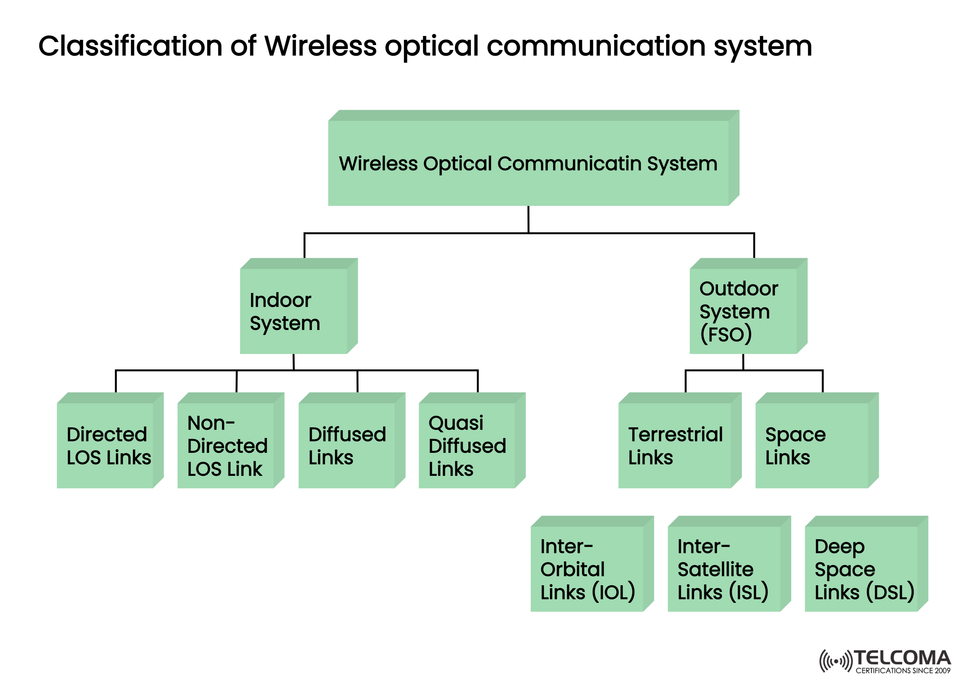

Classification of Wireless Optical Communication Systems
Wireless Optical Communication (WOC) has become a major force in today’s telecommunications scene, providing extremely fast, secure, and cost-effective data transfer using light rather than radio waves. With the growing need for high-bandwidth and interference-free connectivity, WOC systems are becoming essential for 5G backhaul, inter-satellite connections, and communications in deep space.
The diagram uploaded gives a clear classification of wireless optical communication systems, splitting them into indoor and outdoor systems, with additional distinctions based on the type of links used.
In this article, we’ll dive into these classifications, their unique features, and their significance for modern communication networks.
Introduction to Wireless Optical Communication (WOC)
Wireless Optical Communication involves sending data through the atmosphere using optical signals (light waves), mainly in the infrared or visible spectrum. Unlike traditional radio frequency (RF) systems, WOC offers:
Higher data rates (up to several Gbps)
Unlicensed spectrum use
Low interference and high security
Cost-effective deployment
Applications of WOC:
Last-mile connectivity and fiber replacement
5G backhaul links
Communication between buildings
Satellite and deep-space data transmission
These systems can be generally categorized into Indoor Systems and Outdoor Systems (Free Space Optics - FSO).
Major Classification of Wireless Optical Communication Systems
According to the uploaded chart, WOC can be divided into two main types:
Indoor System
Outdoor System (FSO)
Each of these categories contains multiple link configurations depending on how optical signals travel and interact with their surroundings.
Indoor Wireless Optical Communication Systems
Indoor wireless optical communication systems are mostly used in short-range settings like offices, smart homes, and industrial automation. They utilize infrared light or visible light to transmit data between devices, eliminating the need for wired connections.
The indoor system can be further broken down into four main types:
a. Directed Line-of-Sight (LOS) Links
In a directed LOS link, there’s a clear, unobstructed path between the transmitter and receiver.
These links provide high data rates and low error rates since there's minimal multipath distortion.
Common applications include infrared remote controls and point-to-point communication within buildings.
However, they do require careful alignment—if something gets in the way, the performance can drop.
Key Applications:
Infrared (IR) point-to-point communication
Optical docking systems
Wireless device synchronization
b. Non-Directed Line-of-Sight (LOS) Links
These systems use wider beam divergence, which means they don’t need precise alignment.
The transmitter sends out a broad optical signal that can reach various receivers.
They’re more robust against obstacles but usually have lower data rates.
Key Applications:
Wireless LANs using infrared technology
Short-distance communications in dynamic settings
c. Diffused Links
For diffused links, optical signals bounce off walls, ceilings, or reflective surfaces to reach the receiver.
They offer wide coverage without needing strict alignment.
However, the signal strength can drop due to multipath fading and scattering.
Key Applications:
Indoor wireless lighting communication systems (Li-Fi)
Distributed sensor networks
d. Quasi-Diffused Links
These systems blend features of directed and diffused links.
They partially utilize reflection but still maintain some level of directivity for better signal quality.
This gives a balance between coverage and data throughput.
Key Applications:
Industrial automation
Semi-structured communication areas (like factories and offices)
Outdoor Wireless Optical Communication Systems (FSO)
Outdoor wireless optical systems, also known as Free Space Optics (FSO), facilitate high-capacity data transmission over long distances without the need for fiber cables. These systems utilize light beams to send data through the atmosphere or even space.
Outdoor WOC systems are classified into Terrestrial Links and Space Links.
a. Terrestrial Links
These links connect two fixed points on Earth (like buildings or towers).
They employ laser-based communication to create line-of-sight data links.
Perfect for urban settings, campus networks, and temporary fiber replacements.
Very cost-effective since they avoid the expenses tied to fiber installation.
Advantages:
Quick deployment
High data transfer speeds (up to 10 Gbps or more)
Resistant to electromagnetic interference (EMI)
Challenges:
Performance can be affected by fog, rain, and atmospheric turbulence
Key Applications:
5G backhaul connectivity
Metro area network extensions
Connections between enterprise buildings
b. Space Links
Space-based wireless optical systems function beyond Earth’s atmosphere and are crucial for satellite and deep-space communications.
They can be split into three types:
i. Inter-Orbital Links (IOL)
This type establishes communication between satellites in different orbits, like between LEO (Low Earth Orbit) and GEO (Geostationary Orbit) satellites.
It provides global coverage and low-latency inter-satellite communication.
This also decreases reliance on ground-based relay stations.
Key Example:
Optical links connecting Starlink satellites or Earth-observation constellations.
ii. Inter-Satellite Links (ISL)
These links connect satellites within the same orbital layer, forming a mesh network in space.
They offer high data throughput and reliability.
Essential for real-time data sharing and constellation synchronization.
Applications:
Broadband internet constellations (like Starlink and OneWeb)
Remote sensing and Earth observation systems
iii. Deep Space Links (DSL)
This type facilitates communication between Earth and space probes or distant celestial bodies.
It demands extremely powerful transmitters and highly sensitive receivers because of vast distances.
Supports scientific missions, planetary exploration, and space telemetry.
Examples:
NASA’s Deep Space Network (DSN) optical upgrades
Communications for Mars rover and lunar missions
Advantages of Wireless Optical Communication Systems
High Data Rates: Capable of multi-gigabit speeds, perfect for broadband and backhaul.
Security: Light waves don’t penetrate walls, making interception tough.
Cost-Effective: Cuts out the need for expensive fiber trenching.
Spectrum Efficiency: Works in unlicensed optical bands.
Scalability: Easy to implement and expand as demands grow.
Challenges in Wireless Optical Communication
Even with its benefits, WOC systems deal with certain challenges:
Atmospheric Interference: Weather like fog or rain can weaken signals.
Alignment Sensitivity: Outdoor links need precise alignment to work well.
Limited Range: Indoor systems tend to cover shorter distances.
Maintenance Needs: Regular calibration and cleaning are needed to keep them reliable.
Emerging tech such as adaptive optics, beam tracking, and hybrid RF/FSO systems are tackling these issues effectively.
Future of Wireless Optical Communication
As the demand for data continues to rise with 5G, IoT, and satellite mega-constellations, WOC systems are gearing up to play a central role in future communication networks.
Upcoming Trends:
Integration with 6G: Optical wireless is set to be crucial for ultra-high-speed and low-latency 6G backhaul.
Hybrid Systems: Merging RF and optical communication to overcome environmental challenges.
Space Internet Expansion: Optical ISL and IOL links will secure smooth, low-latency space-based connectivity.
Quantum Optical Links: For ultra-secure communication and encryption using quantum technology.
Conclusion
The classification of wireless optical communication systems showcases the variety and flexibility of optical technologies in both indoor and outdoor settings. From short-range indoor infrared systems to deep-space laser links, each type serves a specific purpose in achieving fast, secure, and reliable data transmission.
As the telecom industry heads towards 6G and beyond, wireless optical communication will help connect terrestrial and extraterrestrial communications, offering outstanding performance and scalability for the future of global communication networks.