
CP/UP Independent Dimensioning and Scaling in 5G Networks

📡 CP/UP Independent Dimension and Scale in 5G Networks
The most noteworthy development of 5G architecture is how it decouples the Control Plane (CP) and User Plane (UP). The flexibility provided in decoupling CP and UP provides a unique opportunity for networks to scale each independent of each other. Carriers can now structure their network infrastructure based on the service specific demand profiles for traffic whether it is massive signaling from IoT endpoints or massive data transfer from broadband customers.
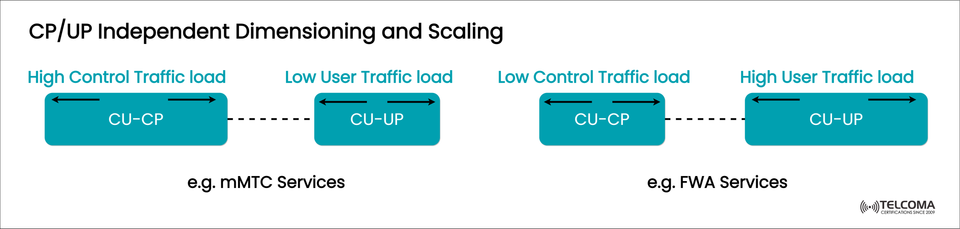
Above are two traffic profiles and examples of deployment strategies:
🔍 What is CP/UP Split?
Control Plane (CU-CP): Responsible for signaling, session management, mobility, and control messages.
User Plane (CU-UP): Responsible for actual user data transport, i.e. video streaming, file downloads, etc.
In short, 5G networks can separate these functions and scale them independently of one another based on demand to maximize resources and optimize service performance.
📊 Traffic Profiles & Scaling Scenarios
- High Control Plane Load, Low User Plane Load
Use Case: massive machine type communications (mMTC)
Example: smart meters, environmental sensors
CU-CP: Scale up to sustain frequent signaling - i.e. connection requests
CU-UP: Minimum bandwidth requirements based on tiny payloads
- Low Control Plane Load, High User Plane Load
Use Case: fixed wireless access (FWA)
Example: home broadband, enterprise data backhaul
📌 Principal Advantages of CP/UP Independent Dimensioning
Advantages Explanation
Network Efficiency Available resources are provisioned where and when needed eliminating waste.
Cost Reduction Affordable operators only invest in dimensioning (CP or UP) whatever scaling is required.
Flexible Tracking for Services Consumption of services can be tracked using virtualized infrastructure based on use case (i.e IoT, FWA, AR/VR)
Quality of Service the Same Operators meet the required quality of service regardless of sudden variations in traffic demands.
5G Dimensioning is Critical for Future Developments Independent CP/UP scaling is predicated on platform elements supporting all future developments (i.e 6G, network slicing).
🛠 Implementation Considerations
Independent Interface Management: The F1-C (control) and F1-U (user) interfaces that connect the DU to CU-CP and additionally to CU-UP must be managed in isolation.
Onboarding Orchestration: If an NFV/MANO or cloud-native managed orchestration (e.g Kubernetes, ONAP) is used support for establishing dynamic scale for CP or UP.
Performance Tracking: KPI management and tracking must also use separate KPI variables to dimension the resources allocated for each CU-CP and CU-UP.
Control Plane/User Plane independent dimensioning represent an enabling capability for 5G Networks and Operators to meet the service demands of the 5G Network. From thousands of devices in IoT to households consuming gigabytes in content.
As we shift towards a more adaptive ecosystem of services (e.g AR/VR, autonomous systems, industrial automation), CP/UP independent dimension will still continue to be a requirement to ensure performance and efficiency during itemized resource utilization.
🔮 Trends that Influence CP/UP Scaling in Future Networks
As networks continue to evolve toward 5G-advanced and indeed to beyond 5G, the scaling capabilities for CP/UP will gain further importance. Here are a few ways to think about how CP/UP scaling relates to future-ready architecture in Terms of increasing flexibility:
One of the trends that facilitate CP/UP scaling is network slicing. Differentiating slices could have different CP/UP requirements. For example, an industrial IoT slice could generate substantial control signalling (CP variable), while an AR/VR slice would require a significant amount of user data throughput (UP variable).
Deployment with Edge Computing is another trend to incorporate. CP functions are often centralized, but the CP can scale with local UPF in proximity to low-latency applications. This means the UPF can scale without burdening centralized CP functions.
The trends to consider also coincide with the emergence of AI/ML, which will allow improved resource allocation of UPF and CU functions. The ability of machine learning to investigate network traffic behaviours and trends to forecast future time periods or events will further allow the operator / cloud service to scale either instances of CU-CP or CU-UP.
The trend toward cloud-native core is the microservice nature of CNFs. Cloud-native core architectures integrate the CU-CP and CU-UP as separate microservices. The containerization and cloud-native architectures are enabling operators to achieve very fine-grained scaling and active, elastic scaling.
📘 Examples
Type Type shifts / behaviour (e.g., reduce and disconnect) CU-CP Scale CU-UP Scale
Smart metering (part of operational high throughput) Frequent connects and disconnects (noted uplink bit rate) High Low
Video streaming Extended sessions and high throughput Moderate High
Emergency alerts Period of time with a rapid surge of signalling High Low
Cloud gaming Steady control signalling and low-latency data transfer Low Very high.
🧩 Best Practices for Operators
📈 Monitor Continuously: Employ telemetry and KPI dashboards for the Control and User planes separately.
⚖️ Balance CP and UP growth: Avoid the temptation of assuming that CP and UP will scale linearly—scaling may happen differently depending on service mix.
☁️ Then Use Virtualization: Use NFV or CNFs to instantiate CP/UP instances on-demand on public and private cloud resources.
🔄 Automate Scaling: Apply auto-scaling rules based on continuous load for CP and UP resources.
🧠 Conclusion:
Flexibility in Scaling Leads to Agile Networks
The ability to independently size and scale the Control Plane and User Plane is a key benefit of agile, service-oriented 5G networks. This design:
Ensures that each traffic type achieves the optimal performance this planning can attain
Ensures effective usage of infrastructure space at the cheapest cost
Allows the operator to fully future-proof their network against service evolution
Whether it's connectivity for low data rates IoT devices or streaming 8K video, the decoupled CP/UP design provides operators with the flexibility to meet every need: agily—and intelligently.