
EN-DC Band Combination Explained: LTE–5G Integration for Enhanced Connectivity

EN-DC Band Combinations: Bridging 4G LTE and 5G NR
As networks transition to a new tradition, EN-DC (E-UTRAN New Radio – Dual Connectivity) is essential to maintaining seamless access to 4G LTE and 5G NR. In this hybrid mode, a user device may simultaneously connect to an LTE node (Evolved Node B or eNB) and a 5G NR node (Next Generation Node B or gNB) to enjoy the features of 5G NR while still taking advantage of LTE coverage.
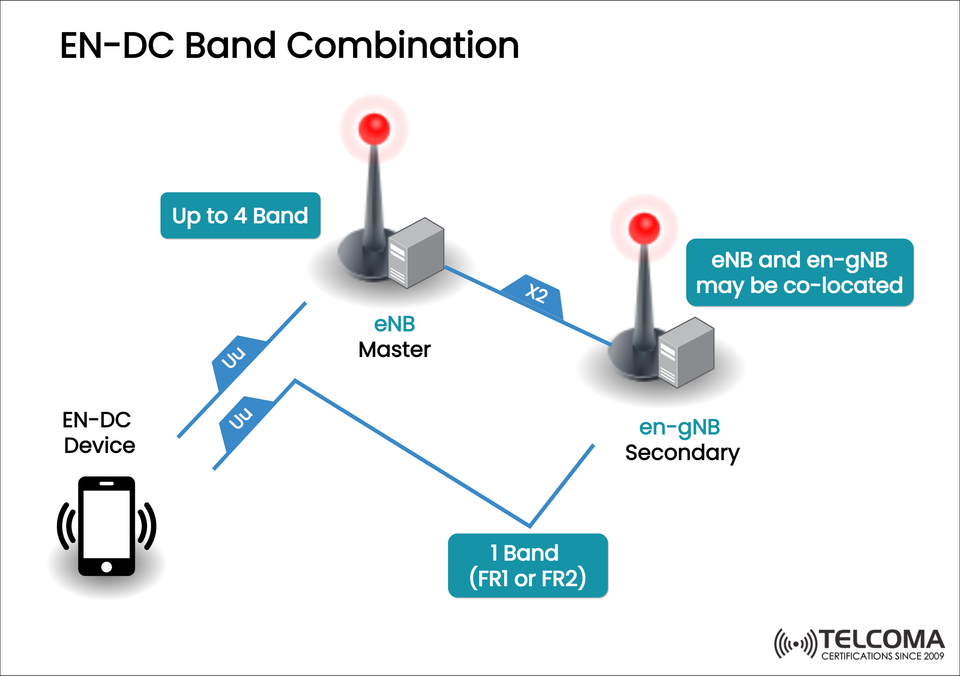
The figure attached helps illustrate how an EN-DC device connects to an eNB, or Master Node, and gNB, or Secondary Node, over two radio links to enhance speed, reliability, and overall experience.
Understanding EN-DC Architecture
EN-DC is one of the earliest modes of Non-Standalone (NSA), 5G deployment. This approach was standardized by the 3rd Generation Partners Group (3GPP) in Release 15; with the LTE eNB acting as the Master Node (MN) and the 5G NR gNB as the Secondary Node (SN).
Main Elements of EN-DC:
Element Explanation Function
EN-DC Device (UE) Mobile device that accommodates dual connectivity. Simultaneously connects to LTE and 5G.
eNB (Evolved Node B) LTE base station operating as the Master Node. Manage control plane and a portion of data traffic.
en-gNB (Next Generation Node B) 5G base station assuming the role of Secondary Node. Responsible for user plane (high-speed) data.
X2 Interface Link that connects eNB and en-gNB. Facilitates signaling and coordination.
How the EN-DC Band Combination Works
The User Equipment (UE) in the EN-DC scenario establishes radio connections with both eNB and en-gNB simultaneously. The eNB takes care of control signaling while en-gNB provides a high-speed data connection by using the 5G connection.
The diagram below highlights the dual radio connection (Uu interface) established through the EN-DC device:
One of these links is established with the eNB (Master) and typically accommodates up to four LTE bands.
The second radio link is established with the en-gNB (Secondary) and accommodates one NR band (FR1 or FR2).
Additionally, the eNB and en-gNB are connected through an X2 interface to ensure coordination and the user plane data is routed through the LTE and 5G layers.
FR1 vs FR2 Bands
FR1 (Frequency Range 1): Sub-6 GHz frequencies that provide wider coverage.
FR2 (Frequency Range 2): mmWave frequencies that deliver ultra-fast data rates but shorter coverage.
Characteristics of EN-DC Band Combination
Dual Connectivity:
The ability to simultaneously connect to LTE and 5G NR improves both user throughput and resiliency of the user connection.
Flexible Band Aggregation:
The EN-DC configuration supports a maximum of 4 LTE bands and 1 NR band (FR1 or FR2).
Dynamic Traffic Distribution:
The network dynamically allocates traffic between LTE and 5G NR - based on radio conditions and load.
Co-location Option:
As depicted in the image below, the eNB and en-gNB can be co-located when the deployment scenario calls for it, which provides streamlined installation and shorter user connection latency.
Seamless Mobility:
EN-DC provides service continuity when a user moves between LTE and 5G coverage areas.
Technical Workflow: Data Flow and Control
Here's how each flow of User and C-plane signaling flows through the EN-DC implementation:
Control Plane (C-Plane):
Handled predominantly by the LTE eNB.
The RRC (Radio Resource Control) connection to the user device is anchored in LTE.
User Plane (U-Plane):
Takes advantage of the split nature of EN-DC between LTE and 5G NR.
User data traffic may be sent via either LTE, NR or both - depending on the link conditions.
X2 Interface Function:
Allows for coordination and synchronization between eNB and en-gNB.
To ensure handover continuity and throughput consistency.
By utilizing a combination of LTE control, 5G data deployment, backward compatibility, and a simple deployment process, 5G services can be quickly deployed and establish service connection continuity.
Benefits of EN-DC Bands Combination
Benefit Description
Improved Data Speeds Combines bandwidth of LTE and 5G for greater throughput.
Faster 5G Deployment Allows early deployment of 5G possible intially with a non-full SA (standalone) architecture.
Extended Coverage LTE has greater coverage distance, which works well with 5G's limited coverage at high frequencies.
Reduced Latency 5G NR has better response time for critical applications.
Network Efficiency Resources can dynamically be used across multiple bands.
EN-DC Band Combination Example
Let’s look at one example configuration for an EN-DC implementation:
LTE Bands (up to 4): Band 3, Band 7, Band 20, and Band 28.
NR Band: n78 (FR1, 3.5 GHz).
This configuration allows:
LTE to handle all signaling and basic connectivity.
5G NR to increase throughput as the device maintains the mid-band spectrum.
The device will take both of these connections and intelligently aggregate them to achieve overall down speeds above 2 Gbps under ideal conditions.
Deployment Scenarios
- Co-located eNB and gNB
Both LTE and 5G radios share the infrastructure.
Easier backhaul and synchronization.
Suitability for dense urban deployments. - Non Co-located eNB and gNB
eNB and gNB are separate while still connected via the X2.
Suitability for early 5G deployment where existing LTE could connect links for gNB at remote sites. - Heterogeneous Networks (HetNets)
A mix of macro and small cells.
EN-DC instances allow for efficient usage of low-band LTE coverage.
Concerns Associated with Implementing EN-DC
With all the benefits of utilizing EN-DC, operators still have some challenges to face:
Inter-site latency: The X2 interface may cause delays if the eNB and gNB are separated by a distance.
Complex configuration: Planning the network is much more complicated due to the need to manage multiple bands and cells.
UE compatibility: Some UE devices will not support the various EN-DC band combinations.
Backhaul capacity: Traffic is increased by dual connected UEs, thus requiring very robust backhaul links.
These concerns can be resolved by operators in different ways, such as optimizing transport networks, using software upgrades, and utilizing automated configuration tools.
EN-DC versus 5G standalone (SA):
Feature EN-DC (Non-Standalone) 5G SA (Standalone)
Core network EPC (LTE Core) 5G Core Network
Control plane anchor LTE eNB 5G gNB
Deployment speed Faster (uses LTE infrastructure) Slower (new infrastructure)
Latency Moderate Lower
Use Case Enhanced mobile broadband Advanced 5G features (URLLC, slicing)
EN-DC serves as a bridge to full 5G, leveraging existing LTE infrastructure while delivering performance benefits in 5G applications.
The Future of EN-DC and Band Combinations
As 5G technology continues to mature, EN-DC band combinations are also changing. 3GPP continues to release updates with NR-LTE band pairings, increasing both compatibility and performance.
Some of the trends are as follows:
Dynamic Spectrum Sharing (DSS). LTE and NR can share spectrum dynamically.
Carrier Aggregation evolution. LTE can aggregate with different NR carriers to deliver gigabit speeds.
Transition to SA networks. EN-DC will always be a part of the process when migrating to SA networks to ensure backward compatibility.
Conclusion
The EN-DC Band Combination is a core technology for introducing 4G LTE and 5G NR as a way for users to experience high data rates and an overall seamless experience during the global transition to 5G.
The EN-DC technology enables operators to deliver enhanced mobile broadband services by combining LTE's reliability with the advanced speeds of 5G NR without having to wait for the completion of the entire rollout of 5G SA networks.
As networks evolve, expect for EN-DC to continue to be a critical bridge technology and preparing the path for fully integrated and ultra-fast 5G ecosystem.