
End-to-End 5G Service Design and Orchestration: RAN, Core, and Cloud Integration

5G Service Design and Orchestration for an End-to-End Process: A Complete Breakdown
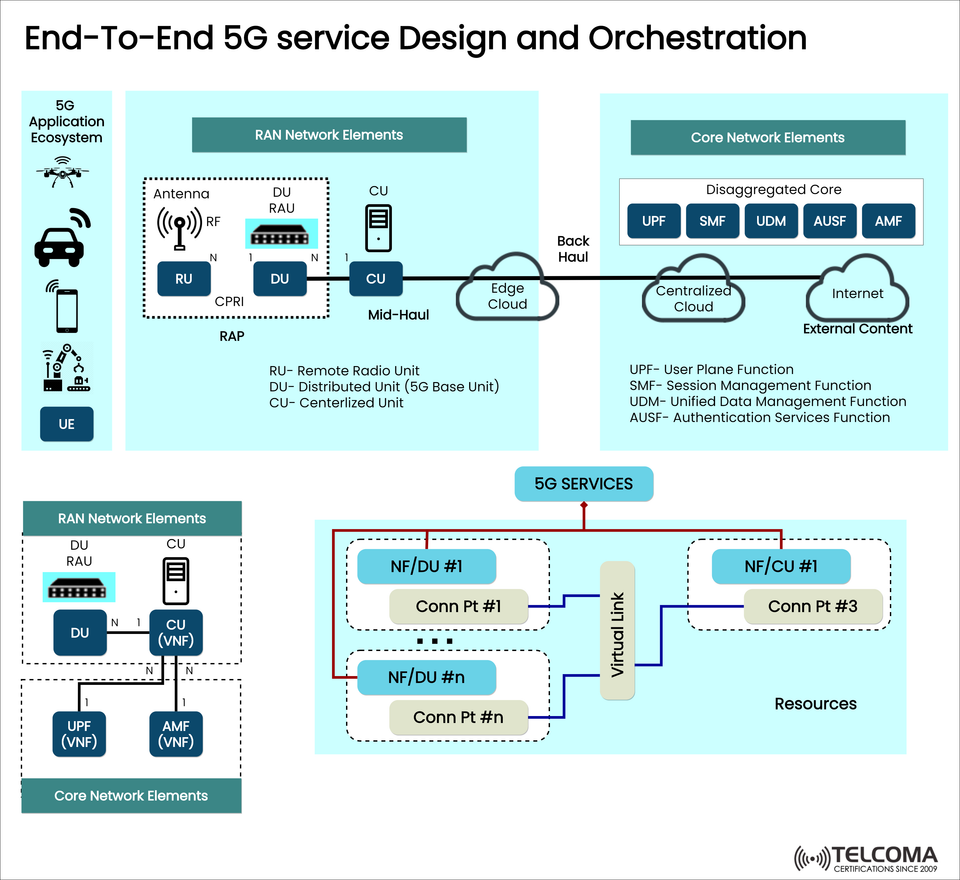
The fifth generation of mobile networks, 5G, is much more than just faster data speeds; it is about a fully virtualized, cloud-native architecture, providing super-reliable, low-latency communication for a dozen different applications. We are going to look at end-to-end service design and orchestration of the 5G network from the image provided. We will identify the major components of the 5G architecture, their capabilities and interconectedness as well as virtualized Network Functions that will deliver flexible and scalable services.
📌 Key Components of the End-to-End 5G Architecture
The image highlights the architecture of the 5G services from the User Equipment (UE) to its destination in the cloud through the Radio Access Network (RAN) and Core Network. Below is the component breakdown as follows:
- User Equipment (UE) and Application Ecosystem
- UE is the device used that can take many forms: smartphones, IoT modules, autonomous vehicles, etc.
- Application ecosystem: examples include AR/VR, smart city devices, drones, etc.
- RAN Network Elements
- The RAN architecture is compartmentalized for improving flexibility, latency and contemporary edge deployment.
Component Description
RU (Remote Unit) Interfaces with antenna, RF processing
DU (Distributed Unit) Handles real-time tasks of the baseband unit
RAP (RAN Access Point): The logical combination of RU and DU.
CPRI (Common Public Radio Interface): The standardized interface between RU and DU.
Mid-Haul: Interconnects DU to CU.
Edge Cloud: Process data and applications at the user location to enable low latency services.
- Core Network Elements (Disaggregated Core)
The core network is designed to be flexible, using virtualized network functions (VNFs) and microservices.
Function Role
UPF User Plane Function - routing and forwarding data
SMF Session Management Function - session management
UDM Unified Data Management - user data
AUSF Authentication Server Function - authentication
AMF Access and Mobility Function - signaling and mobility
Backhaul: Interconnects CU to the core network and centralized cloud.
Centralized Cloud: Core network functions live.
Internet/External Content: Destination for most data traffic.
🔄 Virtualized Network Functions and 5G Services
5G service orchestration is heavily dependent on Network Function Virtualization (NFV). The lower portion of the image schematically illustrates how the functions of the network are deployed as VNFs in the different distributed and centralized units.
Virtualized Architecture Overview:
NF/DU and NF/CU are representing virtual Distributed and Centralized Units.
Each unit connects into Connection Points (Conn Pt #1, #2, etc.).
Virtual Links tie these components together and allow for dynamic resources allocation.
🔍 Benefits of Disaggregated and Virtualized Architecture for 5G
Scalability: Flexible scaling of particular functions on demand.
Flexibility: Instantly deployable and upgraded functions via software.
Efficiency: Better resource utilization in a cloud-native fashion.
Low Latency: Data is not travelling as far as it hops to edge compute locations.
Service Customization: Combines and slices networks to meet the needs of specific applications.
📊 Summary Table - End-to-End Flow
Phase Element/Function(s) Functionality
Access UE, Antenna, RU Device connection and RF
Mid-Haul DU, CU Data forwarding, management, and control
Edge Cloud Edge Nodes Computation tasks for low-latency
Core Network UPF, SMF, UDM, AUSF, AMF Context, session, data, and authentication management
Service Layer VNFs, Virtual Links, Resources Delivery of virtualized 5G services
🧠 Conclusion
5G service orchestration will support a value chain unified by elements of hardware (RU and DU) and software-defined functions (UPF and SMF). The disaggregation of the RAN and Core and edge and cloud elements will support high-performing, flexible, rapidly scalable services when needed, whether in support of IoT tasks or immersive experiences in AR.
The approach to building and orchestrating the 5G network connectivity model is modular, not only representing a technical evolution but representing a cultural evolution towards more intelligent and dynamic networks.
🧩 5G Service Orchestration: Connecting Physical and Virtual
5G orchestration manages the operational activities among network functions (both physical and virtual) across the entire RAN (Radio Access Network) and Core (EPC) with respect to upcoming services and applying the network services dynamically based on a variety of factors including the user, location, and the application
Components of Orchestration
- Network Function Virtualization Orchestrator (NFVO): The NFVO manages network function lifecycle management for the VNFs, e.g., instantiation, scaling, healing, and termination.
- VNF Manager (VNFM): The VNFM manages the instantiation and scaling of individual VNFs and interacts with the NFVO for overall lifecycle management.
- Virtual Infrastructure Manager (VIM): The VIM manages the computing, storage, and networking resources (i.e., OpenStack or Kubernetes clusters, etc.)
- Service Orchestrator: This sits to the top of the NFVO and is responsible for end-to-end service provisioning, monitoring, and policy management for service quality.
These orchestration functions allow the services to be elastic and aware of location – applications with ultra-low latency requirements (i.e., autonomous vehicles) will utilize Edge Cloud, while applications requiring high data throughput (i.e., video streaming) will utilize the Centralized Cloud.
📡 RAN-Centric Virtualization and DU/CU Splitting Models
In cloud-native RAN, we are separating the functions and deploying the functions as VNFs or Cloud Native Functions (CNFs). The advantage is that these functions can be deployed at the appropriate location across the network based on the required latency and bandwidth.
The Split Models are as shown in this table:
Split Model Definition Example Use Case
Option 7.2 The RU will handle the RF functions and the DU will handle the baseband lower layer. Low-latency edge deployments
Option 2 The RU and DU are handled together and the CU is handled separately.
🌐 Core Network Disaggregation: Control and User Plane Separation (CUPS)
The 5G Core decouples the Control Plane (AMF, SMF, AUSF, UDM) from the User Plane (UPF) providing the following benefits:
User Data breakout is localized (UPF at the edge)
Control is centralized in functions (SMF/AMF in the cloud)
Data routing is optimized for improved QoE
The separation achieves not only improved performance but also serves up multi-access edge computing (MEC) use cases:
Smart manufacturing
AR/VR gaming
Real-time health monitoring
🛡️ 5G Security, Scalability, and Service Assurance
Quality and performance are inherent in 5G orchestration. A modular architecture allows for:
Built-In Security:
User authentication is ensured through AUSF.
Firewall, intrusion detection and VPNs can be deployed as VNFs.
Elastic Scalability:
VNFs can auto-scale based on traffic load.
Multi-tenancy with enterprise-specific network slices.
Service Assurance:
Real-time analytics for SLA monitoring.
Closed-loop automation for fault management and healing.