
Implications of 5G-Era Technologies on SON and Network Orchestration
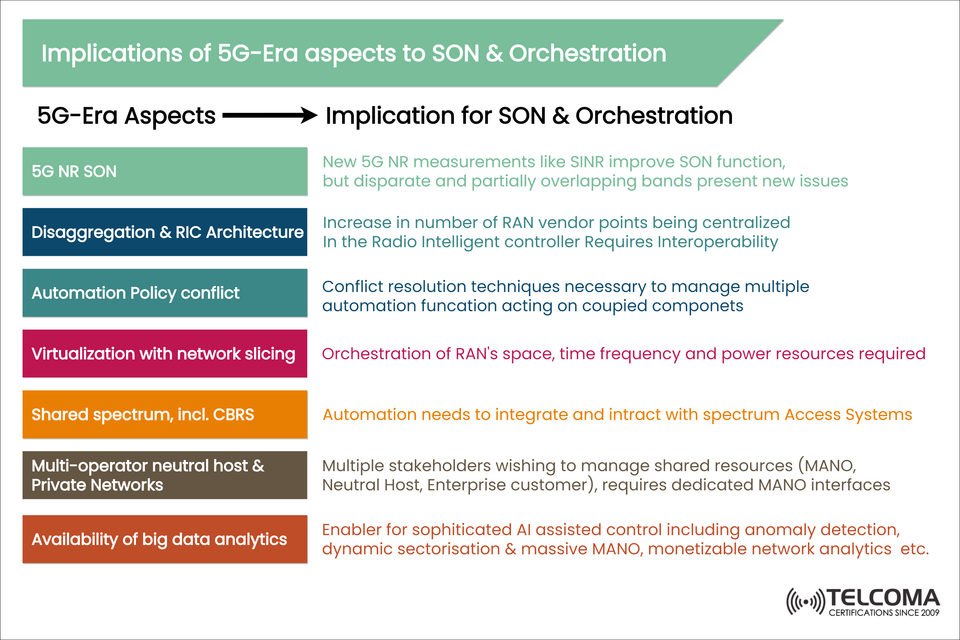

How 5G-Era Innovations are Changing SON and Orchestration?
As 5G deployment gathers momentum throughout the world, the 5G ecosystem introduces some new changes in architecture and operation. These changes, which will include disaggregation, network slicing, and big data analytics, will be transformative for how Self-Organizing Networks (SON) and orchestration will work.
This blog takes a look at the effects of the 5G-era innovations on SON and orchestration, and hopefully presents clear implications for anyone in the telecom industry or simply interested in technology.
📊 Table:
5G-Era Aspect and the Implication for SON & Orchestration
5G-Era Aspect Implication for SON & Orchestration
5G NR SON A new SINR-based measurements enhance SON functions but fragmented and overlapping bands pose new challenges for optimization
Disaggregation & RIC Architecture The centralized control of RIC will bring new demands for interoperability among a mix of RAN vendors
Automation Policy Conflict Increased degree of prerogative around advanced conflict resolution for automation policies that act simultaneously
Virtualization with Network Slicing An even finer-grained orchestration of time, frequency, space and power will be required.
Shared Spectrum (e.g., CBRS) Automation must work with dynamic Spectrum Access Systems in order to provide successful automation on spectrum sharing.
Multi-Operator Networks & Private Networks Orchestration will be even more complex due to multiple stakeholder demands and efforts to use dedicated MANO interfaces.
Access to big data analytics Use of AI-based functions of SON for anomaly detection, dynamic sectorization and analytics for monetization.
- 5G NR SON: New Measurements & Optimization
5G NR brings new measurements such as Signal-to-Interference-plus-Noise Ratio (SINR).
There have numerous SON advancements by incorporating the new metrics in SON functions such as cell optimization and handover decisions.
Despite these new measurements, spectrum fragmentation adds sophistication in inter-band coordination. - Disaggregation & RIC Architecture: More Vendor Touch-Points
The Open RAN model opens the door for disaggregation of software from hardware and requires interactions with multiple vendors.
SON must now also interact with the RAN Intelligent Controller (RIC).
SON has not necessarily utilized standardized interfaces and interoperability in this sense previously, but the disaggregation of RAN functions will demand a level of standardization and interoperability. - Automation Policy Conflict: Is Policy Alignment Possible?
Automation functions may all be running simultaneously, each with their own logic.
Without means to reconcile these differences, a collision of policies may hinder network performance.
SON systems must work toward being able to identify and dynamically resolve automation policy conflicts. - Virtualization with Network Slicing: Resource-Oriented Orchestration
A network slice can be thought of as the RAN's resources segmented by time, frequency, space, and power.
This entails many more granular orchestration layers that need to manage all RAN service level agreements (SLA) at the slice-level.
Integrating with NFV and SDN platforms is central to this migration. - Shared Spectrum & CBRS: Dynamic Spectrum Integration
Spectrum sharing in CBRS bands means many users are sharing frequencies and SON and orchestration can use space- and frequency-level automation to integrate with Spectrum Access Systems (SAS) such as to:
A. Create coordination of access dynamically
B. Manage the interface conditions to mitigate interference
C. Be responsible for the terms or quality of services
6. Multi-Operator and Private Networks: Diverse Stakeholder Interests
Scenarios utilizing Neutral Hosts and Private 5G networks increase orchestrators' complexity.
Multiple stakeholders (e.g., enterprises, MVNOs) will require different management interfaces.
MANO (Management and Orchestration) systems will have to manage multiple stakeholders' needs, support tenant partitioning, and resource partitioning.
7. Big Data Analytics: The Rise of AI-Driven SON
The vast amount of network data provides the opportunity for predictive and prescriptive analytics.
AI-as-a-service SON functions include,
Anomaly detection,
Sector optimization, and
Monetizable usage insights.
This will require MUST be integrated with analytics frameworks and real-time data pipelines.
Conclusion:
Altering SON and Orchestration for 5G
The advent of 5G requires a brand-new outlook on SON and orchestration. In this new era of working with SON, orchestration must work in tandem with a multitude of automation policies and integrate AI with network slices into more intelligent, self-adaptive network, software-based systems.
To operate in this new paradigm, telecom operators must:
Adopt an open set of standards and architecture that is interoperable
Recognize the embedded costs of investing in AI analytics and automation
Ensure orchestration systems are multi-tenant and flexible
SON, orchestration and the new technologies that emerge as part of 5G will all enable telecom operators to reap the full benefits of next-generation connectivity.
Actionable Recommendations for Network Operators
To derive the full benefit of 5G innovations in SON and orchestration, the telecoms vendor and operator community should consider:
Adherence to the O-RAN Alliance framework
Devise standardized interfaces such as the E2 and A1 interfaces to facilitate deploying and integrating RICs.
Support xApps and rApps which provide controls for programmable behavior of SON across various use cases, all of which would make use of RICs.
Integrate the RIC with AI/ML Capabilities
Leverage trained models to implement AI/ML capabilities to track and optimize of wireless users in real time.
Implementation of full AI/ML capabilities where signals in the form of big-data analytics become informative larger data inputs from RAN KPIs fed into the anomaly detection model.
Optimizing Ecosystem for Network Slicing and Shared Spectrum
Orchestration layers must support the allocation of resources and management of slices.
Working with SAS platforms in ecosystem of Dynamic CBRS between all tools.
Building Orchestration Systems in support of Multi-Tenancy
Multi-Domain managed orchestration tools.
Multi-tenant user.
🏁 Final Thoughts
5G is not just another "G" - it changes how we must plan, deploy, and manage telecom networks, whether wired or wireless. The emergence of Open RAN, virtualization, spectrum sharing, and advanced analytics means that SON and orchestration solutions will also need to adapt quickly.
The need for agility, performance, and responsiveness leads telco operators to plans to deploy and develop networks based on open interfaces, artificial intelligence capabilities, and the ability to orchestrate operations and services across vendors.