
Inside Modern Telecom Architecture: Orchestrator, Federation Gateway, and Operator Core Explained

Understanding Modern Telecom Core Architecture: From Orchestrator to Federation Gateway
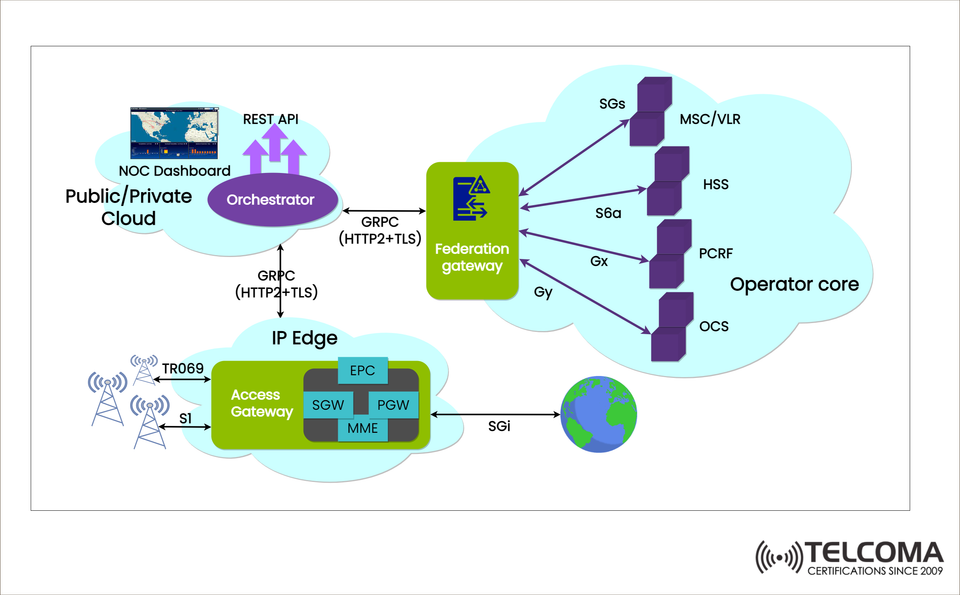
Today's cloud-native 5G networks are prompting operators to rethink how they deploy, manage, and scale their infrastructure. The image uploaded does a great job showing this shift — it illustrates the connections among the Public/Private Cloud, Access Gateway, Federation Gateway, and the Operator Core.
In this blog, we’ll break down each piece of the puzzle and discuss how they work together to ensure reliable connectivity, efficient orchestration, and a seamless link between distributed edge and core systems.
Overview of the Architecture
The diagram gives us a look at a modern telecom architecture that connects cloud-based orchestration, edge networking, and the core functions of operators.
At a high level, the system consists of the following components:
A Public/Private Cloud hosting an Orchestrator and NOC Dashboard
An IP Edge with an Access Gateway that implements EPC (Evolved Packet Core) functionalities
A Federation Gateway serving as a connection to the Operator Core
Operator Core components like HSS, PCRF, OCS, and MSC/VLR
Each of these elements communicates using standardized protocols such as GRPC (HTTP2+TLS), TR-069, and REST APIs, which ensure secure communication and interoperability.
The Public/Private Cloud and Orchestrator
The Public or Private Cloud is central to network management and automation, with the Orchestrator at its heart, handling lifecycle management, network configuration, and monitoring.
The IP Edge and Access Gateway
Now moving to the IP Edge, we come to the Access Gateway — where the integration between Radio Access Networks (RAN) and the Core Network occurs.
a. Access Gateway Role
The Access Gateway serves as the bridge between wireless devices and the core network, managing both control plane and user plane functions. It connects with RAN elements via the S1 interface and manages device configurations through TR-069.
b. Embedded EPC Components
The image shows the Access Gateway incorporating core LTE components known collectively as the Evolved Packet Core (EPC):
EPC ComponentFull FormFunctionSGWServing GatewayRoutes and forwards user data packetsPGWPacket GatewayLinks the EPC to external IP networksMMEMobility Management EntityHandles signaling, mobility, and session management
These functions together guarantee smooth handovers, policy enforcement, and continuity of IP sessions for users.
Federation Gateway: Bridging Edge and Core
At the center of the diagram is the Federation Gateway — a crucial intermediary that keeps the operator’s private network compatible with the wider core network infrastructure.
a. Role of Federation Gateway
The Federation Gateway facilitates:
Protocol translation and mediation between cloud-native and legacy core networks.
Secure interconnection with various operator core interfaces.
Authentication and session management for roaming and inter-network communication.
This architecture sees the Federation Gateway communicating over multiple standardized interfaces:
SGs — links to MSC/VLR for circuit-switched fallback.
S6a — connects with HSS for subscriber authentication.
Gx — interacts with PCRF for policy control.
Gy — connects with OCS for real-time charging and billing.
All these interfaces work to ensure that network functions across different domains stay in sync, maintaining an uninterrupted service.
b. Security and Transport
The communication between the Federation Gateway and other components utilizes GRPC over HTTP2+TLS, which guarantees:
Fast, bi-directional communication.
Strong encryption and authentication.
Efficient resource use in cloud-native settings.
This design fits right in with cloud-first telecom architectures, enhancing performance and secure interoperability.
The Operator Core
The Operator Core depicted in the image represents the main control and management layer of the telecom network. It encompasses several key network elements (NEs) responsible for session management, authentication, policy enforcement, and billing.
a. Key Components of the Operator Core
ComponentFunctionMSC/VLRControls mobility and voice sessions for circuit-switched domains.HSS (Home Subscriber Server)Stores user profiles, authentication data, and subscription information.PCRF (Policy and Charging Rules Function)Establishes QoS and charging policies for user sessions.OCS (Online Charging System)Manages prepaid and real-time charging based on usage.
Together, these modules ensure that both data and signaling planes operate cohesively across LTE and 5G environments.
b. Core Integration
The Federation Gateway provides the link between the IP Edge and these core systems, making sure data flows smoothly and services remain continuous. It handles requests for:
Authentication (S6a with HSS)
Policy control (Gx with PCRF)
Billing (Gy with OCS)
By centralizing these communications, the Federation Gateway reduces complexity and supports multi-operator federation, which is key for roaming or shared network scenarios.
Communication Protocols in the Architecture
The whole ecosystem relies on standardized, secure communication protocols that ensure everything works together seamlessly.
Key Protocols and Interfaces:
GRPC (HTTP2 + TLS): Allows effective, secure communication between cloud and edge elements.
TR-069: Used for remote management and configuration of customer-premises equipment (CPE) and small cells.
S1 Interface: Connects eNodeB (RAN) to EPC (Access Gateway).
SGi Interface: Links the Packet Gateway (PGW) to external IP services and the internet.
REST API: Enables integration with orchestration systems, dashboards, and external OSS/BSS layers.
These standards help ensure flexibility, scalability, and security across distributed telecom environments.
Benefits of This Architecture
This architecture brings a lot of benefits to telecom operators making the transition to 5G and cloud-based infrastructures.
a. Cloud-Native Flexibility
Functions can be virtualized and deployed in public or private clouds, which allows for dynamic scaling.
b. Enhanced Security
Using TLS-encrypted GRPC and REST APIs guarantees secure data exchanges between network elements.
c. Automation and Orchestration
Centralized orchestration streamlines configuration, fault detection, and policy management.
d. Multi-Vendor Interoperability
Open protocols and standard interfaces make it easy for operators to collaborate with different vendors without hassle.
e. Edge Efficiency
With Access Gateways situated at the edge, latency drops, and responsiveness of the network improves significantly.
Real-World Applications
This cloud-integrated telecom architecture is perfect for:
Private 5G and LTE networks tailored for enterprises.
Rural or decentralized telecom deployments where centralized cores are difficult to implement.
Mobile Virtual Network Operators (MVNOs) seeking flexible integration with existing cores.
Network slicing and edge computing applications aimed at IoT and Industry 4.0.
Conclusion
The integration of Orchestrators, Access Gateways, and Federation Gateways signifies a new phase in telecom evolution, blending the capabilities of cloud-native design, open interfaces, and intelligent automation.
By seamlessly linking edge, core, and cloud, this architecture enables operators to provide secure, scalable, and high-performance connectivity — a must for the next wave of digital experiences powered by 5G and beyond.