
Inside the O-RAN Architecture: Understanding RIC, SMO, and Open Interfaces in Next-Gen RAN
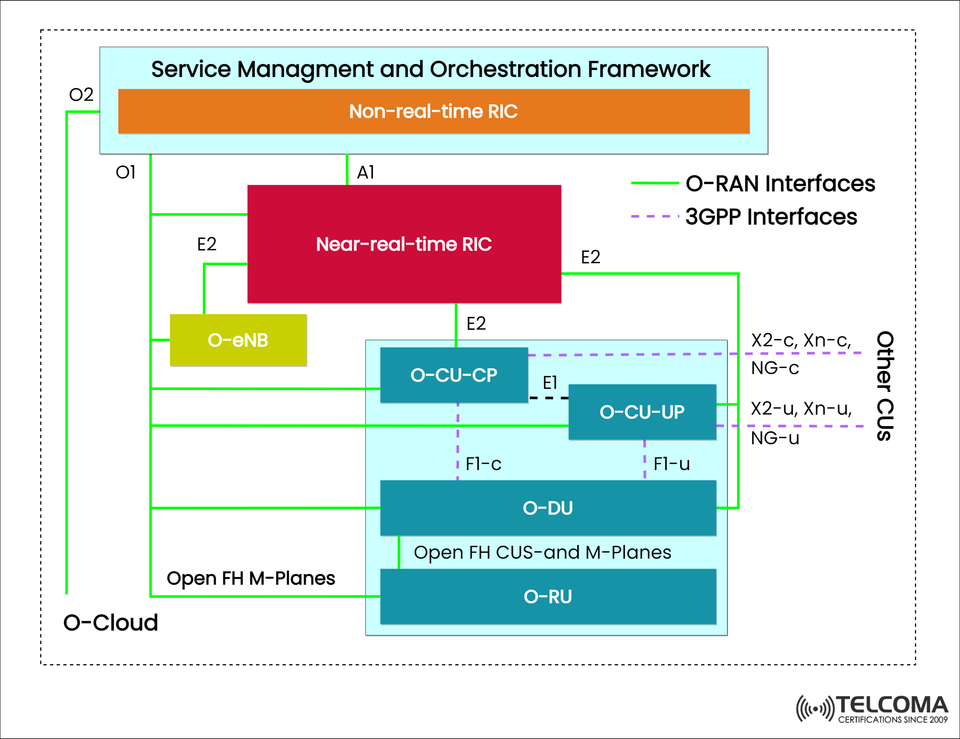

A Closer Look at the O-RAN Architecture: Breaking Down SMO, RIC, and Open Interfaces
The Open Radio Access Network (O-RAN) is shaking up the telecom world by breaking down vendor barriers and adding a bigger dose of intelligence, openness, and connectivity to mobile networks.
The diagram shows the O-RAN functional architecture—a system that pulls together Service Management and Orchestration (SMO), RAN Intelligent Controllers (RICs), and O-RAN functional units (O-CU, O-DU, and O-RU) through standardized O-RAN and 3GPP interfaces.
This setup is key to the evolution of 5G networks and lays the groundwork for intelligent networks that are ready for 6G.
Transitioning from Traditional RAN to Open, Cloud-Native RAN
Traditional RANs were rigid and proprietary, which stifled innovation and made it tough to integrate different systems. Each vendor would provide a complete package of hardware and software, making upgrades pricey and multi-vendor setups almost impossible.
O-RAN changes all that by:
Disaggregating – separating hardware from software.
Establishing Open Interfaces – promoting interoperability among different vendors.
Virtualizing and Cloudifying – running RAN functions as software on standard hardware.
Bringing in Intelligence via RIC – using AI/ML for better performance.
You can see this modern approach in the diagram that showcases the flexible, modular design of an O-RAN system.
Main Components of O-RAN Architecture
At the heart of the O-RAN architecture are five main functional parts:
a. Service Management and Orchestration (SMO) Framework
Think of SMO as the “brain” of the O-RAN setup. It’s in charge of:
Managing the lifecycle of RAN functions.
Overseeing network orchestration and automation.
Integrating the Non-Real-Time RIC for long-term optimization.
SMO tasks include:
Managing configurations.
Monitoring faults and performance.
Training and deploying AI/ML models.
Orchestrating resources across the cloud infrastructure (O-Cloud).
It connects with RAN using the O1 and O2 interfaces.
b. Non-Real-Time RIC
The Non-Real-Time RAN Intelligent Controller (Non-RT RIC) fits within the SMO framework.
Timescale: Works at intervals longer than 1 second (non-real-time).
Main Functions: * Long-term optimization of the network using AI/ML. * Policy management and intent-based control. * Deploying rApps (RIC applications) aimed at enhancing KPIs like throughput, energy efficiency, and mobility.
Key Interface: Links to the Near-RT RIC through the A1 interface.
The Non-RT RIC serves as the policy engine and data hub, directing near-real-time actions based on both historical insights and predictive analysis.
c. Near-Real-Time RIC
The Near-Real-Time RIC is the smart control layer that handles immediate, short-term optimizations of the RAN.
Timescale: Functions within 10 ms to 1 second.
Main Functions: * Managing radio resources and directing traffic. * Overseeing handovers, mitigating interference, and ensuring quality of service (QoS). * Making decisions via xApps, which are modular applications powered by AI.
Key Interface: Utilizes the E2 interface to communicate with O-CU and O-DU.
Essentially, the Near-RT RIC brings in real-time flexibility to RAN operations—much like how a reflex reacts quickly to changes.
d. O-RAN Functional Units (O-CU, O-DU, O-RU)
These units make up the disaggregated functional components of the 5G gNodeB (gNB):
Unit Function Location Main Protocols O-CU (Centralized Unit)Handles top-level tasks like RRC and PDCP Regional/Edge CloudE1, F1O-DU (Distributed Unit)Takes care of real-time scheduling and lower MAC/PHY tasks Edge CloudF1, E2O-RU (Radio Unit)Handles RF transmission, precoding, and beamforming Cell Site Open FH M-Planes
The O-CU has further divisions into:
O-CU-CP (Control Plane): RRC, PDCP (for signaling).
O-CU-UP (User Plane): SDAP, PDCP (for data transfer).
e. O-eNB (Optional for 4G Integration)
The O-eNB serves as an LTE base station within the O-RAN framework, ensuring backward compatibility with 4G/5G interactions. It operates through E2 and X2 interfaces for seamless integration in non-standalone (NSA) networks.
The Role of O-Cloud
All the separate components in O-RAN—CU, DU, and RIC—are hosted on the O-Cloud infrastructure. O-Cloud provides:
A virtualization environment for running RAN functions.
Resource pooling across edge and regional clouds.
Elastic scaling according to demand.
It also supports open APIs and automation tools for integrating cloud-native technologies like Kubernetes, Docker, and OpenStack.
The O2 interface connects the SMO to the O-Cloud, managing orchestration and resource distribution.
Interaction Between RICs and SMO: The Intelligence Loop
The O-RAN architecture creates a closed-loop automation system involving the SMO, Non-RT RIC, Near-RT RIC, and RAN nodes:
SMO/Non-RT RIC: Gathers historical data and refines AI models.
A1 Interface: Shares policies and AI insights with the Near-RT RIC.
Near-RT RIC: Implements real-time control through xApps.
E2 Interface: Carries out actions and collects telemetry from the CU/DU.
Feedback Loop: Returns data for model retraining and ongoing improvement.
This system turns the RAN into a self-optimizing and self-healing network, cutting down on the need for human intervention and lowering operational costs.
Advantages of the O-RAN Architecture
a. Interoperability and Vendor Flexibility
Open interfaces mean no vendor lock-in.
Operators can mix components from different vendors.
b. Intelligent Automation
AI-based optimization through RIC and SMO means less manual tuning.
c. Cloud-Native Adaptability
Functions operate as virtualized or containerized network functions (VNFs/CNFs).
d. Cost and Energy Savings
Using standard hardware and dynamic scaling cuts down on CAPEX and OPEX.
e. Scalability and Quick Adjustments
Cloud-native setups allow for flexible scaling to support dense 5G and future 6G scenarios.
Hurdles in O-RAN Deployment
While O-RAN brings a ton of benefits, it also comes with new technical challenges:
Testing Interoperability: Making sure multi-vendor systems work together smoothly.
Controlling Latency: Keeping latency down to sub-millisecond levels across the different components.
Addressing Security Risks: Open interfaces need robust encryption and monitoring practices.
Gaining Operation Expertise: Transitioning from hardware-focused to software-centered requires retraining.
Industry collaborations (like the O-RAN Alliance PlugFests) are tackling these issues through worldwide testing and standard-setting.
Wrapping Up: O-RAN—The Foundation of Intelligent, Open RAN Systems
The diagram encapsulates the essence of O-RAN: an open, disaggregated, and intelligent RAN setup that combines cloud-native infrastructure with AI-driven smarts.
By bringing together SMO, Non-RT RIC, Near-RT RIC, and O-Cloud, O-RAN enables automation, flexibility, and interoperability—the three key tenets of next-gen mobile networks.