
Mini-slot Transmission in 5G NR Uplink: Achieving Ultra-Low Latency and Dynamic Scheduling

Mini-slot Transmission in the Uplink: Boosting 5G NR’s Low-Latency Capabilities
The 5G New Radio (NR) standard aims to provide flexibility, scalability, and top-notch performance across various applications — from enhanced Mobile Broadband (eMBB) to Ultra-Reliable Low-Latency Communication (URLLC).
A standout feature that makes 5G's ultra-low latency possible is mini-slot transmission. It allows data to be sent without waiting for a full slot duration. While this concept applies to both uplink and downlink, we’ll focus on mini-slot transmission in the uplink, which you can see in the uploaded image.
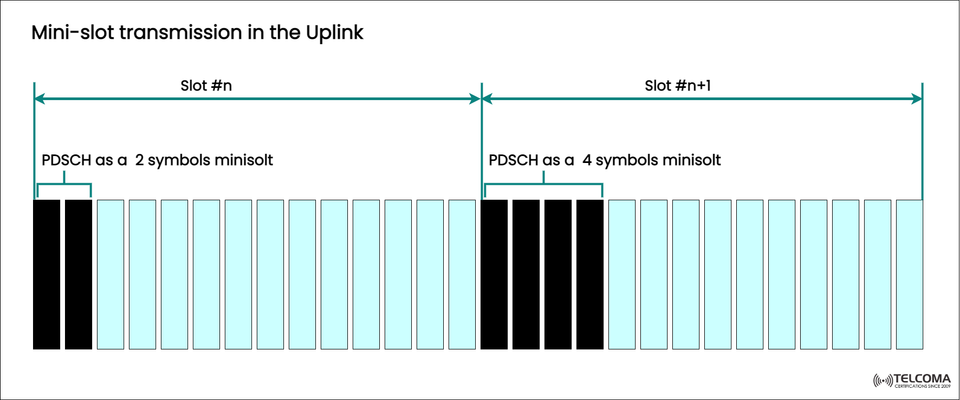
The image demonstrates how Physical Uplink Shared Channel (PUSCH) transmissions can use 2-symbol or 4-symbol mini-slots in consecutive slots, giving unmatched flexibility and responsiveness in uplink communication.
Getting to Know Uplink Mini-slot Transmission
In LTE systems, uplink transmissions were bound to fixed Transmission Time Intervals (TTIs), usually lasting 1 millisecond. Though this was great for continuous traffic, it created latency that was too high for new real-time and mission-critical services.
5G NR tackles this issue with mini-slot-based transmissions, allowing user equipment (UE) to send data instantly — without needing to align with slot boundaries.
What’s a Mini-slot in 5G Uplink?
A mini-slot is a short transmission time interval made up of 2, 4, or 7 OFDM symbols, as opposed to the typical 14-symbol full slot.
This quick scheduling unit enables instant uplink data transmission that's perfect for low-latency needs like industrial automation, connected vehicles, and remote control systems.
Image Overview: Uplink Mini-slot Concept
The uploaded image illustrates two consecutive uplink slots:
Slot #n: Displays PUSCH as a 2-symbol mini-slot — a very brief, immediate transmission.
Slot #n+1: Displays PUSCH as a 4-symbol mini-slot — a slightly longer transmission, providing more data capacity while still keeping latency low.
The black blocks in each slot show ongoing uplink mini-slot transmissions, while the light blue blocks represent available or unused symbols in the slot.
This visual representation emphasizes how 5G NR enables asynchronous, dynamic scheduling — transmissions can kick off at any symbol boundary rather than being locked to slot boundaries.
Key Features of Uplink Mini-slot Transmission
Mini-slot-based uplink transmissions come with a host of key technical features that set them apart from traditional slot-based scheduling:
Flexible Start Timing: Transmissions can begin at any symbol boundary.
Short Duration: Made up of 2, 4, or 7 OFDM symbols, this drastically cuts down on latency.
Dynamic Resource Allocation: The gNB (base station) can distribute uplink resources based on real-time demand.
Preemption Support: URLLC transmissions can take precedence over current eMBB traffic.
Applicable in Both TDD and FDD modes.
This level of flexibility means 5G NR can tackle varied services simultaneously — from heavy video streaming to crucial telemetry — with minimal delay.
How Uplink Mini-slot Transmission Works
The mini-slot transmission process in the uplink involves several coordinated steps between UE (User Equipment) and the gNB (Next Generation Node B):
Scheduling Request (SR): The UE sends a Scheduling Request to the gNB, letting it know there’s uplink data to transmit.
Grant Allocation: The gNB replies with an uplink grant, detailing mini-slot parameters — start symbol, duration, and frequency allocation.
Data Transmission: The UE sends data over PUSCH using the assigned mini-slot (for example, 2-symbol or 4-symbol).
Acknowledgment: The gNB decodes the data and acknowledges receipt via PUCCH (Physical Uplink Control Channel) or HARQ feedback.
This speedy scheduling method ensures instant access to uplink resources, cutting down on end-to-end delays.
Full Slot vs. Mini-slot Transmission (Uplink Comparison)
Parameter Full Slot Transmission Mini-slot Transmission
Number of Symbols142, 4, or 7**
Start Timing Aligned with slot boundary
Any OFDM symbol**
Latency~1 msAs low as 0.125 ms**
Use Case eMBB, continuous data URLLC, real-time signaling**
Flexibility Fixed scheduling Dynamic, event-triggered**
Resource Efficiency May waste symbols Highly efficient for bursts
This table showcases how mini-slot transmissions enhance 5G uplink communication, making it more responsive and efficient, especially for quick bursts of critical data.
The Role of Numerology in Mini-slot Transmission
5G NR outlines multiple numerologies, each with varying subcarrier spacing (SCS) and symbol durations. The performance of mini-slots directly hinges on the selected numerology (μ).
Numerology (μ)Subcarrier Spacing (kHz)Slot Duration (ms)Mini-slot Duration (2 Symbols)
0 151.0~0.14 ms
1 300.5~0.07 ms
2 600.25~0.035 ms
3 1200.125~0.018 ms
4 2400.0625~0.009 ms
As numerology increases, both slot and mini-slot durations shrink — allowing for microsecond-level transmission times, which is critical for millimeter-wave (mmWave) frequencies.
Applications of Uplink Mini-slot Transmission
Mini-slot transmissions enable a wide range of time-sensitive and critical 5G applications, especially in scenarios where uplink latency is key.
- Industrial Automation
Machines and sensors communicate instantly using mini-slots to transmit control data with sub-millisecond latency, ensuring safety and accuracy.
- Autonomous Vehicles
Vehicles constantly relay situational awareness data (like speed, proximity, braking) to nearby nodes or edge servers through uplink mini-slots.
- Remote Surgery and Teleoperation
Robotic tools and sensors utilize mini-slots to send haptic feedback and sensor data right away, enabling surgeons to safely carry out remote procedures.
- Smart Grids and Energy Networks
Mini-slots support real-time monitoring and fault detection, ensuring low-latency uplink communication between distributed grid sensors.
Mini-slot Scheduling and Preemption in Uplink
In dynamic 5G systems, URLLC transmissions can take over ongoing eMBB uplink sessions. This allows the base station to interrupt regular slot data with a mini-slot to prioritize urgent URLLC packets.
Example:
The UE is sending eMBB data in a full slot.
A URLLC packet comes in that needs immediate transmission.
The gNB schedules a 2-symbol mini-slot within the current slot for the URLLC data.
The eMBB transmission continues after the URLLC data is sent.
This method guarantees predictable latency and mission-critical reliability, keeping overall system performance intact.
Benefits of Mini-slot Transmission in Uplink
Technical Benefits
Ultra-low latency: Allows for data transmission within microseconds.
Flexible scheduling: Can operate independently of slot boundaries.
Dynamic prioritization: Supports preemptive URLLC transmissions.
Efficient spectrum usage: Minimizes resource waste for small data packets.
Increased reliability: Facilitates hybrid retransmission (HARQ).
Operational Advantages
Greater network responsiveness.
Smooth coexistence of varied 5G services (URLLC, eMBB, mMTC).
Enhanced user experience in latency-sensitive applications.
Challenges in Implementing Mini-slot Transmission
While mini-slot operation is powerful, it adds complexity to 5G network design:
Increased control signaling: Frequent scheduling grants may raise overhead.
Interference management: Overlapping uplink mini-slots need advanced coordination.
HARQ timing optimization: Retransmission timing must adapt to fluctuating TTI lengths.
UE synchronization: Requires precise symbol-level timing.
Getting past these challenges calls for smart scheduling algorithms, edge processing, and adaptive HARQ feedback methods.
Future Directions and Enhancements
Future 3GPP releases (Release 17 and beyond) look to boost mini-slot-based communication by introducing:
Adaptive TTI scheduling algorithms.
AI-driven resource allocation.
Dynamic prioritization between URLLC and eMBB traffic.
Coordinated uplink-downlink mini-slot systems for full duplex communication.
These advancements will solidify 5G’s role in building real-time, intelligent networks.
Summary
Mini-slot transmission in the 5G NR uplink offers a groundbreaking way to achieve instantaneous and flexible data transfer. By permitting uplink transmissions to start at any symbol boundary with 2-, 4-, or 7-symbol durations, it reduces latency and maximizes resource efficiency.
As seen in the image, mini-slots allow user equipment to send time-critical data without waiting for slot boundaries — making sure we have ultra-reliable, low-latency communication essential for URLLC, autonomous systems, and industrial IoT.
In short, uplink mini-slot transmission is vital for real-time 5G NR — connecting network responsiveness with machine-speed communication, paving the path for a hyper-connected, intelligent future in telecommunications.