
Understanding NR CA Band Notation in 5G: Intra-band Contiguous, Non-contiguous, and Inter-band Carrier Aggregation Explained

NR CA Band Notation in 5G: A Closer Look at Intra-band and Inter-band Carrier Aggregation
As we transition from LTE to 5G New Radio (NR), there’s been a skyrocketing demand for higher data rates, wider bandwidth, and smoother connectivity. One key technology driving this progress is Carrier Aggregation (CA) — which is essentially a technique that brings together several frequency carriers to boost throughput and improve spectrum efficiency.
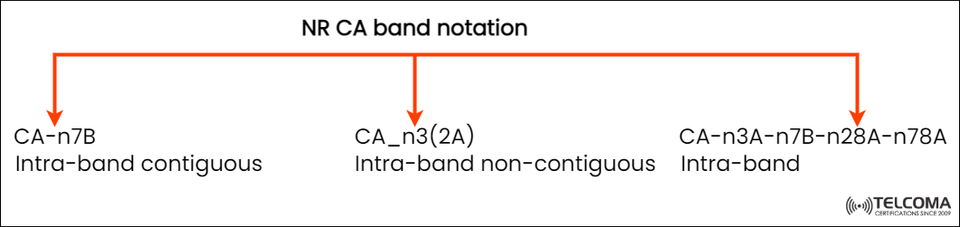
To make carrier aggregation work well, 5G NR employs a notation system that showcases different band combinations and aggregation types. The image shared does a great job of illustrating how these NR CA band notations are organized across three main categories:
Intra-band contiguous,
Intra-band non-contiguous, and
Inter-band carrier aggregation.
Let’s dive into each concept, look at the notation, and see how they contribute to the performance of 5G NR.
What Is Carrier Aggregation (CA)?
Carrier Aggregation allows a 5G network to bundle multiple carriers (or frequency bands) — referred to as Component Carriers (CCs) — into a single, larger channel. This setup boosts the total available bandwidth and increases data throughput all without needing additional spectrum.
To put it in simpler terms, think of it as merging several narrow roads into a multi-lane highway to better manage the traffic flow.
Key Benefits of Carrier Aggregation
Higher data rates (reaching several Gbps in 5G)
Better spectrum utilization
Enhanced user experience even under heavy network load
Broader coverage thanks to multi-band support
NR CA Band Notation: An Overview
In 5G NR, combinations of carrier aggregation are represented using a standardized band notation created by 3GPP (3rd Generation Partnership Project).
The accompanying image explains the three main notations used to categorize how carriers are aggregated within or across frequency bands:
Notation Example Type Description
CA-n7B | Intra-band Contiguous | Aggregation within the same band with adjacent frequencies
CA_n3(2A) | Intra-band Non-contiguous | Aggregation within the same band but separated by frequency gaps
CA-n3A-n7B-n28A-n78A | Inter-band | Aggregation across multiple different bands
- Intra-band Contiguous Carrier Aggregation (CA-n7B)
Definition
Intra-band contiguous CA refers to a situation where multiple component carriers are aggregated within the same frequency band, and their frequencies are adjacent (continuous).
For example, CA-n7B indicates that carrier aggregation occurs in NR Band n7, with all the aggregated carriers sitting next to each other in the spectrum.
Technical Characteristics
Carriers belong to one NR band (like Band n7).
The frequencies are contiguous — there’s no frequency gap.
It's generally easier to implement since it requires just a single RF chain.
Commonly seen in mid-band 5G deployments.
Advantages
Simpler RF design — only one local oscillator and one RF front-end needed.
Lower latency and reduced power consumption.
Better spectral efficiency within the same band.
Example Scenario
Imagine a mobile operator possesses a 40 MHz bandwidth in Band n7 (2600 MHz). They can merge two 20 MHz carriers together:
CA-n7B = 2600–2640 MHz (continuous)
This gives an effective 40 MHz bandwidth, essentially doubling data throughput in the same frequency band.
- Intra-band Non-contiguous Carrier Aggregation (CA_n3(2A))
Definition
In this setup, multiple carriers are within the same NR band, but they aren’t adjacent. There are frequency gaps between them.
The notation CA_n3(2A) indicates two non-contiguous component carriers in NR Band n3 (1800 MHz band).
Technical Characteristics
Carriers are in the same frequency band, but separated by unused spectrum.
This requires a more complex RF design when compared to contiguous aggregation.
Usually implemented when operators have fragmented spectrum allocations within the same band.
Advantages
Effective use of fragmented spectrum.
Operators can combine non-adjacent carriers to boost throughput.
Greater flexibility in making use of existing frequency resources.
Example Scenario
An operator might hold two separate 15 MHz blocks in Band n3:
Block 1: 1710–1725 MHz Block 2: 1735–1750 MHz
By pooling these non-contiguous carriers:
CA_n3(2A) = Intra-band non-contiguous aggregation
The network effectively creates a 30 MHz logical bandwidth, despite the gaps in frequency.
- Inter-band Carrier Aggregation (CA-n3A-n7B-n28A-n78A)
Definition
Inter-band CA brings together component carriers from different frequency bands.
The notation CA-n3A-n7B-n28A-n78A indicates aggregation involving:
Band n3 (1800 MHz)
Band n7 (2600 MHz)
Band n28 (700 MHz)
Band n78 (3500 MHz)
Technical Characteristics
Carriers originate from several frequency bands, usually mixing low, mid, and high bands.
This allows for high capacity and wide coverage at the same time.
It necessitates multiple RF chains or transceivers to handle different frequencies.
Advantages
Blends the strengths of each band:
Low bands (like n28) → Great coverage and deep indoor penetration.
Mid bands (like n3, n7) → Balanced coverage and capacity.
High bands (like n78) → Huge bandwidth and high data rates.
Maximizes overall spectral efficiency and network performance.
Supports multi-gigabit 5G speeds.
Example Scenario
A network might combine:
20 MHz from Band n3 (1800 MHz)
20 MHz from Band n7 (2600 MHz)
10 MHz from Band n28 (700 MHz)
100 MHz from Band n78 (3.5 GHz)
This results in a composite channel of 150 MHz, which enables high throughput and low latency under various conditions.
Comparative Table: Types of NR CA Band Configurations
Type Notation Example Frequency Relationship Complexity Use Case
Intra-band Contiguous | CA-n7B | Adjacent frequencies in the same band | Low | Simplest aggregation, mid-band 5G
Intra-band Non-contiguous | CA_n3(2A) | Separated frequencies in the same band | Medium | Fragmented spectrum aggregation
Inter-band | CA-n3A-n7B-n28A-n78A | Frequencies from different bands | High | Maximum throughput & flexibility
Importance of CA Band Notation in 5G NR
The NR CA band notation isn’t just there for show; it offers crucial insights into how the 5G network is designed, deployed, and fine-tuned.
Here’s why it’s significant:
Streamlines Network Planning: Engineers can quickly identify aggregation configurations.
Guarantees Device Compatibility: Notation advises device makers on which combinations to support.
Aids in Interoperability Testing: Helps verify CA performance across different vendors and bands.
Optimizes Spectrum Use: Promotes smarter allocation and aggregation across fragmented assets.
Carrier Aggregation in Real-world 5G Networks
Today’s 5G networks typically employ combinations such as:
CA-n78C → Contiguous aggregation within the 3.5 GHz band.
CA-n3A-n78A → Inter-band aggregation between 1800 MHz and 3.5 GHz.
CA-n28A-n78A → Mixing low-band coverage with high-band capacity.
These setups enable 5G smartphones and devices to attain data rates that can surpass 2–5 Gbps, which depends on the available spectrum and how densely the network is deployed.
Challenges in Implementing CA Band Configurations
Even with its benefits, carrier aggregation comes with its own set of challenges:
RF Complexity: Handling multiple frequency chains raises the cost of devices and their power consumption.
Interference Management: Non-contiguous carriers may suffer from interference from nearby systems.
Spectrum Licensing: Operators need access to multiple frequency allocations to maximize benefits.
Device Compatibility: Not all devices support every CA combination.
Advancements in RF front-end design, multi-band antennas, and 3GPP standardization continue to tackle these hurdles.
Conclusion
The NR CA band notation — as demonstrated in the image — gives a standardized way to show how 5G NR networks aggregate carriers across frequency bands.
From intra-band contiguous (CA-n7B) through intra-band non-contiguous (CA_n3(2A)) to inter-band aggregation (CA-n3A-n7B-n28A-n78A), each configuration plays a vital role in boosting network speed, coverage, and efficiency.
Carrier Aggregation is indeed the foundation of 5G’s multi-gigabit experience, allowing operators to utilize every single bit of spectrum effectively. Grasping these notations helps telecom professionals, engineers, and enthusiasts understand the intricate workings behind 5G’s remarkable performance.